

Build Life Science Skills: Immersive & ...
Events
Discover how Skillwell helps companies like Merck and AstraZeneca build critical compliance and ...

Traditional instruction is good at delivering information. What it's less good at is building the ability to use that information under real conditions.
That's the gap immersive technologies exist to close — not by replacing conventional education, but by adding the practice layer that turns knowledge into capability.
Let's dig into how an immersive learning platform works, why AI accelerates it, and what the research shows about outcomes.
Immersive learning is any educational approach that fully engages learners through realistic, interactive environments — where they participate rather than observe.
Learners are active agents in the experience, not passive recipients of information.
That active involvement changes how they relate to the material — they're invested in outcomes, not waiting for content to end. The format demands attention rather than requesting it.
Scenarios mirror real-world situations closely enough that the skills built inside transfer to the job outside.
A medical student practicing a patient conversation in a VR simulation isn't just learning what to say — they're developing the judgment and emotional readiness to say it under real conditions.
The closer the practice environment to the real one, the more directly skills transfer. This is what Skillwell Simulate is built around — subject matter experts creating branching simulations that reflect the specific situations their learners will actually face.
Learners can manipulate elements within the environment, make decisions, and see what follows.
That cause-and-effect structure is what creates genuine practice — not awareness of what the right answer is, but experience making the right call under conditions that feel real.
What separates immersive learning from a well-produced video or a well-written case study isn't the technology — it's the learning model. Students explore, experiment, make mistakes, and form understanding through the experience itself. That's what makes skills stick rather than fade.
VR and AR are the technologies most associated with immersive learning — and for good reason. Let's look at what each actually enables, and where the evidence on outcomes is strongest.
|
Technology |
Immersion level |
Hardware needed |
Best use cases |
Scalability |
|---|---|---|---|---|
|
Virtual Reality (VR) |
Full |
Headset required |
Procedural training, high-stakes scenarios, clinical skills |
Moderate — hardware limits deployment |
|
Augmented Reality (AR) |
Partial |
Smartphone or smart glasses |
On-the-job guidance, technical maintenance, contextual learning |
High — mobile-accessible formats scale easily |
|
Mixed Reality (MR) |
Full + physical |
Specialized headset (e.g. HoloLens) |
Complex technical training requiring real + digital interaction |
Low — most demanding to deploy |
|
Simulation platforms |
Moderate–high |
None — browser-based |
Decision-making, interpersonal skills, compliance, onboarding |
Very high — consistent delivery to any audience size |
|
Gamification |
Low–moderate |
None |
Motivation, engagement, sustained learning programs |
Very high — layered onto any platform |
|
AI-adaptive learning |
Varies |
None |
Personalized pathways across all formats |
Very high — adjusts automatically at scale |
VR places learners inside fully simulated environments where they interact with content rather than observe it from a distance.
For subjects where context and stakes matter — clinical medicine, emergency response, high-stakes sales conversations — putting a learner inside the scenario rather than describing it changes both the cognitive and emotional dimensions of the experience.
AR overlays digital content onto real-world environments, enabling context-specific learning in the actual workspace.
A technician seeing step-by-step guidance appear over the equipment they're working on. A medical professional with patient data overlaid on their field of view during a procedure.
The learning doesn't require stepping away from the job — it happens in it.
Both technologies share the same underlying mechanism: engaging multiple learning modalities simultaneously.
Visual, auditory, and kinesthetic engagement together create stronger memory encoding than any single channel alone. A corporate training program that integrated VR simulation for soft skills development found participants reported 30% higher retention rates compared to traditional training.
That retention gap is what drives the outcomes organizations care about — 40% faster upskilling and a 27% average skill improvement — because skills that are retained are skills that transfer.
Traditional education moves everyone through the same content at roughly the same pace. That's efficient to deliver and easy to manage — and it means some learners are bored while others are lost. AI changes the economics of personalization.
AI-driven systems analyze learner behavior in real time and adjust what comes next based on how a person is actually performing.
Someone who demonstrates mastery of a concept quickly doesn't repeat it. Someone who's struggling gets additional practice before moving on.
Skillwell Adapt uses this approach to create personalized learning pathways that adjust continuously — so every learner is always working at the right level of challenge rather than waiting for the group or falling behind it.
In traditional settings, feedback arrives after the fact — a grade days later, a comment on a returned paper.
In AI-powered immersive environments, feedback is immediate and contextual: tied to the specific decision a learner just made, in the moment it matters most. That immediacy is what accelerates development.
Learners can course-correct in real time rather than repeating the same mistake across multiple assessments.
The integration of verified skills data into AI-powered immersive learning means the system isn't just adjusting content — it's building a picture of what each learner has actually demonstrated.
That picture is more useful than a completion record for instructors, for managers, and for the learners themselves. It's the difference between knowing someone finished a course and knowing they can do the thing.
The case for immersive technology in learning isn't theoretical — it shows up in outcomes. Let's look at the benefits that matter most.
Learners in immersive environments are more motivated, more focused, and more willing to persist through challenging material.
When the experience demands active participation — decision-making, consequence-navigation, real-time response — engagement isn't something that needs to be manufactured. It's built into the format.
Immersive experiences create stronger memory encoding than passive formats because they engage learners emotionally, physically, and cognitively.
Research shows learners retain information at a 75% higher rate through immersive methods than through conventional instruction — a difference that doesn't disappear over time, the way lecture-based retention typically does.
Learners practice skills in contexts that closely mirror where those skills will actually be used. That alignment between training environment and performance environment is what closes the gap that traditional instruction leaves open.
Students who've navigated a realistic simulation of a difficult conversation, a clinical decision, or a compliance dilemma arrive at the real version with experience rather than just knowledge.
The differences between immersive and traditional learning aren't marginal — they're structural. Here's where they diverge most clearly.
Traditional methods rely on lectures and passive content consumption, which creates a low ceiling for engagement regardless of how well the material is designed.
Immersive formats raise that ceiling by making engagement structural — learners participate because the format requires it, not because they're particularly motivated on a given day.
Many traditional approaches present knowledge in abstract form and leave learners to figure out how it applies to their actual work.
Immersive learning embeds knowledge in context from the start — the scenario is where the learning happens, not an illustration added afterward.
For learning and development strategy that aims to connect training investment to business outcomes, this contextual anchoring is what makes the ROI case.
Traditional assessment feedback arrives after the fact. Immersive feedback arrives in the moment — tied to the decision that prompted it.
That timing difference has a compounding effect on development: learners who can adjust immediately develop more rapidly than those who must wait for the next assessment cycle to correct course.
Two practical dimensions deserve attention for any organization making investment decisions in this space.
The upfront investment in high-fidelity VR can be significant.
The calculation changes when outcomes are factored in — 40% faster upskilling, 27% average skill improvement, and meaningful reductions in time-to-competency all represent real cost savings that offset technology investment.
AI-powered authoring tools have also lowered the production cost of simulation-based immersive learning substantially, making the format accessible to organizations that couldn't previously justify the development investment.
New immersive learning platforms need to work with existing infrastructure, not require replacing it.
The right relationship is the one Skillwell operates on: immersive platforms create the learning experience and capture skills data; the LMS handles administration, completion tracking, and compliance records.
That integration approach protects existing investment while adding the capability that traditional LMS-only training can't provide. For a broader view of where emerging technologies are shaping the future of L&D, the trajectory of AI-driven personalization and cloud-based simulation delivery is worth tracking.
Skillwell combines AI-powered adaptive learning with immersive simulation to create experiences that build real capability — not just records of completion.
If you want to see what that looks like for your organization's specific training challenges, take a tour of the Skillwell platform.
Immersive technologies create active participation rather than passive consumption — learners make decisions and experience consequences rather than receiving information.
Retention rates are 75% higher through immersive experiences than through conventional instruction because experience creates stronger memory encoding than description.
Real-world scenario alignment means skills built in a simulation transfer to actual job performance more reliably than abstract instruction.
Feedback in immersive environments is immediate and contextual — tied to the specific decision just made, not delivered days after the fact.
Organizations report 40% faster upskilling and 27% average skill improvement when immersive learning replaces traditional training formats.
AI-powered adaptive systems analyze learner behavior in real time and adjust content based on how each individual is actually performing.
Learners who demonstrate mastery move forward; those who are struggling receive additional practice rather than progressing on a fixed schedule.
Continuous, contextual feedback allows learners to course-correct immediately rather than waiting for the next assessment cycle.
Verified skills data generated by AI-powered systems shows what learners can actually do — not just whether they completed a module.
Personalized learning pathways created by AI consistently outperform standardized instruction on engagement, retention, and skill transfer.
Engagement is structural in immersive formats — the experience demands active participation rather than requesting it.
Memory encoding is stronger when learning engages visual, auditory, and kinesthetic channels simultaneously.
Learners practice in contexts that closely mirror real performance environments, creating direct transfer of skills.
Immersive platforms capture verified skills data that proves competence rather than just documenting completion.
AI-powered authoring tools have made building high-quality simulation experiences dramatically faster and more accessible than they were even a few years ago.
40% faster upskilling and 27% average skill improvement are the headline outcomes — both represent real cost reductions in time-to-competency and retraining.
Immersive platforms integrate with existing LMS infrastructure rather than replacing it, protecting current investment while adding capability.
Verified skills data connects L&D investment to measurable workforce outcomes, making the business case to leadership significantly clearer.
AI-powered authoring tools have reduced the development cost of simulation-based training substantially — branching simulations that used to take months now take minutes.
Organizations that track downstream performance metrics — not just training completion — consistently find that immersive learning investment pays back.
Discover how Skillwell helps companies like Merck and AstraZeneca build critical compliance and ...

Here is the uncomfortable truth about AI in learning today: ...
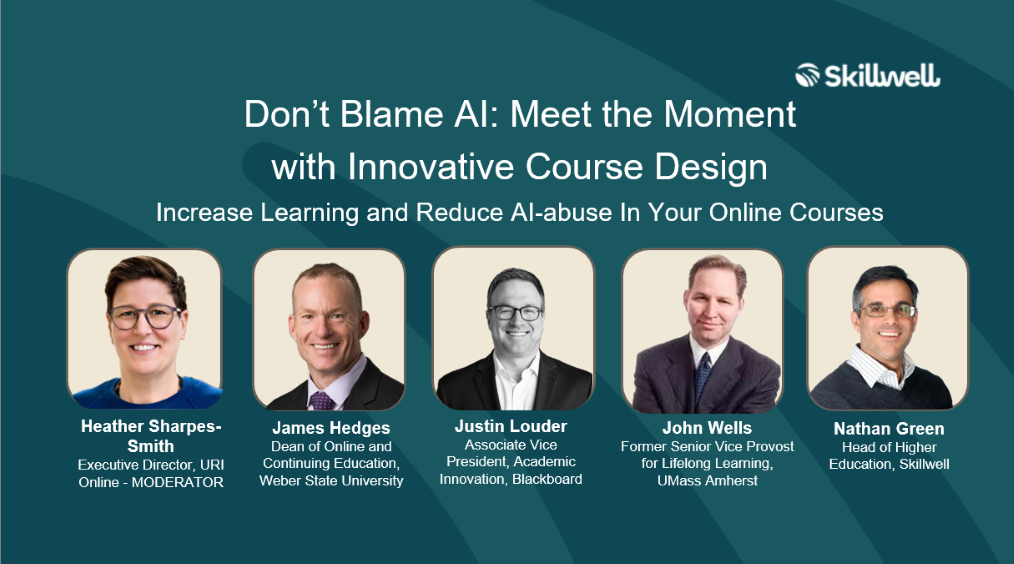
Join our webinar panel discussion to learn how to use formative and immersive elements to increase learning and reduce ...
Discover how Skillwell helps companies like Merck and AstraZeneca build critical compliance and ...
Here is the uncomfortable truth about AI in learning today: ...
Join our webinar panel discussion to learn how to use formative and immersive elements to increase learning and reduce ...