

Build Life Science Skills: Immersive & ...
Events
Discover how Skillwell helps companies like Merck and AstraZeneca build critical compliance and ...

The learning and development landscape is shifting faster than most organizations' training programs can keep up.
New technologies aren't just improving existing approaches—they're enabling entirely new models of how people learn, practice, and demonstrate competence.
For L&D leaders evaluating where to invest, understanding which emerging educational technologies are producing real results (and which are still mostly hype) is essential.
Several technologies are reshaping how learning happens across education and corporate training. Here are five that are producing measurable impact.
AI is the most transformative force in education today. From adaptive learning pathways that personalize content in real time to predictive analytics that identify at-risk learners before they fall behind, AI tailors educational experiences to individual needs at a scale no human instructor could manage alone.
UNESCO has described AI integration in higher education as a priority for responsible, ethical advancement of learning outcomes.
VR immerses learners in realistic scenarios that traditional methods can't replicate. In fields like healthcare, engineering, and high-stakes corporate environments, VR provides experiential learning where mistakes are safe but the experience feels real.
The rapid evolution of VR is opening new possibilities for immersive learning that bridges the gap between theory and applied practice.
AR overlays digital content onto the physical environment, enabling interactive learning experiences that help learners visualize complex concepts in tangible ways.
In manufacturing, maintenance, and medical training, AR-guided procedures reduce errors and accelerate skill acquisition by providing real-time guidance during actual tasks.
In education and workforce development, blockchain provides a secure, verifiable way to credential skills and achievements.
As organizations move toward skills-based hiring, the ability to verify competencies through trusted digital records—rather than relying solely on degrees and certificates—becomes increasingly valuable.
Data-driven insights into learner behavior, engagement patterns, and outcome trends enable organizations to make evidence-based decisions about program design and resource allocation.
Learning analytics turns training from a trust-based investment into a measurable business function with clear performance indicators.
These emerging educational technologies are being adopted across K–12 schools, higher education institutions, and corporate training programs—each context finding different combinations most effective for their specific needs.
AI is at the forefront of the future of technology in education in 2026, and its integration into L&D practices is already well beyond the experimental phase.
AI algorithms analyze learner data to create tailored experiences that adjust in real time. Skillwell Adapt uses an AI-powered adaptive engine to build individual learner models that evolve with every interaction—delivering content that matches each person's demonstrated knowledge level rather than their job title or tenure.
AI identifies specific competency gaps within teams and across organizations, allowing L&D leaders to focus training resources where they'll produce the most impact.
This targeted approach has produced a 27% average skill improvement for organizations using adaptive methods—because training addresses actual gaps rather than assumed ones.
AI-driven assessments provide immediate feedback, helping learners understand their progress and identify areas for improvement without waiting for manual review.
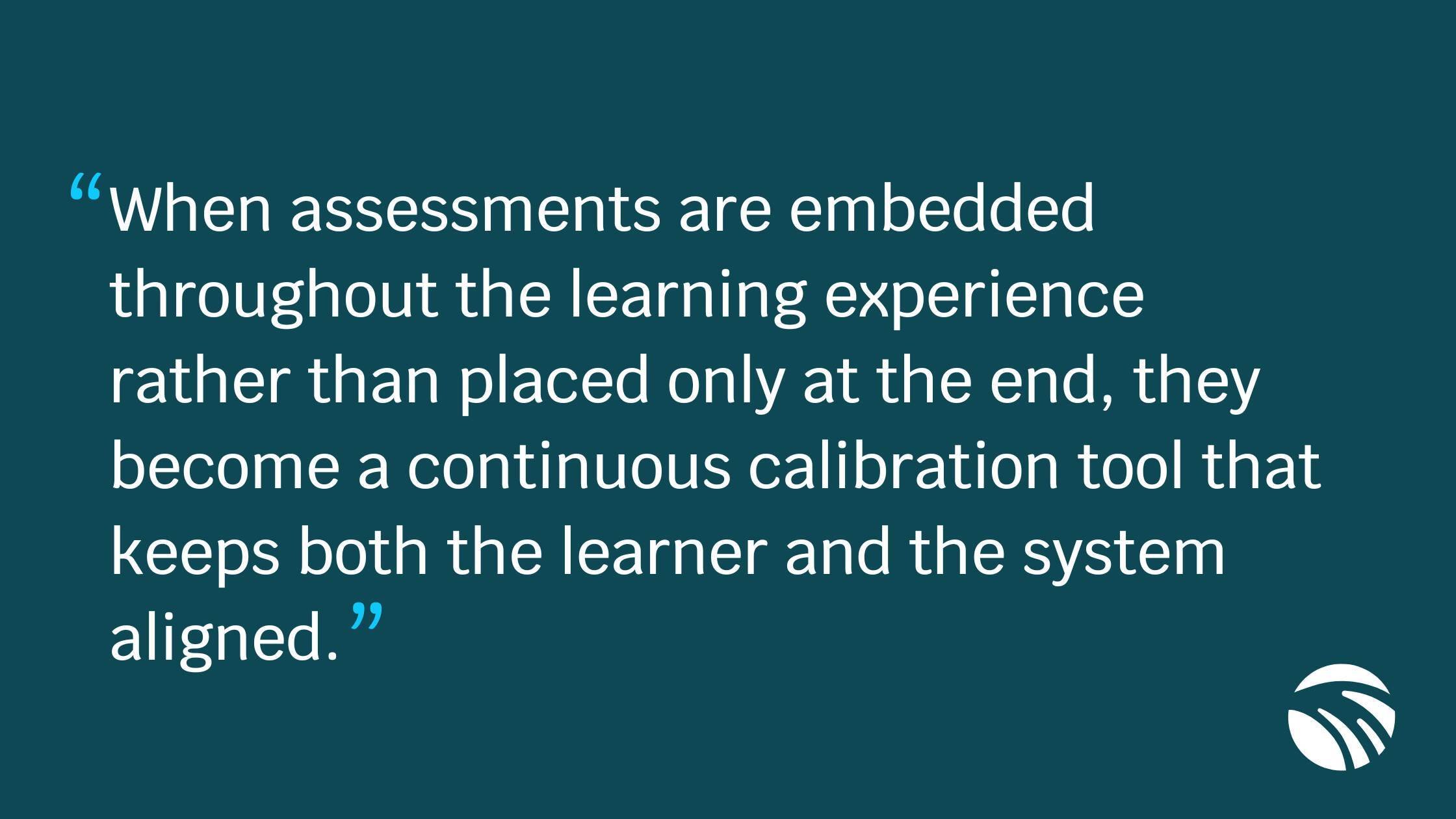
When assessments are embedded throughout the learning experience rather than placed only at the end, they become a continuous calibration tool that keeps both the learner and the system aligned.
The benefits of AI integration extend to both learners and instructors. Learners get more relevant, engaging experiences. Instructors and L&D teams get actionable data about what's working and where programs need refinement—creating a feedback loop that improves the entire system over time.
Modern technology gives instructors and L&D teams capabilities that were impossible a decade ago. Several tools and approaches are driving this shift.
Adaptive platforms adjust content based on individual learner performance, ensuring each person progresses at their own pace through material that's appropriately challenging.
This isn't just convenience—it's measurably more effective than static content delivery, because every minute of training addresses a genuine learning need.
Advanced LMS solutions track learner progress, provide tailored resource recommendations, and generate analytics that help instructors identify who needs additional support.
When integrated with adaptive technology, the LMS becomes a data-rich command center for personalized learning at scale.
Tools that enable rapid creation of branching simulations allow instructors to design scenario-based learning experiences that respond to individual decisions.
This kind of interactive content engages diverse learning styles and builds the applied judgment that passive content can't develop.
Organizations using simulation-based approaches have reported 40% faster upskilling—because learners practice the actual decisions they'll face on the job.
The impact of personalized learning on engagement and outcomes is well-documented.
When learners feel that their experience is tailored to their needs, motivation increases and skill mastery follows. The educational technology tools trends 2026 point clearly toward deeper personalization as the defining feature of effective L&D.
Looking at the trajectory of the future of technology in education in 2026 and beyond, several trends are becoming clear.
AI will continue deepening its role in personalized learning, moving from content recommendation to genuine learner modeling—understanding not just what someone got wrong, but why, and adjusting instruction accordingly.
AI-powered authoring tools will further reduce the time and expertise required to create effective training content.
As hardware costs decrease and content creation tools mature, VR and AR will move from specialized applications to mainstream L&D tools.
The ability to create realistic workplace scenarios for practice and assessment will become a standard expectation rather than a premium feature.
Organizations will increasingly rely on learning analytics and skills data to guide training strategy, ensuring resources flow to the highest-impact programs.
The shift from intuition-based L&D planning to evidence-based decision making is already underway and will accelerate as analytics tools become more sophisticated and accessible.
As trust in digital credentials grows, blockchain will play an expanding role in verifying skills and achievements—particularly as skills-based training replaces degree-based hiring in more industries.
The organizations leading in workforce learning and development are the ones adopting these technologies now—not waiting for them to become table stakes.
Skillwell integrates AI-powered adaptive learning with immersive simulation training to deliver the future of L&D today. Explore how the platform can transform your training outcomes.
Which emerging technology has the biggest impact on L&D right now?
Do organizations need to adopt all five emerging technologies at once?
How is AI specifically changing L&D practice?
What should organizations evaluate before investing in new L&D technology?
How do learning analytics change the way L&D decisions get made?
How do VR and simulation-based training differ, and when does each apply?
Discover how Skillwell helps companies like Merck and AstraZeneca build critical compliance and ...

Here is the uncomfortable truth about AI in learning today: ...
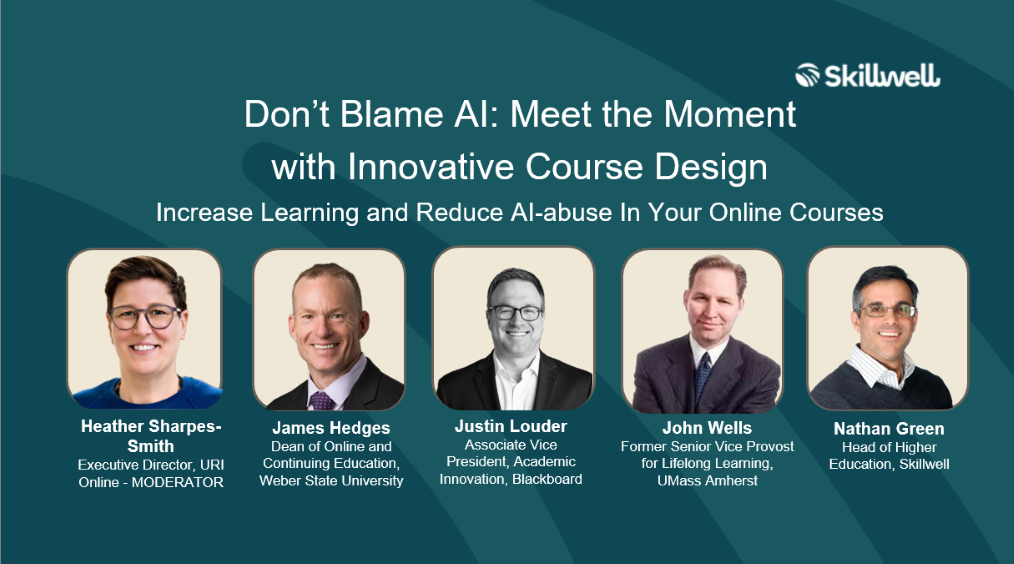
Join our webinar panel discussion to learn how to use formative and immersive elements to increase learning and reduce ...
Discover how Skillwell helps companies like Merck and AstraZeneca build critical compliance and ...
Here is the uncomfortable truth about AI in learning today: ...
Join our webinar panel discussion to learn how to use formative and immersive elements to increase learning and reduce ...