

Build Life Science Skills: Immersive & ...
Events
Discover how Skillwell helps companies like Merck and AstraZeneca build critical compliance and ...

In an era where organizations face constant change and intensifying competition, learning and development have moved from a nice-to-have benefit to a strategic imperative.
The companies that invest deliberately in employee growth aren't just building skills—they're building the organizational resilience that separates market leaders from everyone else.
But effective L&D doesn't happen by accident. It requires a clear understanding of what learning and development actually mean, which areas they need to cover, what objectives they should serve, and how technology can amplify their impact.
This guide covers all of those dimensions—from the fundamentals to measurement strategies—so you can build an L&D function that drives real business results.
Learning and development in a corporate context refers to the systematic approach organizations take to build employee skills, knowledge, and competencies over time.
It's not a single training event or an annual compliance check—it's an ongoing investment in the people who drive the business forward.
The importance of L&D comes down to three things.
First, it directly enhances employee performance and productivity by closing skill gaps that limit output. Second, it drives engagement and retention—employees who see a clear path for growth are significantly less likely to leave.
Third, it builds the organizational adaptability that businesses need to respond to market shifts, new technology, and evolving customer expectations.
In essence, effective learning and development strategies create a workforce that doesn't just perform today's tasks—it's equipped to take on tomorrow's challenges.
The science of learning and development supports this: when organizations align training with how people actually learn—through spaced practice, retrieval, and applied experience—the results compound over time.
Integrating AI-powered adaptive learning into L&D initiatives takes this further. Rather than delivering the same course to every employee, adaptive systems personalize pathways based on individual performance data—accelerating growth for advanced learners while giving others the reinforcement they need.
Combined with immersive simulations that let employees practice in realistic scenarios, this approach produces verified skills data—evidence of what people can actually do, not just what courses they completed.
Understanding the key dimensions of L&D is essential for building a strategy that covers the full spectrum of employee growth. The seven areas of learning and development include:
Introducing new employees to company culture, expectations, and the knowledge they need to contribute quickly. Effective personalized onboarding programs reduce time-to-productivity and set the foundation for long-term engagement.
When onboarding adapts to what each new hire already knows—rather than running everyone through the same generic orientation—the experience is both faster and more relevant.
Enhancing the specific job-related skills employees need to perform their current roles effectively. This is where skills-based training produces the most immediate ROI—targeted skill development that closes defined gaps and shows measurable improvement in performance.
Preparing high-potential employees for managerial and executive roles.
Leadership development goes beyond teaching management techniques—it builds the decision-making ability, emotional intelligence, and strategic thinking that organizations need at every level.
Simulation-based training is particularly effective here because leadership skills are best developed through practice in realistic, high-stakes scenarios—not through slide decks.
Ensuring employees understand and adhere to relevant laws, regulations, and company policies.
While compliance training is often treated as a checkbox exercise, adaptive approaches can make it significantly more efficient—allowing employees who demonstrate existing knowledge to move quickly while ensuring those with gaps get the reinforcement they need.
Building interpersonal capabilities like communication, collaboration, conflict resolution, and emotional intelligence.
These skills are increasingly critical as organizations become more complex and cross-functional. The challenge is that soft skills are difficult to teach through traditional content delivery—they require practice and feedback in realistic contexts.
Building expertise in specialized areas—software proficiency, data analysis, engineering practices, or any domain-specific capability.
Technical skills evolve rapidly, which makes the ability to deploy updated training quickly a competitive advantage. Platforms that enable rapid content creation allow organizations to keep pace without lengthy development cycles.
Supporting long-term career growth and aspirations through mentorship, stretch assignments, and personalized learning strategies.
Career development is what transforms L&D from a cost center into an engagement engine—employees who see investment in their future are the ones who stay and grow with the organization.
These areas contribute to overall performance by aligning learning and development goals with business objectives. The science of learning and development emphasizes addressing all seven comprehensively rather than overinvesting in one while neglecting others.
Organizations that take a balanced approach build workforces that are both immediately capable and adaptable to future demands.
Incorporating immersive simulation training across these areas adds a practice dimension that traditional content delivery can't match. Employees don't just learn concepts—they apply them in realistic scenarios that test decision-making under conditions that mirror actual work.
Organizations using this approach have achieved 40% faster upskilling and a 27% average improvement in skill mastery.
The integration of skills data analytics allows organizations to track progress across all seven areas, identifying where skill gaps persist and where development programs are producing the strongest results.
This data-driven approach empowers decision-makers to refine programs continuously, ensuring alignment with both business objectives and individual employee needs.
The primary objectives of learning and development revolve around three interconnected goals that drive both individual and organizational performance.
This isn't just about technical proficiency—it includes the decision-making, problem-solving, and communication skills that determine how effectively someone can apply their knowledge in practice.
L&D programs that provide meaningful development opportunities—not just checkbox training—foster loyalty and reduce the turnover costs that drain productivity and institutional knowledge.
Learning and development company courses that align with individual career aspirations are particularly effective at keeping high performers engaged.
The most effective programs don't exist in isolation—they're designed around specific performance gaps and measured against business metrics. When L&D is aligned with strategic goals, training investments translate directly into productivity gains, error reduction, and faster time to competency.
Employing skills data analytics gives organizations the visibility to design targeted programs that address specific gaps rather than applying broad-brush training to everyone.
This data-driven approach ensures that L&D efforts align with strategic learning and development goals, maximizing return on every training dollar invested.
While often used interchangeably, learning and development and training and development are distinct concepts—and understanding the difference matters for how organizations structure their programs.
Training typically focuses on specific skills or knowledge needed for a particular job or task. It's targeted, time-bound, and designed to produce a defined competency.
Compliance training, software onboarding, and certification preparation are classic training initiatives—they have clear start points, end points, and measurable outcomes.
Learning and development encompass a broader spectrum. It includes training, but also ongoing personal and professional growth—leadership development, career planning, personalized learning paths, and the continuous skill building that keeps employees adaptable over time. L&D is the long game; training is one tool within it.
Both concepts complement each other in practice:
Training provides the immediate skills needed for job performance.
L&D supports the long-term career growth and organizational adaptability that sustain competitive advantage.
The most effective organizations don't choose between them—they integrate training into a comprehensive L&D strategy that serves both immediate needs and future capability building.
For example, integrating simulation training into L&D programs creates realistic workplace scenarios that prepare employees for specific tasks and build broader problem-solving abilities.
An employee completing a branching simulation doesn't just learn the procedure—they develop the judgment to handle variations they haven't explicitly been taught.
An AI-powered adaptive engine that assesses prior knowledge and adjusts pathways accordingly ensures that training respects individual learning curves rather than forcing a one-size-fits-all experience.
Employees progress through their learning pathways more efficiently, focusing on genuine gaps rather than reviewing material they've already mastered.
Assessing the effectiveness of L&D programs is where many organizations struggle—not because measurement is impossible, but because they're tracking the wrong things.
Completion rates and satisfaction surveys tell you whether people showed up and whether they enjoyed the experience. They don't tell you whether the training actually changed behavior or improved performance.
The metrics that matter for connecting L&D to business outcomes include:
When L&D programs are effective, engagement scores improve because employees feel invested in—and they can see their own growth trajectory.
This is where verified skills data becomes essential—it measures what people can demonstrate, not just what they were exposed to. Organizations using adaptive learning software that captures performance data during realistic simulations get a much clearer picture of genuine capability than those relying on end-of-course quizzes.
Strong development programs reduce turnover—and the cost savings from reduced recruiting and onboarding often justify the L&D investment on their own.
Metrics such as sales growth, productivity, error rates, and customer satisfaction connect L&D outcomes directly to the numbers leadership cares about. The strongest L&D programs can draw a clear line from specific training initiatives to specific business improvements.
Adaptive approaches that personalize pathways and eliminate redundant content have achieved 40% faster upskilling—a metric that directly affects how quickly new hires contribute and how fast existing employees can take on expanded responsibilities.
A data-driven approach to measurement—using the analytics built into modern L&D platforms—ensures that training investments are continuously optimized.
Rather than running the same program year after year and hoping it works, organizations can see exactly where programs are producing results and where they need refinement.
Technology has fundamentally changed what's possible in learning and development—and the gap between organizations using modern L&D technology and those relying on legacy approaches is widening.
Personalization is the most significant advantage. Adaptive learning platforms tailor pathways to individual needs and performance data, ensuring each employee gets training that's relevant to their specific gaps. This isn't just more engaging—it's measurably more effective. When training matches what someone actually needs to learn, every minute of development time produces more value.
Accessibility means learning resources are available when and where employees need them—not locked into scheduled classroom sessions that conflict with work demands. This is particularly critical for distributed workforces and organizations operating across time zones.
Engagement improves when technology introduces interactive elements that go beyond passive content consumption.
Immersive simulations let learners engage in realistic workplace scenarios where their decisions have consequences—building the kind of applied judgment that reading about a topic simply can't develop.
The ability to create branching simulations rapidly allows organizations to keep training content current with evolving business needs.
Scalability is what makes technology essential for learning and development in education and corporate settings alike.
An adaptive platform can deliver personalized training to thousands of employees simultaneously—something no instructor-led program could match without exponential cost increases.
Organizations that integrate with platforms like Degreed can embed adaptive learning directly into their existing technology stack, scaling delivery without disrupting established workflows.
The combination of these capabilities is transforming how learning and development company courses are designed and delivered. Rather than static curricula that become outdated before they're fully deployed, technology-enabled L&D evolves continuously based on learner data and business needs.
Yes—learning and development is an integral component of HR's strategic function, though the relationship is more nuanced than the question suggests. L&D sits within HR in most organizations, but its impact extends well beyond traditional HR boundaries.
By integrating L&D strategies within HR, organizations can align training initiatives with organizational goals, foster a culture of continuous learning, and drive the employee engagement and retention that HR is ultimately accountable for. HR professionals play a crucial role in designing and implementing L&D strategies that support both individual growth and organizational performance.
Learning and development in HR examples include:
Structured onboarding programs that accelerate time-to-productivity
Leadership development pipelines that build internal succession candidates
Compliance training that reduces organizational risk
Skills-based development programs that close specific workforce capability gaps
What's changing is the sophistication of the tools HR uses to execute these programs. Modern corporate training software that captures verified skills data gives HR teams evidence of workforce competence that goes beyond training attendance records.
This data is instrumental in workforce planning, succession decisions, and demonstrating L&D's impact to leadership.
Technology also enhances HR's ability to scale training delivery across the organization.
Skillwell combines AI-powered adaptive pathways with immersive simulation training, enabling HR teams to deliver personalized, evidence-based development at a scale that would be impossible with traditional instructor-led approaches alone.
This is particularly important for fast-paced industries where agility and adaptability are essential.
Effective learning and development doesn't stop at content delivery—it produces evidence of real capability growth.
Skillwell combines AI-powered adaptive learning with immersive simulation training to create L&D programs that build verified skills, accelerate time to competency, and give you the data to prove what's working.
From onboarding to leadership development, explore what a modern L&D platform can do for your organization.
Structured onboarding that uses adaptive technology to personalize each new hire's experience based on their role, prior knowledge, and demonstrated competency — reducing time-to-productivity without sacrificing consistency.
Leadership development programs that use simulation-based practice to build decision-making and management skills before candidates step into new roles.
Skills gap analyses that connect workforce capability data to targeted development initiatives — so training investment goes where it produces the highest business impact.
The most effective L&D examples in HR share one trait: they connect training activities to measurable outcomes rather than treating development as an isolated administrative function.
Reducing time to competency for new hires — getting people from onboarding to productive contribution faster.
Improving retention through meaningful development opportunities that signal genuine investment in employee growth.
Closing identified skill gaps across the workforce before they become performance problems.
Building internal leadership pipelines so succession doesn't depend entirely on external hiring.
The most effective goals are specific and measurable: "reduce average onboarding time from 12 weeks to 8 weeks while maintaining 90-day performance scores" — not "improve training."
People learn most effectively through spaced practice, retrieval-based learning, and applied experience — not passive content consumption; programs that ignore this produce temporary knowledge, not durable skill.
Spacing learning over time and incorporating frequent low-stakes retrieval practice dramatically outperforms intensive one-time training in long-term retention.
Applied practice in realistic contexts — simulation, scenario-based exercises, on-the-job application — produces the transfer from learning to performance that content alone can't.
Adaptive platforms apply these principles automatically by adjusting content delivery based on each learner's demonstrated retention and performance patterns.
The ability to demonstrate measurable outcomes — not just polished course catalogs or completion dashboards.
Adaptive technology that personalizes learning pathways based on demonstrated performance, not assigned content sequences.
Verified skills data that captures what employees can actually do, not just what they've been exposed to.
Integration with existing technology infrastructure and the ability to scale without proportional increases in administration cost.
Education focuses on knowledge acquisition and academic achievement; corporate L&D targets workforce capability, job performance, and business results.
The underlying learning science is the same — spaced practice, retrieval, applied experience — but the goals, metrics, and stakeholders differ significantly.
The technology is converging: adaptive platforms from higher education are now standard in corporate settings, and simulation-based training methods from corporate L&D are increasingly adopted in academic programs.
The most practically important difference: corporate L&D is accountable to business outcomes on shorter timelines, making measurement and rapid iteration more critical.
Discover how Skillwell helps companies like Merck and AstraZeneca build critical compliance and ...

Here is the uncomfortable truth about AI in learning today: ...
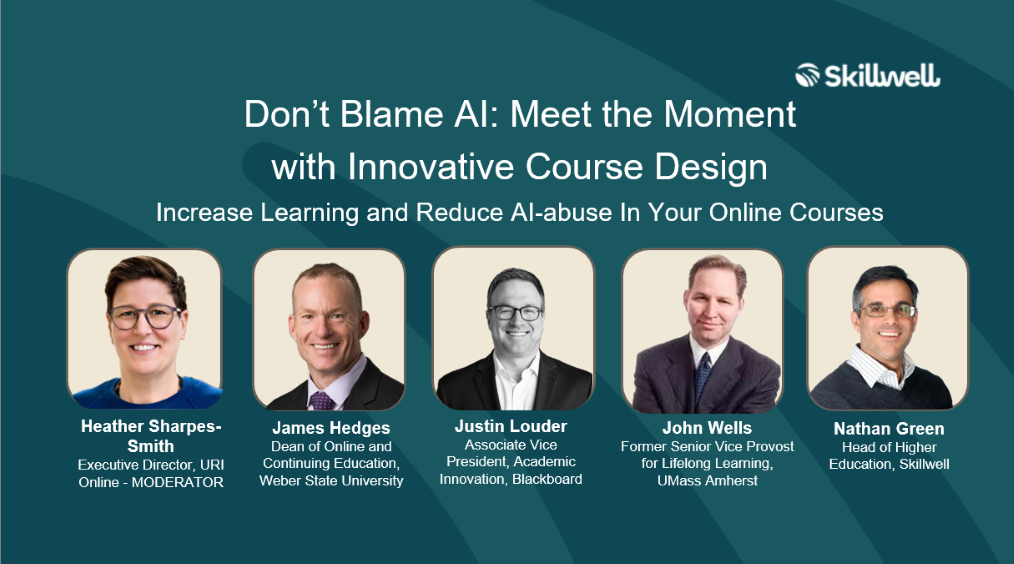
Join our webinar panel discussion to learn how to use formative and immersive elements to increase learning and reduce ...
Discover how Skillwell helps companies like Merck and AstraZeneca build critical compliance and ...
Here is the uncomfortable truth about AI in learning today: ...
Join our webinar panel discussion to learn how to use formative and immersive elements to increase learning and reduce ...