

Build Life Science Skills: Immersive & ...
Events
Discover how Skillwell helps companies like Merck and AstraZeneca build critical compliance and ...
There's a gap at the heart of most training programs.
Learners can watch a video, pass a quiz, and check a completion box — and still not be ready for the moment that counts. Immersive learning exists to close that gap.
By placing people in realistic, interactive scenarios where they make real decisions and see real consequences, it builds the kind of skills that actually transfer to the job.
Let's dig into what immersive learning is, why it works, how it's applied across industries, and what the research says about its effectiveness.
Immersive learning is an educational approach that places learners inside rich, interactive environments — not just in front of them.
Rather than consuming information passively, participants take on roles, make decisions, and experience the consequences of those choices in a context that mirrors real-world work.
A few things define the method:
Realistic simulations that mirror actual workplace scenarios, not idealized or sanitized versions of them.
Active participation, where the learner is the agent — making choices, not just watching someone else make them.
Immediate, structured feedback that shows what the decision produced and why.
What makes immersive learning genuinely different is that it bridges theory and practice. Most training stops at understanding — learners leave knowing what to do in principle. Immersive learning goes further by giving them experience doing it before the stakes are real. That experience is where skills mastery actually develops.
AI has made this approach dramatically more accessible. Tools like Skillwell Simulate let subject matter experts create branching simulations in minutes — no technical expertise, no lengthy development cycles. Organizations can build training that reflects real job challenges and update it as those challenges evolve.
.jpg?width=2240&height=1260&name=Immersive%20Learning%20(Pillar).jpg)
The honest answer is that traditional training methods have a retention problem. Learners forget most of what they hear, read, or watch — and the skills that don't stick don't transfer. Immersive learning attacks that problem directly by replacing passive consumption with active experience.
Let's look at a few of the key benefits:
Learners who are actively doing something stay focused in ways that passive formats can't replicate. Research has found that courses integrating immersive elements show a 75% improvement in student engagement compared to traditional methods.
The same body of research indicates that learners retain information at a 75% higher rate through immersive experiences than through conventional instruction. Experience creates memory in a way that observation simply doesn't.
Immersive training doesn't just generate completion records — it captures evidence of actual performance. That verified skills data gives organizations a real picture of workforce capability, not just a record of who clicked through a module.
Organizations using immersive learning approaches report 40% faster upskilling and an average 27% improvement in skill levels — results that matter when capability gaps are costing the business.
Beyond individual performance, immersive learning enables something traditional training rarely achieves: a direct connection between L&D investment and business outcomes.
When you can show not just that training happened but that skills improved, you can tie learning and development to the results leadership actually cares about.
Skills-based training programs built on immersive scenarios prepare employees for the situations they'll actually face — difficult conversations, ethical dilemmas, high-pressure decisions.
The confidence that comes from having navigated those situations in a safe environment is what shows up when the real moment arrives.
Immersive learning isn't a single format — it's a framework that adapts to the demands of different roles, industries, and risk levels. The scenarios change. The stakes change. The specific skills being built change. But the underlying approach — learning through experience — stays constant.
Let's look at how it plays out across a few key sectors.
In healthcare training, the cost of an unprepared practitioner is high. Immersive simulations let medical professionals practice patient conversations, clinical decision-making, and procedural judgment in environments where mistakes are lessons rather than liabilities.
AI-powered personalized learning pathways mean each practitioner can work on the specific areas where their performance data shows gaps — not sit through training they've already mastered.
Research on immersive virtual anatomy tools found a 55.95% improvement in knowledge acquisition scores compared to traditional instruction.
In corporate environments, immersive learning is particularly effective for the high-frequency, high-stakes interactions that drive business outcomes: customer service, sales conversations, crisis response, and leadership development.
These are skills that can't be taught by telling — they develop through practice.
AI-powered authoring tools have removed the biggest barrier to adoption. Organizations can now build realistic branching scenarios in minutes, not months, making it feasible to keep training current with the actual demands of the job.
In academic settings, immersive learning in higher education brings complex subjects to life in ways lectures and textbooks can't. History becomes navigable. Scientific processes become interactive. Students don't just read about systems — they engage with them.
Verified skills data gives educators a clearer picture of mastery. Rather than measuring only completion or recall on a standardized test, institutions can assess what students can actually do — and identify where additional support is needed.
This is one of the most important questions in the field — and one where immersive learning has a real advantage over traditional formats.
Because learners are actively performing in scenarios rather than passively consuming content, there's far more to measure.
Here's how the strongest measurement approaches tend to work:
Evaluating knowledge and capability before and after an immersive experience provides a clear baseline-to-outcome comparison. When assessment is built into the learning path itself — not just tacked on at the end — it shapes what learners focus on and how content is delivered to them.
Immersive simulations capture how learners make decisions under realistic conditions, not just whether they can recall facts. That performance data gives organizations something traditional assessments don't: evidence of applied capability.
Research shows immersive environments produce 40% faster upskilling and 27% average skill improvement.
For industries with regulatory requirements, immersive learning platforms can generate documentation that proves competence — not just completion. That distinction matters enormously in healthcare, financial services, and life sciences.
The difference between these methods and traditional teaching metrics — standardized tests, completion rates — is that they reflect what learners can do, not just what they know.
That shift from knowledge measurement to capability verification is what makes immersive learning data genuinely useful for workforce planning.
AI-powered authoring tools extend this even further. Now, L&D teams can build customized scenario-based assessments, adjust the difficulty of branching simulations based on performance, and continuously refine training pathways based on data revealing where learners are struggling.
The research base for immersive learning has grown substantially — and the findings are consistent. Immersive approaches outperform traditional methods on engagement, retention, and skill application. Let's look closer at what the evidence shows.
Immersive learning draws on several well-established educational frameworks, all of which gain new power when paired with realistic simulation and adaptive technology.
Learners build knowledge through experience rather than absorption. Adaptive learning powered by AI extends this further — content adjusts to each individual based on how they're actually performing, not a one-size-fits-all prediction of what they need.
Many immersive scenarios place learners in situations that require working with others — building communication skills and interpersonal judgment alongside the specific competencies being trained. This mirrors actual workplace dynamics far more accurately than an individual study.
Learners engage with real challenges that require critical thinking and judgment, not recall. A study published in Scientific Reports found that problem-based and interactive teaching methods significantly enhance critical thinking (β = 0.536) and learning outcomes (β = 0.551) in higher education.
These approaches aren't just theoretically sound — they're practically effective. When combined with AI-powered simulation tools, they produce learning experiences that are both rigorous and scalable.
No training approach is without its friction points. Understanding the common challenges in immersive learning — and how to address them — is worth a closer look before implementation.
New or unfamiliar scenarios can create hesitation, particularly for learners who are used to lower-stakes formats. Well-designed immersive platforms ease learners in gradually, building familiarity before increasing complexity.
Some learners struggle to bridge what they know conceptually with what to do in a live scenario. Branching simulations that are carefully mapped to specific learning objectives help close this gap — the scenario becomes the bridge.
Research on hybrid simulation methods found that immersive VR significantly improved academic performance, practical skills, and career preparedness.
More information isn't always better. Effective immersive learning designs prioritize feedback that is immediate, specific, and actionable — giving learners a clear signal about what to adjust rather than an overwhelming volume of data.
When you look at what actually happens when organizations make the shift to immersive learning, three things tend to stand out.
The combination of AI-powered adaptive learning with immersive simulation keeps learners active rather than passive. Engagement isn't just a feel-good metric — it correlates directly with retention and transfer.
Immersive VR gamification produced a notable effect size of 0.882 for cognitive outcomes and 1.104 for affective outcomes compared to conventional learning methods. Learning through doing creates memory that passive learning doesn't.
Learners who practice skills in realistic scenarios are significantly more prepared to apply them in real-world contexts. A systematic review found that immersive learning environments consistently produce gains in motivation, conceptual understanding, and knowledge retention.
Put it all together, and the picture is clear: immersive learning isn't just more engaging than traditional formats — it's more effective. When combined with verified skills data and adaptive pathways that adjust to each learner, it becomes a genuinely powerful framework for building workforce capability at scale.
Understanding the case for immersive learning is one thing. Seeing what it looks like for your specific teams, training objectives, and industry is another.
Skillwell combines AI-powered adaptive learning with immersive simulation to create experiences that build real skills — not just completion records. If you're ready to see what that looks like in practice, take a tour of Skillwell's immersive learning platform.
Immersive learning is a training approach that places learners inside realistic, interactive scenarios where they make decisions and experience consequences — building skills through practice rather than passive observation.
It's used across industries including healthcare, corporate training, retail, and higher education.
Scenarios can range from difficult patient conversations to high-stakes leadership decisions to compliance dilemmas.
Modern AI tools let organizations create branching simulations in minutes, making immersive learning accessible at scale.
Unlike passive training, immersive learning builds decision-making confidence and creates lasting memory through experience.
It can be delivered alongside existing LMS platforms — Skillwell integrates with your current infrastructure rather than replacing it.
Immersive learning outperforms traditional formats because it replaces passive content consumption with active practice — and practice is what actually builds skills.
Research shows immersive approaches produce a 75% improvement in learner engagement compared to traditional methods.
Retention rates are significantly higher because learners form memories through doing, not watching.
Verified skills data captured during simulations gives organizations evidence of actual capability, not just completion.
Learners arrive at real-world situations more prepared because they've already navigated them in a safe environment.
Organizations report 40% faster upskilling and 27% average skill improvement when using immersive training approaches.
Traditional eLearning asks learners to consume content — read, watch, click through. Immersive learning asks them to perform — make decisions, respond to situations, and receive feedback on how they handled them.
eLearning typically measures completion; immersive learning measures demonstrated competence.
Immersive scenarios are designed to mirror real job situations, not deliver information in a structured sequence.
Feedback in immersive learning is contextual and immediate — tied to the specific decision the learner just made.
The two aren't mutually exclusive — many organizations use eLearning for foundational knowledge and immersive learning for skill application.
Immersive learning generates richer data about learner performance that can inform coaching, development plans, and workforce strategy.
Immersive learning is used across a wide range of industries — anywhere that the gap between knowing and doing creates risk, cost, or competitive disadvantage.
Healthcare organizations use it to prepare clinicians and leaders for high-stakes patient conversations and clinical judgment calls.
Corporate training teams use it for sales effectiveness, customer service, leadership development, and compliance.
Life sciences and pharmaceutical companies rely on it for ethics training and regulatory compliance documentation.
Retail organizations use immersive scenarios to develop consistent customer-facing skills across distributed workforces.
Higher education institutions use it to bring complex subjects to life and assess student competency beyond standardized testing.
Yes — and this is an important distinction. Skillwell works alongside your existing LMS, not in place of it. Your LMS manages and tracks learning; Skillwell creates the learning experience itself.
Most immersive learning platforms, including Skillwell, are built to integrate with major LMS systems.
Your LMS continues to handle administration, compliance records, and completion tracking.
Skillwell adds immersive simulation and adaptive pathways on top of that infrastructure.
Organizations don't need to replace their existing training stack — they enhance it.
This approach protects existing LMS investment while adding the capability that traditional platforms can't provide.
Immersive learning produces richer measurement opportunities than traditional formats because learners are actively performing, not just answering recall questions.
Pre- and post-assessments show knowledge and capability change over time with clear baseline comparisons.
Performance data captured during simulations reflects how learners make decisions under realistic conditions.
Verified skills data provides evidence of demonstrated competence — not just what someone said they know.
Audit-ready records support compliance documentation in regulated industries like healthcare and life sciences.
Organizations can correlate skills data with business outcomes, connecting L&D investment to measurable results.
Discover how Skillwell helps companies like Merck and AstraZeneca build critical compliance and ...

Here is the uncomfortable truth about AI in learning today: ...
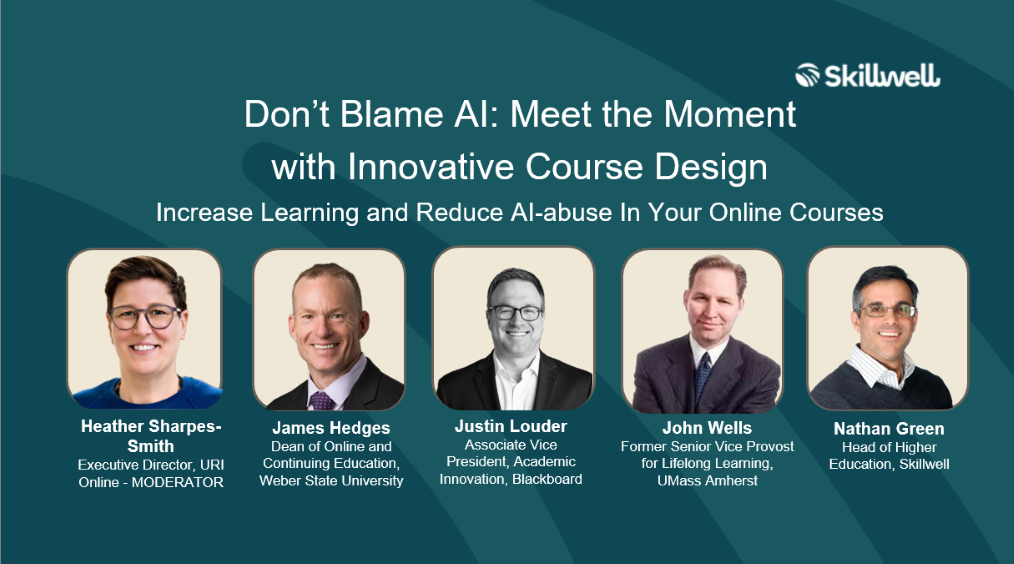
Join our webinar panel discussion to learn how to use formative and immersive elements to increase learning and reduce ...
Discover how Skillwell helps companies like Merck and AstraZeneca build critical compliance and ...
Here is the uncomfortable truth about AI in learning today: ...
Join our webinar panel discussion to learn how to use formative and immersive elements to increase learning and reduce ...