

Build Life Science Skills: Immersive & ...
Events
Discover how Skillwell helps companies like Merck and AstraZeneca build critical compliance and ...

Every organization claims to value learning and development. Far fewer have a coherent strategy for it.
The difference between organizations that see measurable returns on their L&D investment and those that don't usually comes down to whether their learning and development strategies are genuinely integrated with business priorities.
Otherwise, they're running training programs in parallel with the business rather than in service of it.
Let’s cover what an effective L&D strategy actually looks like: how it connects to HR and business goals, how it drives engagement and retention, how training needs get assessed, how content gets delivered, how on-the-job learning gets embedded, and how effectiveness gets measured.
Within HR, a learning and development strategy is the systematic approach an organization uses to build employee skills and competencies in alignment with business objectives.
It's not a training catalog or an LMS implementation—it's the framework that determines what gets built, for whom, through what methods, and how success is defined.
L&D strategies that aren't anchored to specific business priorities are the most common and most expensive form of waste in HR.
The investments feel productive—courses are delivered, completion rates are tracked—but when capability doesn't improve in the areas that matter to the business, the investment fails to justify itself.
Effective learning and development strategies start by mapping skills requirements to strategic priorities: a technology company scaling new product lines needs different capability than a healthcare organization managing compliance requirements or a retail chain focused on customer experience differentiation.
The training that follows has to reflect those specific gaps.
Organizations building L&D strategy 2026 frameworks increasingly rely on AI-powered adaptive learning to connect strategic intent with individual learning execution. Rather than applying the same training to everyone regardless of their starting point, adaptive platforms build individual learner models that adjust content based on demonstrated knowledge—ensuring each employee's development time targets genuine gaps, not areas of existing competency.
The result is a strategy that scales without sacrificing relevance: Skillwell Adapt's pre-assessment features allow organizations to route employees directly to what they need, producing measurable outcomes like 40% faster upskilling and 27% average skill improvement that justify continued investment.
The connection between L&D investment and retention is well-documented—employees who don't see a path for professional growth look for one elsewhere. But the mechanism matters: not all training generates engagement, and not all engagement translates to retention.
Training that feels generic, outdated, or disconnected from daily work generates resentment, not engagement.
Employees who sit through mandatory courses that don't apply to their roles learn to treat L&D as a compliance exercise rather than a professional investment. The organizations that break this pattern design programs where the relevance is obvious and immediate.
Engagement deepens when employees can apply new skills in realistic situations—not just complete modules. Immersive simulation training creates practice environments where employees build applied confidence before they need it on the job.
This hands-on experience produces a qualitatively different kind of learning than passive content delivery—one that translates into actual performance change rather than temporary knowledge.
Organizations that build continuous learning into the normal rhythm of work—rather than scheduling it as occasional events—create an environment where employees see growth as ongoing.
This cultural dimension of L&D strategy is as important as the programs themselves: when employees experience development as a constant rather than a periodic event, it becomes part of what they value about working for the organization.
Effective learning and development strategies start with rigorous needs assessment. Training built on assumptions rather than evidence routinely misses the gaps that matter most—and wastes resources on development that doesn't move the business.
Direct employee input provides valuable signals about perceived skill gaps and development priorities—but it needs to be triangulated with objective data.
Employees don't always accurately identify their own knowledge deficits, and self-reported needs can miss the areas where people don't know what they don't know.
Reviewing performance metrics, error rates, customer satisfaction data, and productivity trends provides objective evidence of where capability gaps exist.
This approach is particularly valuable because it grounds training investment in documented business problems—making both the need and the expected outcome clear before programs launch.
Modern learning and development platforms can analyze individual learning patterns and performance data to identify skill gaps with greater precision than manual assessment processes.
This capability transforms needs assessment from a periodic exercise into a continuous feedback loop—surfacing development opportunities as they emerge rather than waiting for annual review cycles.
The right delivery method depends on the skill being built and the learner's context—not on which format is most convenient to produce or administer.
In-person training and workshops provide direct interaction and are highly effective for collaborative skills, relationship-dependent learning, and situations where human presence changes the learning dynamic. Their constraint is scalability: they don't reach distributed teams efficiently and require significant coordination overhead.
Self-paced e-learning and microlearning modules offer flexibility and consistency at scale—every learner gets the same content regardless of location or schedule. They work well for knowledge transfer, process training, and compliance content. Their limitation is that passive content delivery rarely builds applied competence for skills that require judgment and practice.
For skills requiring decision-making, judgment under pressure, or application in high-stakes contexts, branching simulations provide what no other delivery method can: realistic practice with consequences. The ability to build these simulations in minutes rather than months through Skillwell Simulate makes simulation-based delivery accessible even for organizations without large L&D development teams.
Formal training delivers the foundation; on-the-job learning is where skills actually solidify. Learning and development strategy templates that treat formal programs as the entirety of the strategy miss the majority of where learning actually happens.
Rotating employees through different roles or functions builds the systems-level understanding that formal training rarely delivers.
Employees who understand multiple parts of the business make better decisions, communicate more effectively across teams, and develop the adaptability that organizations increasingly need.
Pairing employees with experienced colleagues for structured knowledge transfer accelerates development in ways that courses cannot replicate. Mentorship builds institutional knowledge, cultural fluency, and the interpersonal judgment that supports career progression.
Learning that's integrated into how performance is evaluated and discussed—rather than tracked separately in an LMS—becomes part of how employees think about their development.
Verified skills data that captures competency evidence from daily work and formal training creates a complete picture of capability development that performance reviews alone can't provide.
A learning and development strategy that can't be measured can't be improved—and can't be defended when budget conversations get difficult.
Useful KPIs connect learning activities directly to business outcomes: time to competency for new roles, skill proficiency scores before and after training, performance metric changes attributable to development programs, and retention rates among employees with active development plans.
Completion rates and satisfaction scores are the easiest metrics to collect and the least useful for strategic decision-making.
Calculating ROI requires connecting training costs—development, delivery, technology, employee time—to measurable performance improvements: productivity gains, error reductions, faster onboarding, decreased turnover.
The organizations that do this rigorously can demonstrate exactly what their L&D investment returns, making the case for sustained or increased investment from concrete evidence rather than intuition.
Organizations that build skills data analytics into their L&D infrastructure can move from periodic strategy reviews to continuous improvement cycles.
When performance data flows back into program design in real time, training stays current with both business needs and individual employee trajectories—rather than aging out of relevance between annual reviews.
The difference between an learning and development strategy that produces measurable business impact and one that produces training activity is alignment, personalization, and the ability to verify that capability is actually being built. Skillwell combines adaptive learning with immersive simulation training to deliver verified skills data that proves development is happening—not just that training was completed.
A strategy defines what capability the organization needs to build, why it matters to business outcomes, and the high-level approach for building it.
A plan is the operational document: who gets trained on what, through which programs, on what timeline, with what budget.
Strategy without a plan stays abstract and never executes. A plan without strategy produces training activity without business impact.
The most common failure mode is organizations that have detailed plans — training calendars, LMS enrollments, completion targets — but no strategic foundation connecting any of it to what the business actually needs.
Misalignment with business priorities — training programs built around what's easy to deliver rather than what the organization needs employees to do better.
Needs assessment based on assumption rather than data — programs that address perceived gaps rather than documented capability deficits.
Measuring activity instead of outcomes: tracking completions and hours rather than skill growth, performance change, or business impact.
Treating formal training as the whole strategy and ignoring where most learning actually happens — on the job, through mentorship, and through applied practice.
Employees who don't see a visible path for professional growth look for one elsewhere; L&D investment signals that the organization sees their future, not just their current output.
Relevance matters more than volume — training that clearly connects to daily work and career advancement generates genuine engagement; generic compliance training does the opposite.
Organizations that build continuous learning into the normal rhythm of work, rather than scheduling it as occasional events, create an environment where growth feels like a cultural constant.
The loyalty effect compounds: employees with active development plans have measurably higher retention rates, and the institutional knowledge they carry becomes harder to replace the longer they stay.
Connect training costs — development, delivery, technology, employee time — to measurable performance improvements: productivity gains, error reductions, faster onboarding, decreased turnover.
Establish baseline metrics before programs launch; without a before-and-after comparison, ROI calculation becomes guesswork.
Move beyond completion rates and satisfaction scores — useful KPIs connect learning activities to business outcomes: time to competency, skill proficiency change, performance metric improvement.
Organizations that do this rigorously build the evidence base that defends L&D budgets when resources get constrained.
Core strategic elements — capability priorities tied to multi-year business objectives — should be reviewed annually or when significant business shifts occur.
Operational elements — specific programs, delivery methods, content currency — should be reviewed quarterly, especially in industries where skill requirements evolve quickly.
Build continuous feedback loops so problems surface in real time rather than only at scheduled review cycles; skills data analytics makes this possible without waiting for formal reviews.
Any significant change in workforce composition, market conditions, or strategic direction should trigger an immediate strategy review, not a wait until the next annual cycle.
It forces clarity on the decisions that matter most: what business outcomes the strategy supports, what capability gaps it addresses, how success will be measured, and who owns execution.
It distinguishes strategy from catalog — templates focused primarily on listing programs without tying them to business priorities produce documentation, not strategy.
It includes a measurement framework from the start, not as an afterthought; measurement designed after programs launch is almost always too late to establish meaningful baselines.
It's short enough to guide real decisions — a strategy document that nobody references isn't a strategy, it's a compliance artifact.
Discover how Skillwell helps companies like Merck and AstraZeneca build critical compliance and ...

Here is the uncomfortable truth about AI in learning today: ...
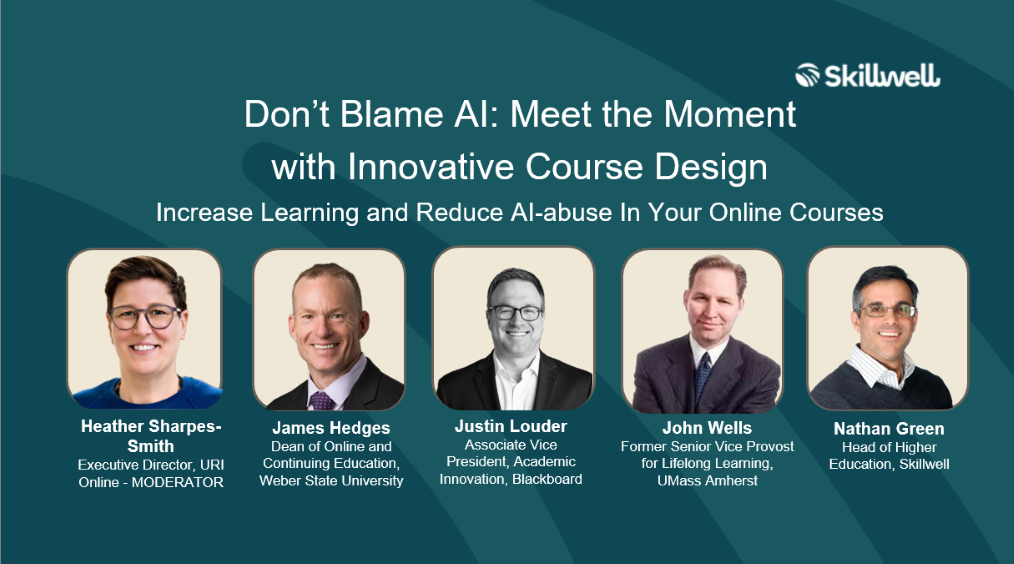
Join our webinar panel discussion to learn how to use formative and immersive elements to increase learning and reduce ...
Discover how Skillwell helps companies like Merck and AstraZeneca build critical compliance and ...
Here is the uncomfortable truth about AI in learning today: ...
Join our webinar panel discussion to learn how to use formative and immersive elements to increase learning and reduce ...