

Build Life Science Skills: Immersive & ...
Events
Discover how Skillwell helps companies like Merck and AstraZeneca build critical compliance and ...

Choosing the right immersive learning platform isn't just a technology decision — it's a learning design decision.
The platform shapes what experiences are possible, how quickly educators can build them, and whether the data generated actually tells you something useful about whether learners are developing the skills they need.
Let's dig into how immersive learning platforms work, what technologies power them, and how to think about finding the right fit.
Immersive learning is an educational approach that places learners inside realistic, interactive environments — engaging them through experience rather than passive consumption of information. Three things define a well-designed immersive experience:
Learners engage with content rather than receive it. They make decisions, navigate consequences, and build skills through the act of doing. The platform's job is to make that participation feel meaningful — not like clicking through slides with extra steps.
The scenarios learners practice in need to mirror the actual situations they'll face on the job.
Generic or overly simplified simulations produce engagement without transfer. Relevance is what creates the connection between what happens inside the simulation and what happens in real performance.
Tools like Skillwell Simulate are built around this principle — subject matter experts can create branching simulations in minutes that reflect the specific challenges their learners will actually encounter.
Immediate, contextual feedback is what separates immersive learning from a well-produced video.
When learners see the consequence of their choice right away — not on a graded assessment a week later — that feedback loop is what accelerates skill development.
Pair that with AI-powered adaptive learning that adjusts the pathway based on how a learner performs, and the experience becomes genuinely personalized rather than one-size.
Where immersive learning platforms most clearly outperform traditional instruction is in the quality of data they generate. Rather than tracking who completed a module, they capture verified skills data that shows what learners can actually do — evidence of demonstrated competence that connects L&D investment to real workforce outcomes.
The research here is consistent and substantial. Active learning in immersive environments produces measurably different outcomes than lecture-based instruction across the dimensions that matter most.
Students in active learning environments are more involved, more motivated, and more persistent with difficult material.
A study found that collaborative engagement in immersive virtual environments significantly enhances knowledge retention.
When students are making decisions and seeing consequences, engagement isn't something that has to be manufactured — the format demands it.
A 2024 study found that immersive virtual reality field trips positively impact academic achievement and cognitive load — pointing to stronger retention through immersive experience than through conventional instruction.
Students remember what they did and decided. They're less reliably able to recall what they were told.
Research on immersive learning environments — including metaverse-based learning contexts — shows that social interaction, realistic simulation, and active participation all contribute to stronger collaboration and knowledge retention than passive formats allow.
The emotional dimension matters too: when a learner is genuinely invested in the outcome of a scenario, the memory encoding is stronger.
At the organizational level, these differences translate to outcomes L&D teams can point to: 27% average skill improvement, 40% faster upskilling, and audit-ready competence records that prove capability rather than just document completion. Immersive platforms that integrate with existing LMS infrastructure deliver those outcomes without requiring a wholesale infrastructure rebuild.
The tool landscape has expanded significantly, and the right choice depends on what you're trying to build, who's building it, and who it's for. Here are a few platforms worth knowing.
For organizations focused on building branching simulation experiences that develop real workplace skills, Skillwell Simulate is purpose-built for that use case.
Subject matter experts can design scenarios in minutes without technical expertise. The platform integrates with existing LMS systems, captures verified skills data, and generates audit-ready competence records.
Research has found that immersive VR learning environments in higher education received strong student acceptance — reinforcing that well-designed platforms improve both experience and outcomes.
A versatile game engine used to build custom immersive educational applications, particularly in engineering, sciences, and technical training contexts where highly realistic 3D environments matter.
Unity offers significant flexibility, but building on it requires development expertise — it's better suited to institutions with technical resources than to instructors who want to build their own scenarios.
An interactive platform that integrates VR content into classroom lessons, with gamification elements that increase engagement.
Nearpod is accessible for educators without deep technical backgrounds and works well for adding immersive moments to existing curricula rather than building full simulation-based programs.
The practical question for most organizations isn't which platform is most impressive — it's which one instructors will actually use. Platforms that require technical expertise to author content tend to see lower adoption rates regardless of their capabilities. This is where authoring speed matters: a platform that lets a subject matter expert build a scenario in minutes removes the barrier that causes most immersive learning initiatives to stall.
The platforms that deliver the strongest results are those that combine multiple technologies deliberately rather than relying on any single format. Let's look at how each major technology contributes.
AR overlays digital information onto the physical world — enabling interactive learning in the actual workspace rather than a separate simulated environment.
In engineering education, AR-powered virtual laboratories let students conduct experiments in a risk-free 3D setting. A 2025 arXiv study on gamified learning in a virtual high-voltage lab found significant improvements in student engagement and knowledge retention compared to traditional methods.
The key advantage of AR in corporate training is context: learners can access guidance exactly where and when they need it.
VR places learners inside fully simulated environments — ideal for high-stakes procedural training, high-context scenarios like patient care, or situations that are difficult or impossible to replicate in physical settings.
VR learning environments have been developed for disciplines ranging from clinical medicine to linear algebra, designed around principles of ease of use, authentic experience, and continuous feedback.
The immersion level VR provides creates stronger emotional engagement — and stronger memory encoding — than screen-based alternatives.
Incorporating game mechanics — progression, challenge, reward — into learning increases motivation and helps learners persist through difficult material.
A systematic review in Interactive Learning Environments found that combining AI and immersive technologies such as VR and AR with gamification elements produces personalized, engaging experiences that improve motivation and knowledge retention.
Gamification works best when it's connected to the skill being developed, not just added as surface-level decoration.
AI is what makes immersive learning genuinely adaptive rather than just interactive. Platforms that monitor learner interactions and adjust content based on performance data create personalized learning pathways that meet each individual where they are.
Rather than routing everyone through the same experience at the same pace, AI-powered systems continuously assess and respond — which is how you get to 40% faster upskilling rather than incremental improvement.
For instructors and organizations exploring immersive learning for the first time, lower-barrier entry points are worth knowing about. These platforms prioritize ease of use and accessibility over maximum capability.
An AR/VR tool that lets educators take students on virtual field trips — providing a visually immersive introduction to concepts across subjects. It's a useful starting point for institutions that want to add immersive moments to existing curricula without building full simulation programs.
Offers a range of VR experiences designed for educational settings with a user-friendly interface. ClassVR is well-suited for institutions that want to deploy VR across a classroom without requiring students or teachers to have prior technical experience.
A social learning platform that integrates various immersive tools into a collaborative environment. Useful for institutions that want to build community alongside content — particularly for programs where peer learning is part of the design.
These platforms are accessible starting points, but organizations that want to build programs around measurable skill development — and generate the verified skills data that proves it — will typically need to move toward platforms with stronger authoring capabilities and performance analytics.
That's where the ROI case gets compelling, and where outcomes like 40% faster upskilling become achievable rather than aspirational.
The strongest immersive learning programs aren't built on a single platform — they combine tools strategically around specific learning objectives. Here's how to think about that integration:
Start with what you're trying to build — a competency, a behavior, a judgment call — and choose the tools that best support that development.
An organization that starts with 'we want to use VR' and works backward to find learning applications tends to get worse outcomes than one that starts with 'our sales team needs to practice objection handling' and chooses the format that creates the best practice conditions.
For sales and service training, leadership development, and compliance and risk programs, that typically means branching simulation — format matched to decision-making development.
Combining conventional instruction with immersive practice tends to outperform either format alone.
A lecture establishes the conceptual foundation; a simulation creates the practice conditions where that foundation gets applied under realistic pressure. Flipped classroom models work particularly well here — students engage with content before class and use class time for immersive application.
Adaptive learning platforms that adjust the simulation experience based on each learner's preparation level make this even more effective.
Immersive learning that's purely individual misses a dimension of real workplace performance.
Group-based simulation activities that require teams to navigate shared scenarios develop interpersonal skills alongside technical competencies — and generate data about how individuals perform in a collaborative context, not just solo.
This is especially relevant in onboarding programs where new hire integration is as important as skills acquisition.
Soft skills — communication, leadership, conflict resolution, customer empathy — are where the gap between knowing and doing is widest, and where immersive learning has some of its strongest applications. The key is finding platforms that create the psychological realism needed for genuine practice, not just scripted interaction.
Platforms like Virti use AI-powered simulation and interactive video to build roleplay scenarios for communication, leadership, and customer service training. The combination of realistic virtual humans and branching conversation paths creates practice conditions close enough to real interactions that the skills transfer.
Platforms like Cenario.ai allow organizations to build custom AI personas for specific scenario types — a difficult customer, a resistant direct report, a skeptical client. Practicing against a persona that behaves unpredictably (as real people do) develops more robust communication skills than scripted dialogue options.
Across soft skills platforms, the evaluation criteria that matter most are: how realistic the interaction feels, whether the feedback is specific and actionable, and whether the platform captures performance data that distinguishes one learner's development from another's.
Platforms that treat all completions as equivalent — without measuring the quality of the decisions made — miss the point of soft skills training.
For a broader view of how technology is reshaping what's possible in learning and development strategy, the role of emerging technologies in L&D and how organizations are building programs that connect training to business outcomes is worth exploring.
Skillwell combines AI-powered adaptive learning with immersive simulation to give organizations a platform that's practical to deploy, easy to author in, and built to generate the skills data that proves ROI.
Whether you're starting fresh or scaling an existing program, see how Skillwell works with a guided platform tour.
An immersive learning platform creates realistic, interactive environments where learners build skills through active practice rather than passive consumption of content.
Most platforms combine scenario-based simulation, branching decision pathways, and immediate feedback to replicate real-world challenges in a safe context.
AI-powered adaptive systems adjust the experience based on each learner's performance — so pathways are personalized rather than one-size.
Platforms capture verified skills data that shows what learners can actually do, not just whether they completed a module.
Immersive learning platforms integrate with existing LMS infrastructure rather than replacing it — adding capability without requiring a rebuild.
Students in active learning environments demonstrate consistently higher engagement, retention, and motivation than those in lecture-based formats.
A 2024 study found that immersive VR field trips positively impact academic achievement and cognitive load compared to traditional methods.
Emotional engagement in immersive environments creates stronger memory encoding — learners remember what they did, not just what they were told.
Organizations report 40% faster upskilling and 27% average skill improvement when immersive learning replaces traditional training formats.
Active learning produces 275% higher learner confidence in applying skills compared to conventional instruction.
Virtual Reality (VR) places learners inside fully simulated environments for high-stakes procedural and contextual training.
Augmented Reality (AR) overlays digital content onto real-world settings, enabling context-specific learning in the actual workspace.
Branching simulation platforms let instructors build scenario-based experiences where learner choices shape the path — no technical expertise required on modern tools.
Gamification elements — progression, challenge, reward — increase motivation and help learners persist through difficult material.
AI-powered adaptive engines adjust difficulty and content focus in real time based on each learner's performance data.
Authoring speed matters — platforms that let subject matter experts build scenarios without technical expertise see significantly higher adoption rates.
LMS integration is essential — the platform should enhance existing infrastructure, not require replacing it.
Performance analytics should go beyond completion tracking to capture verified skills data showing demonstrated competence at a granular level.
Soft skills platforms should be evaluated on how realistic the interaction feels and how specifically the feedback addresses the quality of learner decisions.
The best measure of platform value is downstream outcomes — skill improvement rates, time to competency, and whether performance data connects to business results.
Discover how Skillwell helps companies like Merck and AstraZeneca build critical compliance and ...

Here is the uncomfortable truth about AI in learning today: ...
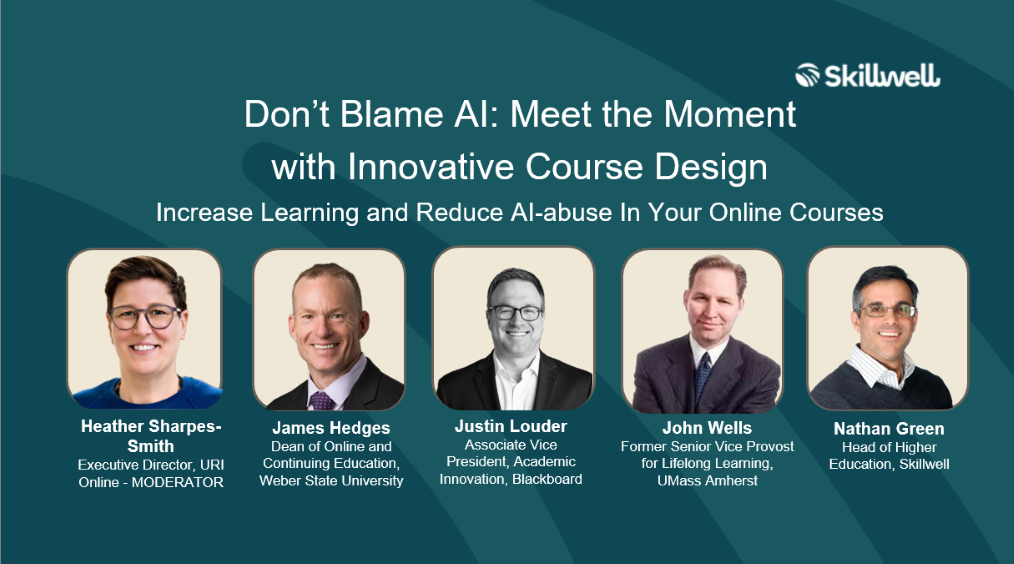
Join our webinar panel discussion to learn how to use formative and immersive elements to increase learning and reduce ...
Discover how Skillwell helps companies like Merck and AstraZeneca build critical compliance and ...
Here is the uncomfortable truth about AI in learning today: ...
Join our webinar panel discussion to learn how to use formative and immersive elements to increase learning and reduce ...