
Beyond the Content Explosion: What 17 ...
Blogs
Here is the uncomfortable truth about AI in learning today: ...
Durable skills don’t develop all at once. They build through repeated practice, honest feedback, and exposure to increasingly complex situations over time.
The challenge for most organizations isn’t deciding whether to develop them — it’s knowing where employees actually are, what comes next, and how to close the gap systematically.
This article covers how durable skills development actually works — the stages learners move through, the methods that accelerate progress, and how to turn deliberate practice into measurable capability.
Skill development follows a recognizable progression.
The Dreyfus model of skill acquisition — widely referenced in professional development research — describes five stages from novice to expert, where learners move from rule-following to intuitive, experience-driven performance.
For durable skills, that journey looks like this:
|
Stage |
What it looks like |
L&D implication |
|
1. Novice |
Follows clear rules and guidelines; needs detailed instruction to complete tasks |
Provide structured frameworks and worked examples; avoid ambiguity until foundations are solid |
|
2. Advanced Beginner |
Starts applying knowledge to new situations but still relies on guidance for novel challenges |
Introduce realistic scenarios with some complexity; coaching support still important |
|
3. Competent |
Plans and executes tasks independently; makes informed decisions with confidence |
Move to simulation-based practice; increase complexity and reduce scaffolding |
|
4. Proficient |
Sees the bigger picture; adapts to changing conditions and mentors others |
Stretch assignments, cross-functional challenges, and peer coaching responsibilities |
|
5. Expert |
Intuition and experience guide action; anticipates challenges and innovates solutions |
Leadership scenarios, complex simulations, knowledge transfer and mentorship roles |
Knowing where each employee sits on this continuum makes targeted development possible. A novice needs structure and frameworks; an expert needs complexity and challenge. Treating all employees as though they’re at the same stage is one of the most common reasons durable skills frameworks fail.
AI-powered adaptive learning addresses this directly by dynamically adjusting content and difficulty based on demonstrated performance — so every learner progresses from wherever they actually are, not from a fixed starting point.
Durable skills require deliberate practice in realistic conditions — the same principle that applies to developing any complex capability. Here’s what that looks like in practice.
Simulation-based learning is the most direct method. Placing employees in realistic workplace scenarios — a difficult conversation, a high-stakes decision, a cross-functional conflict — builds the judgment, communication, and adaptability that can’t be developed through content alone.
The key is realism: scenarios that mirror actual job situations produce learning that transfers to actual job performance.
A large meta-analysis of simulation-based education found significant positive effects on learning outcomes across disciplines, with simulation consistently outperforming traditional methods for complex skill development.
A University of Central Florida study found performance improvements of up to 20% compared with conventional training.
Feedback loops are equally essential. Regular input from managers, peers, and coaches — combined with performance data from simulations — gives learners the specific, actionable information they need to adjust their approach.
Without honest feedback, growth in interpersonal and leadership skills is especially slow.
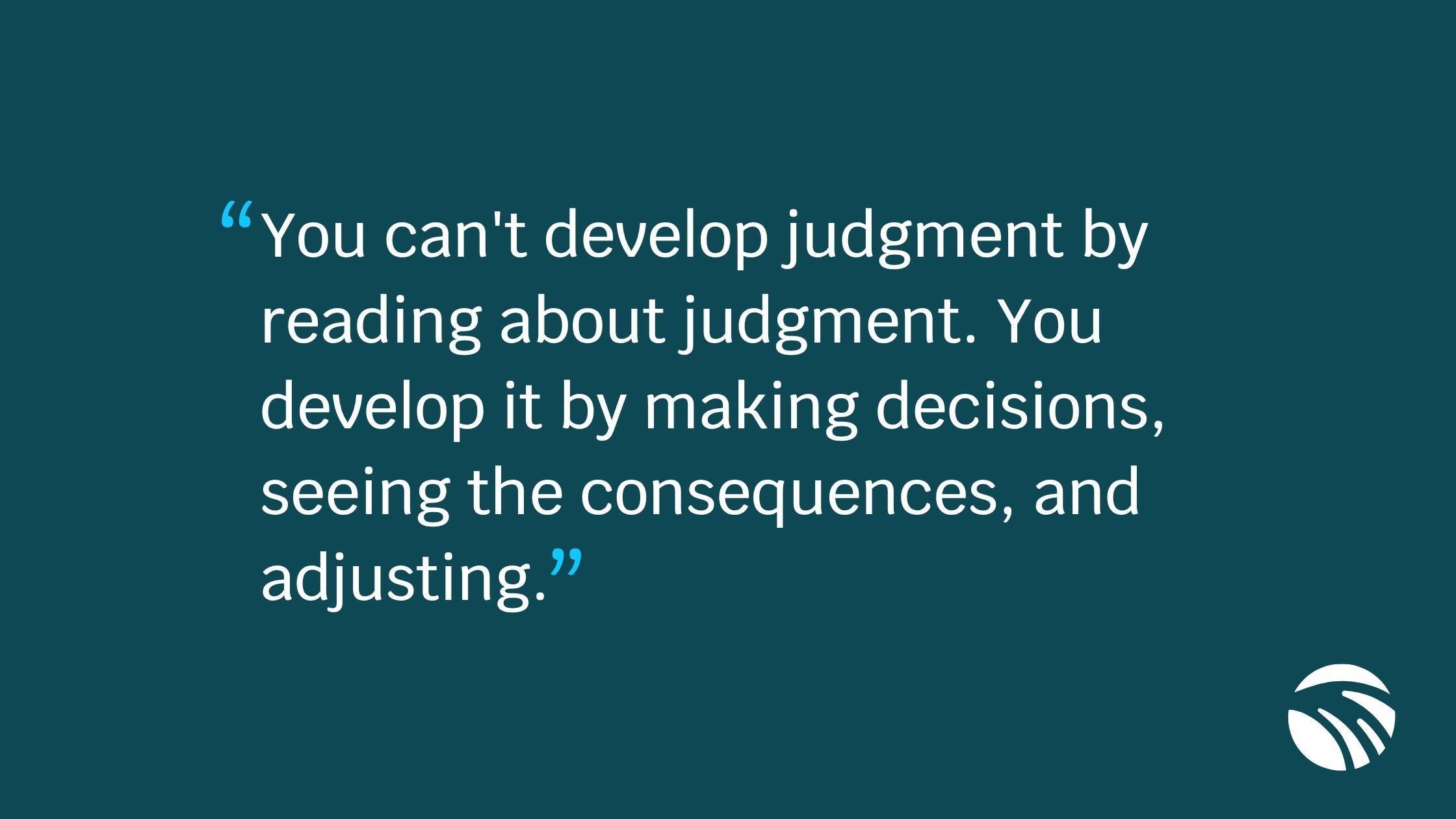
Sustained durable skills development requires a system, not a one-time event. You can’t develop judgment by reading about judgment. You develop it by making decisions, seeing the consequences, and adjusting.
Here’s how that looks in practice for both individuals and learning and development teams.
Before designing development interventions, organizations need to know where gaps actually are — not based on self-reporting, but on demonstrated performance in realistic conditions.
Simulation-based assessment provides this baseline; it captures how people actually behave under pressure, not how they think they would.
Adaptive platforms that adjust content, difficulty, and sequence based on each individual’s performance ensure that development stays targeted over time — closing the right gaps rather than repeating what’s already been mastered.
Research indicates AI-powered personalization can deliver up to a 73% improvement in learning outcomes compared with one-size-fits-all approaches.
Verified skills data offers objective evidence of demonstrated competence captured during simulations and assessments.
The difference between a completion record and a verified skills record is the difference between knowing someone attended training and knowing they can actually perform. For organizations making decisions about promotion, succession planning, or compliance, that distinction matters enormously.
According to TalentLMS upskilling research, the majority of employees actively want more opportunities to develop new skills — and organizations that create structured, ongoing development pathways see stronger retention as a result.
For corporate L&D, the most effective activities share a design principle: they require the skill to be used, not just understood. Here’s what works:
Branching simulations place employees inside dynamic, realistic workplace scenarios where their choices drive outcomes.
Unlike passive e-learning, simulations require critical thinking, communication, and judgment in real time — and they capture performance data that makes progress visible.
Modern canvas-based authoring tools let subject matter experts build these scenarios in minutes, which means training stays current as business needs evolve.
Stretch assignments and cross-functional projects provide real-world practice in conditions that matter. An employee asked to lead a project outside their usual domain develops adaptability and leadership through the work itself — not through a module about adaptability.
Structured debrief after simulations and real-world challenges is what converts experience into learning. Without reflection — what happened, what I decided, what I would do differently — the development value of experience doesn’t fully transfer.
Peer feedback and mentorship add the interpersonal dimension. For skills like communication and emotional intelligence, honest input from colleagues who work closely with the learner is one of the most reliable development inputs available.
Development that sticks requires more than content — it requires practice, feedback, and a system for tracking progress over time.
Skillwell combines AI-powered adaptive learning with immersive simulation to build durable skills systematically, with verified data to show it’s working.
Novice: rule-following, needs detailed instruction
Advanced beginner: applies knowledge to new situations but still relies on guidance
Competent: plans and executes independently, makes informed decisions
Proficient: sees the bigger picture, adapts, mentors others
Expert: intuition-driven, anticipates challenges, innovates — each stage requires different learning design to support progression
Simulation-based practice in realistic scenarios — where choices drive outcomes and performance is captured as data
Adaptive learning pathways that adjust to individual performance, not fixed content sequences
Structured feedback loops from managers, peers, and coaches that provide specific, actionable input
Stretch assignments and real-world challenges that require the skill to be used, not just studied
Simulation-based assessment captures demonstrated behavior in realistic scenarios — not self-reported competency or knowledge recall
Verified skills data from scenario performance provides objective, audit-ready evidence of demonstrated competence
Adaptive platforms track progress across individual learning journeys, showing where gaps are closing and where more focus is needed
360-degree feedback from peers and managers adds the interpersonal dimension that simulation data alone doesn’t fully capture
There is no fixed timeline — progression depends on starting point, practice frequency, feedback quality, and the complexity of the skill
Adaptive learning programs that target specific gaps and provide immediate feedback accelerate development significantly compared with traditional methods
AI-powered personalization has been shown to improve learning outcomes by up to 73% compared with one-size-fits-all approaches
The key is treating development as an ongoing loop — practice, feedback, adjustment — rather than a single training event
Here is the uncomfortable truth about AI in learning today: ...
Adaptive learning promises personalized pathways and measurable gains. Seasoned buyers know no technology arrives without ...
Remote and hybrid higher education changed what "hands-on" can mean.
Here is the uncomfortable truth about AI in learning today: ...
Adaptive learning promises personalized pathways and measurable gains. Seasoned buyers know no technology arrives without ...
Remote and hybrid higher education changed what "hands-on" can mean.