

Beyond the Content Explosion: What 17 ...
Blogs
Here is the uncomfortable truth about AI in learning today: ...

Most employee training fails to deliver what organizations actually need: capable people who can perform.
The problem isn't effort. Companies invest significant resources in learning and development. But traditional approaches—video courses, slide decks, knowledge checks—focus on content delivery rather than capability building.
Employees complete training. They pass quizzes and earn certificates.
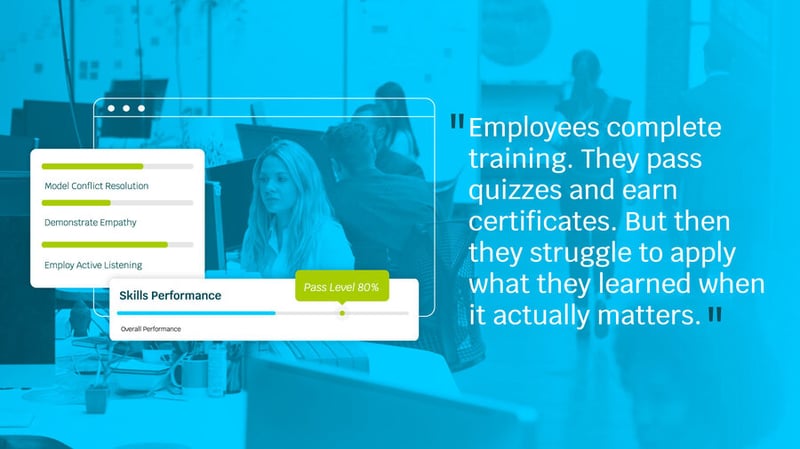
But then they struggle to apply what they learned when it actually matters.
Skills training software takes a different approach. Instead of measuring what employees watched or clicked through, it develops and verifies what they can actually do.
The focus shifts from completion to competence, from content consumption to demonstrated mastery.
For organizations serious about workforce development, this distinction changes everything.
Skills training software is a digital platform designed to build real, measurable employee capabilities through targeted learning experiences.
Unlike traditional training systems that simply deliver content, these platforms combine adaptive technology, immersive practice, and verified skills data to develop genuine competence.
The best solutions personalize training to individual needs, create realistic practice environments, and capture evidence of what employees can actually do—not just what courses they finished.
This approach matters especially in industries where performance is high-stakes: healthcare settings with critical patient conversations, financial services with compliance requirements, sales teams navigating complex negotiations, or any role where mistakes carry real consequences.
Skills training software bridges the gap between knowing and doing. Employees don't just learn concepts—they practice applying them in realistic scenarios until they achieve mastery.
Not all platforms deliver equally. The features below separate solutions that build genuine capability from those that simply manage content.
The best platforms adjust to each learner in real time. Instead of forcing everyone through identical content at the same pace, adaptive learning systems modify difficulty, pacing, and focus based on individual performance.
This personalization drives better outcomes. A 2025 study on AI-driven adaptive learning found significant improvements in learner engagement and performance when training was adjusted to individual needs and comprehension levels.
At Skillwell, our AI-powered adaptive learning creates personalized pathways based on assessment results and ongoing performance data. Learners spend time on skills they actually need to develop—not content they've already mastered.
Reading about a skill isn't the same as practicing it. Immersive simulation training puts employees in realistic scenarios where they make decisions, navigate challenges, and see consequences—all in a safe environment where mistakes become learning opportunities.
This matters because adults learn best through experience. The 2024 State of the Industry report found that 83% of organizations now use simulations and scenario-based learning to enhance training effectiveness.
Day-in-the-life scenarios are particularly powerful. When a healthcare worker practices a difficult patient conversation, or a sales rep navigates a complex negotiation, they're building capability they can apply immediately on the job.
Completion metrics tell you who finished a course. They don't tell you who can actually perform.
Verified skills data captures evidence of demonstrated competence during training. It shows how someone performed in simulations, what decisions they made, where they excelled, and where gaps remain.
According to a 2024 report from Betterworks, 86% of organizations now use technology to assess and track employee skills—recognizing that data-driven approaches produce better training outcomes than intuition alone.
This data serves multiple purposes: it informs personalized learning pathways, identifies organizational capability gaps, and provides audit-ready documentation of employee competence.
Creating effective training content used to require months of development time and specialized technical skills. Modern AI-powered authoring tools change that equation dramatically.
Subject matter experts can now generate branching simulations in minutes—no coding or instructional design expertise required. This democratizes content creation and allows organizations to respond quickly to emerging skill needs.
The adoption curve is steep. A 2024 report from Continu found that 30% of L&D teams already use AI-powered tools in their learning programs, with 91% of those planning to increase AI usage in 2025.
Static, linear content limits learning. Branching simulations let employees navigate different paths based on their choices, seeing how decisions lead to different outcomes.
This interactivity makes learning engaging and relevant. Every choice matters. Learners develop judgment through experience rather than memorizing "correct" answers.
The 2024 State of the Industry report notes that 46% of organizations now use immersive learning methods, including AI applications embedded into learning experiences.
Individual training events matter less than capability trends over time. Skills data analytics track how proficiency develops across employees, teams, and the organization—surfacing insights that inform strategic decisions.
Which skills are improving? Where do persistent gaps exist? How do training investments correlate with performance outcomes? Analytics answer these questions with data rather than assumptions.
This visibility transforms L&D from a cost center into a strategic function that demonstrably improves workforce capability.
New hire onboarding often follows a one-size-fits-all approach: everyone completes the same orientation regardless of their background or role requirements.
Adaptive assessment-driven onboarding takes a smarter approach. It evaluates what new hires already know, identifies gaps specific to their role, and creates personalized 30-60-90 day journeys that accelerate time to productivity.
A 2024 industry report found that 64% of organizations measure the number of employees trained as a key performance indicator—but leading organizations go further, measuring time to competence and verified skill development.
In regulated industries, proving employee competence isn't optional—it's a legal requirement. Skills training software that generates audit-ready, evidence-based records reduces compliance burden while providing stakeholders confidence in workforce readiness.
This documentation goes beyond completion certificates. It demonstrates that employees practiced specific scenarios, made appropriate decisions, and achieved verified proficiency levels.
The right platform delivers advantages across multiple dimensions—for individual learners, L&D teams, and the organization as a whole.
Generic training wastes time on content some employees have already mastered while rushing past areas where they need more practice. Personalized pathways solve this by tailoring content to individual needs, roles, and proficiency levels.
Using verified skills data captured during simulations, platforms can instantly adjust learning pathways. Each employee receives training relevant to their specific development needs—not generic content designed for the average learner.
When training focuses only on actual gaps and uses practice-based methods that accelerate learning, development happens faster. Organizations consistently see 40% faster upskilling compared to traditional approaches.
This efficiency matters. Faster skill development means employees contribute sooner, reducing the productivity gap during onboarding and role transitions.
Interactive training methods—simulations, branching scenarios, realistic practice—keep employees engaged in ways that passive content cannot. Learners stay motivated because the training feels relevant to their actual work.
This engagement translates to better retention. When employees practice handling situations rather than just reading about them, the learning sticks.
For organizations in regulated industries, skills training software provides the documentation needed to demonstrate workforce competence. Audit-ready records prove that employees completed specific training and demonstrated required proficiency levels.
This capability reduces compliance burden while strengthening the organization's regulatory position.
Data-driven continuous improvement
Skills data analytics enable organizations to continuously refine their training investments. Which programs produce the strongest outcomes? Where do capability gaps persist? How should resources be allocated?
Data answers these questions, transforming L&D from a reactive function into a strategic driver of organizational capability.
Research consistently shows that effective training drives business results. A 2025 report found that companies with comprehensive employee training programs have 218% higher income per employee than those without formalized training.
Skills training software makes this impact measurable by connecting verified competency data to performance outcomes.
Selecting the right platform requires a structured evaluation process. Here's how to approach it:
Start with clarity on what capabilities you need to develop and why. Which skills are most critical for business outcomes? Where do the biggest gaps exist? How do training goals align with strategic priorities?
This clarity shapes every subsequent decision and ensures you select a platform that addresses actual needs.
Assess platforms against the features that matter most: adaptive learning, immersive simulation, verified skills data, AI-powered authoring, and analytics capabilities.
Not every platform delivers on all of these. Prioritize based on your specific requirements and use cases.
Here's an important distinction: skills training software enhances your LMS—it doesn't replace it.
Your Learning Management System handles administration, tracking, and compliance record-keeping. Skills training software creates the actual learning experience—the immersive practice that builds real capability.
Look for platforms that integrate smoothly with your existing LMS infrastructure. At Skillwell, we work alongside your current systems to enhance them, not compete with them.
The best features mean nothing if employees don't engage with the platform. Assess the user experience from both perspectives: learners completing training and administrators managing programs.
Is navigation intuitive? Does the interface encourage engagement? Can administrators easily track progress and manage content?
Implementation is just the beginning. Evaluate what ongoing support vendors provide: customer success resources, best practices guidance, technical assistance, and community forums.
Strong vendor support significantly impacts long-term success with any platform.
Cost matters, but value matters more. Consider the full picture: How will the platform impact time to competence? What's the expected improvement in performance outcomes? How much will compliance burden decrease?
The right platform pays for itself through improved workforce capability and reduced training inefficiency.
Many organizations worry that adopting new training technology means replacing their current infrastructure. That's not the case with well-designed skills training software.
Your Learning Management System serves important functions: assigning training, tracking completions, managing compliance records, and reporting on learning activity. These capabilities remain valuable.
What traditional LMS platforms weren't designed for is building genuine skill through immersive practice. That's where skills training software adds value—creating the learning experience itself while your LMS handles the administrative layer.
When skills training software integrates with your LMS, you get comprehensive capability: immersive skill-building experiences with robust tracking and administration. Completion data flows back to your LMS. Compliance records stay centralized. But the actual training develops real, verified competence.
At Skillwell, we've designed our platform to enhance existing learning ecosystems. You don't have to choose between your current infrastructure and effective skill development—you can have both.
Organizations that implement skills training software effectively see measurable improvements across key metrics:
These outcomes compound over time. As your workforce develops stronger capabilities, performance improves, compliance risk decreases, and the organization builds sustainable competitive advantage through its people.
Skills training software transforms how organizations develop their people. Instead of hoping that content consumption translates to performance, you build verified capability through adaptive learning, immersive practice, and data-driven personalization.
For L&D leaders evaluating options, the key is focusing on platforms that deliver what actually matters: genuine skill development, not just course completions.
At Skillwell, we've built our platform around this principle. AI-powered adaptive learning creates personalized pathways based on individual proficiency. Immersive simulations let employees practice in realistic scenarios. Verified skills data captures evidence of mastery—not just attendance.
And we integrate with your existing LMS, enhancing your current infrastructure rather than replacing it.
The result? Training that develops real capability, faster—with the documentation to prove it.
Ready to see what Skillwell can do for your organization? Explore how we combine AI-powered adaptive learning with immersive simulation to build verified workforce capability.
Here is the uncomfortable truth about AI in learning today: ...
Adaptive learning promises personalized pathways and measurable gains. Seasoned buyers know no technology arrives without ...
Remote and hybrid higher education changed what "hands-on" can mean.
Here is the uncomfortable truth about AI in learning today: ...
Adaptive learning promises personalized pathways and measurable gains. Seasoned buyers know no technology arrives without ...
Remote and hybrid higher education changed what "hands-on" can mean.