

Beyond the Content Explosion: What 17 ...
Blogs
Here is the uncomfortable truth about AI in learning today: ...
Technical skills have a shelf life. The tools, platforms, and processes that define a role today may be obsolete within a few years — sometimes sooner.
Durable skills — the foundational human capabilities that transcend any specific job, technology, or industry — don’t expire. They compound.
Communication, critical thinking, adaptability, leadership, emotional intelligence, collaboration — these are the abilities that stay relevant as roles evolve, teams change, and technology reshapes entire industries. Organizations that invest in them build workforces that don’t just keep pace with change. They lead through it.
This guide covers what durable skills are, which ones matter most right now, how to build and measure them at scale, and why they’re the real driver of long-term career and business performance.
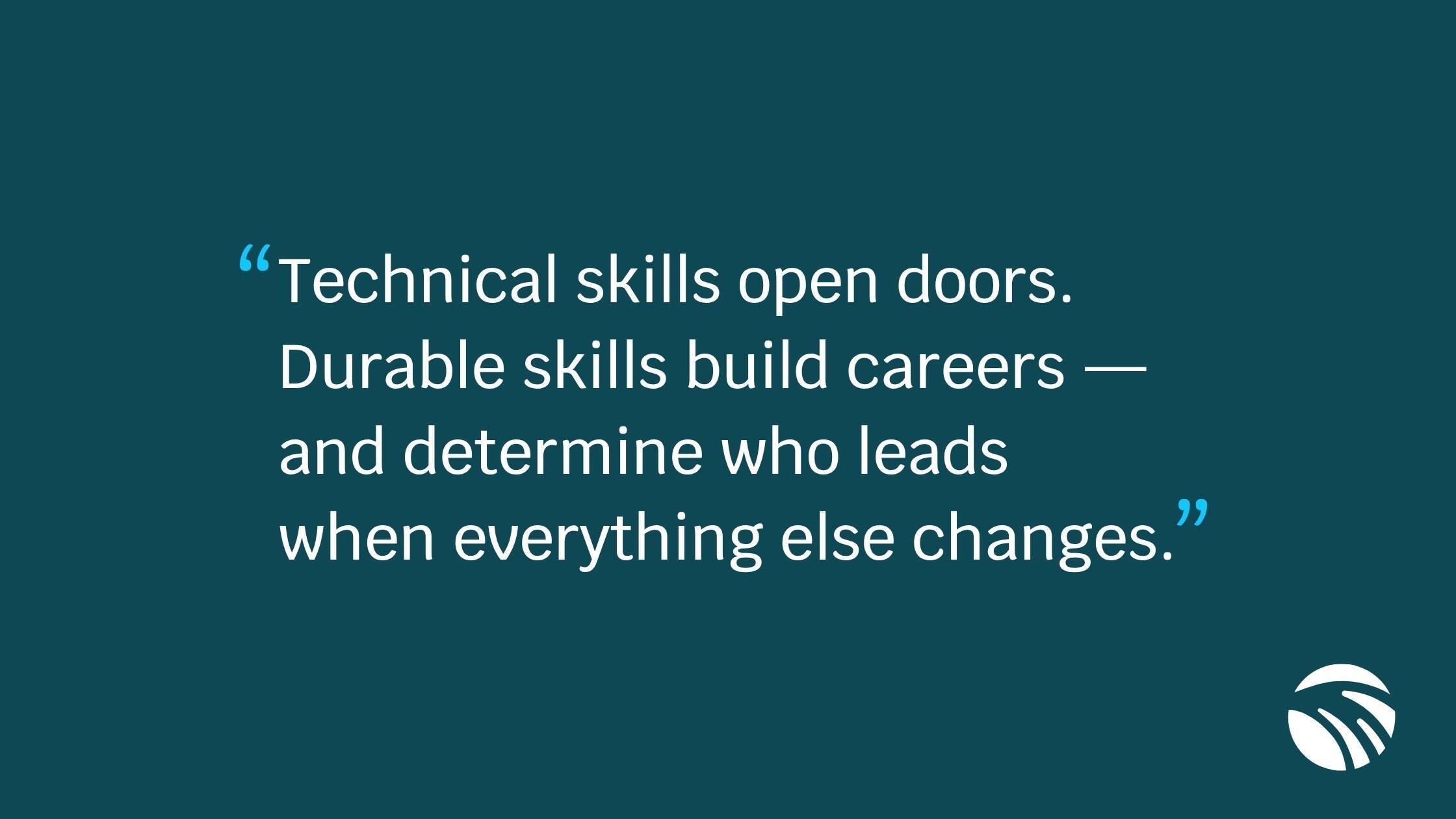
Technical skills open doors. Durable skills build careers — and determine who leads when everything else changes.
Durable skills — sometimes called power skills or core skills — are foundational human capabilities that remain effective across industries, roles, and technological shifts. Where technical skills can lose relevance as tools change, durable skills are rooted in how people think, communicate, and solve problems. They don’t go stale.
What makes them particularly valuable for organizations is their transferability. A strong communicator is effective in sales and in compliance training. A leader who can navigate ambiguity in healthcare is equally valuable in professional services. Durable skills move with people across teams, departments, and career stages — making them a high-return investment for any workforce development strategy.
According to the World Economic Forum’s Future of Jobs 2025 report, 39% of core skills required in the job market are expected to change by 2030. With technical skills particularly vulnerable to that kind of disruption, the case for prioritizing durable, human-centric capabilities has never been stronger.
Not all durable skills carry equal weight in the current environment. As AI automates more routine cognitive tasks and global teams become the norm, certain capabilities are pulling ahead.
Critical thinking tops the World Economic Forum’s list of most essential skills for 2025. As data proliferates and decisions grow more complex, the ability to evaluate information objectively, identify patterns, and reach sound conclusions separates effective employees from overwhelmed ones. Creative thinking and complex problem-solving follow closely — especially in roles where standard procedures don’t cover emerging challenges.
LinkedIn’s Global Talent Trends research found that 92% of talent professionals consider soft skills equally or more important than hard skills when evaluating candidates. Communication, collaboration, and leadership consistently rank among the most in-demand capabilities across industries. In distributed and cross-functional teams, the ability to communicate clearly, influence without authority, and lead through ambiguity determines whether projects land or stall.
Resilience, flexibility, and agility appear prominently in WEF analysis of skills employers are prioritizing. The pace of change means employees who can pivot quickly, absorb uncertainty without losing effectiveness, and keep developing their own capabilities over time are disproportionately valuable. Emotional intelligence — knowing how to read situations, regulate responses, and connect with others — underpins all of it.
This is where most traditional training approaches fall short. Durable skills can’t be built by watching a video or completing a module. Communication, leadership, and adaptability require practice, feedback, and repetition in realistic conditions. You can’t develop judgment by reading about judgment. You develop it by making decisions, seeing the consequences, and adjusting.
A 2025 industry report on simulation-based learning found that organizations using immersive training save an average of 4.3 months on onboarding compared to traditional methods, with seven in ten companies reporting faster employee readiness overall. More than half of employees who used simulation-based learning reported being more likely to stay at their current job — a retention benefit that compounds well beyond the skill-building itself.
Instead of abstract scenarios, learners practice inside realistic workplace situations — a difficult conversation with a direct report, a compliance dilemma, a cross-functional negotiation — where their choices lead to real consequences within the simulation. They build decision-making confidence without real-world risk.
Adaptive platforms personalize learning pathways based on each individual’s demonstrated performance — learners spend their time on what they actually need, not on content they’ve already mastered. Evidence from learning-industry analyses shows this approach accelerates skill development and improves engagement because the content stays relevant and the feedback is immediate. Pairing adaptive learning with immersive simulation creates a closed loop: learners practice, receive targeted feedback, and return to scenarios calibrated to where they actually are.
One of the most significant practical advances for learning and development teams is authoring speed. Modern canvas-based tools let subject matter experts build branching simulations in minutes rather than months — no technical expertise required. A healthcare organization can build a simulation around a new compliance scenario the same week a regulation changes. A retail company can deploy onboarding scenarios for a new product launch while the launch is still fresh. That responsiveness makes durable skills training sustainable at scale — not a one-time initiative, but an ongoing practice that evolves with the organization.
The challenge with measuring durable skills isn’t that it’s impossible — it’s that traditional tools weren’t built for it. A quiz that tests whether someone can recite the steps of active listening doesn’t tell you whether they can actually listen actively under pressure. Effective measurement requires approaches that capture demonstrated behavior, not just knowledge recall.
Simulation-based assessment is the most direct method. When employees work through realistic scenarios, their actual decisions and responses become measurable data points. Verified skills data captured this way gives L&D teams objective evidence of competence — not whether someone completed a module, but whether they can handle the situation when it counts.
360-degree feedback from peers, managers, and direct reports adds the interpersonal dimension — particularly valuable for leadership and communication skills, where others’ experience of working with someone is itself the measure.
Behavioral interviews and situational judgment assessments provide pre-hire and development-conversation data when structured around observable behaviors rather than general impressions. The goal is specificity: what exactly did the employee do, say, or decide in a given situation — not how they’d rate their own communication on a scale of one to ten.
The common thread across all of these: they produce audit-ready documentation that moves the conversation beyond “did they complete the training?” to “can we demonstrate they’re capable?” For organizations in regulated industries — healthcare, life sciences, financial services — that distinction matters for compliance and risk management, not just L&D reporting.
Employers use distinct approaches for technical versus durable skills — and the most effective hiring programs treat both with equal rigor. Technical abilities get evaluated through practical tests, certifications, and portfolio reviews. Durable skills require a different toolkit: behavioral interviews, group exercises, situational judgment tests, and increasingly, job-embedded simulations that reveal how a candidate actually operates under realistic pressure.
The industries where this distinction matters most tend to be the ones where a wrong hire is costly — in performance, patient outcomes, or client relationships. Here’s how that plays out across Skillwell’s core sectors.
Healthcare organizations assess durable skills because patient safety depends on them. Hiring managers evaluate communication, empathy, and critical thinking through scenario-based interviews and simulated patient interactions. Leadership development programs use simulation to assess how candidates respond to high-pressure decisions before placing them in management roles. Compliance-focused hiring also requires documented evidence that candidates can apply ethical decision-making in context — not just confirm they’ve read the policy.
Retail organizations prioritize speed-to-competency, which means durable skills assessment is often built into onboarding rather than pre-hire screening. Simulation-based tools let managers evaluate how new hires handle difficult customer interactions, product questions, and service escalations early — and intervene with targeted coaching before gaps become performance issues.
In professional services, the interview process often IS the assessment. How a candidate communicates, listens, structures an argument, and handles pushback in a hiring conversation reveals the same capabilities that determine performance on the job. Technology companies increasingly use work-sample simulations — cross-functional collaboration scenarios, stakeholder communication exercises — to surface durable skills that behavioral interview questions alone don’t reliably predict.
Life sciences organizations face audit requirements that extend to hiring. Demonstrating that a new hire has been assessed — not just trained — on compliance-relevant durable skills before onboarding is increasingly part of regulatory readiness. Simulation-based assessments with documented performance records give talent and compliance teams a defensible paper trail from day one.
The simplest way to draw the line: technical skills get people hired. Durable skills determine how far they go.
A software developer who knows a specific programming language can complete the work in front of them. But when that language becomes less relevant — as they often do — what determines whether that developer remains valuable is their ability to learn new tools quickly, communicate across teams, and navigate the ambiguity of building something that hasn’t been built before. Technical expertise is the entry requirement. Durable skills are what drive advancement — and what keep people effective when everything else changes.
This shows up clearly in hiring and promotion data. The same LinkedIn research found that 89% of talent professionals report that when a hire doesn’t work out, the reason is almost never a lack of technical skill — it’s a lack of durable ones. Poor communication. Low adaptability. Difficulty working across teams. The technical bar was cleared; the human capabilities weren’t there.
For organizations, this has direct implications for how they develop and promote talent. The managers, directors, and executives who lead effectively through change aren’t simply the most technically proficient people in the room. They’re the ones who can communicate a vision, adapt under uncertainty, coach their teams, and make sound decisions when there’s no playbook. Those capabilities compound over time — whereas technical skills often have to be actively refreshed just to stay current.
The business case is measurable. The World Economic Forum reports that 63% of employers cite skill gaps as the single biggest barrier to business transformation between now and 2030. Organizations that close those gaps — systematically, with verifiable evidence — don’t just reduce risk; they build a durable competitive advantage. Skillwell clients using adaptive and simulation-based development report 40% faster upskilling compared to traditional methods, a 27% average improvement in skill proficiency, and the ability to scale training delivery tenfold.
Those outcomes translate directly into career-level results: faster time-to-promotion, stronger retention of high performers, and professional development assessment data that connects L&D investment to business performance — not just training completions.
Durable skills don’t develop through passive content. They develop through practice — realistic, feedback-rich, repeatable practice that puts employees inside the scenarios they’ll actually face.
Skillwell combines AI-powered adaptive learning with immersive simulation to create training that builds capability you can measure and verify — working alongside your existing LMS, not in place of it.
Ready to see what that looks like for your organization?
Foundational human capabilities — communication, critical thinking, adaptability, leadership, collaboration, and emotional intelligence — that remain valuable across changing roles, technologies, and industries
Unlike technical skills, they don’t become obsolete as tools and platforms evolve
Sometimes called power skills, core skills, or human skills
Increasingly prioritized by employers as AI automates routine tasks and the pace of organizational change accelerates
Technical skills are role-specific and tied to particular tools or methodologies — they have a defined shelf life as technology evolves
Durable skills are transferable and apply across any environment, industry, or career stage
LinkedIn data shows 89% of hiring failures are attributed to a lack of durable skills, not technical ability
The two are complementary: technical expertise is the entry requirement; durable skills determine advancement and long-term effectiveness
The WEF Future of Jobs 2025 report identifies analytical thinking, resilience, flexibility, and leadership as top employer priorities
Creative thinking, adaptability, and emotional intelligence are increasingly valued as AI takes over more routine cognitive work
Communication and collaboration consistently rank among the most in-demand capabilities across industries
92% of talent professionals say soft skills matter as much or more than hard skills when making hiring decisions
Passive content — videos, readings, standard e-learning modules — doesn’t build durable skills; practice in realistic conditions does
Immersive simulation training places learners inside authentic scenarios where they make decisions and see consequences in real time
AI-powered adaptive learning personalizes pathways based on individual performance, focusing development where it’s most needed
Organizations combining adaptive learning with simulation report 40% faster upskilling and measurable improvements in skill proficiency
Simulation-based assessment captures actual decision-making behavior — providing verified skills data rather than course completion records
360-degree feedback from peers and managers adds interpersonal and leadership dimensions to the measurement picture
Behavioral interviews and situational judgment assessments provide development data grounded in observable behavior
Audit-ready documentation from simulation performance supports compliance requirements in regulated industries
63% of employers cite skill gaps as the top barrier to business transformation, per the WEF Future of Jobs 2025 report
Organizations that invest in durable skills development report faster upskilling, stronger retention, and measurable performance improvements
Durable skills create resilience against technological disruption — employees who can adapt, communicate, and lead are more future-proof than their job titles
Verifying these capabilities connects L&D investment to business outcomes, not just training completions
Yes — canvas-based authoring tools let subject matter experts build branching simulations in minutes, without technical expertise
Adaptive platforms adjust content and difficulty individually for each learner, making personalized development scalable across thousands of employees
Organizations report the ability to scale training delivery tenfold using adaptive and simulation-based approaches
Verified skills data at scale gives leadership real-time visibility into workforce capability and readiness across teams and geographies
Skillwell combines adaptive learning and immersive simulation to build and measure durable skills through realistic workplace scenarios
Skillwell Simulate lets subject matter experts create branching simulations without technical expertise, deployable in minutes
Skillwell Verify captures verified skills data — objective evidence of demonstrated competence, not just course completion
Skillwell integrates with your existing LMS, enhancing it with hands-on skill-building rather than replacing it
Here is the uncomfortable truth about AI in learning today: ...
Adaptive learning promises personalized pathways and measurable gains. Seasoned buyers know no technology arrives without ...
Remote and hybrid higher education changed what "hands-on" can mean.
Here is the uncomfortable truth about AI in learning today: ...
Adaptive learning promises personalized pathways and measurable gains. Seasoned buyers know no technology arrives without ...
Remote and hybrid higher education changed what "hands-on" can mean.