

Beyond the Content Explosion: What 17 ...
Blogs
Here is the uncomfortable truth about AI in learning today: ...
Traditional training treats every employee the same. Everyone completes identical content at the same pace, regardless of what they already know or where they actually need to grow.
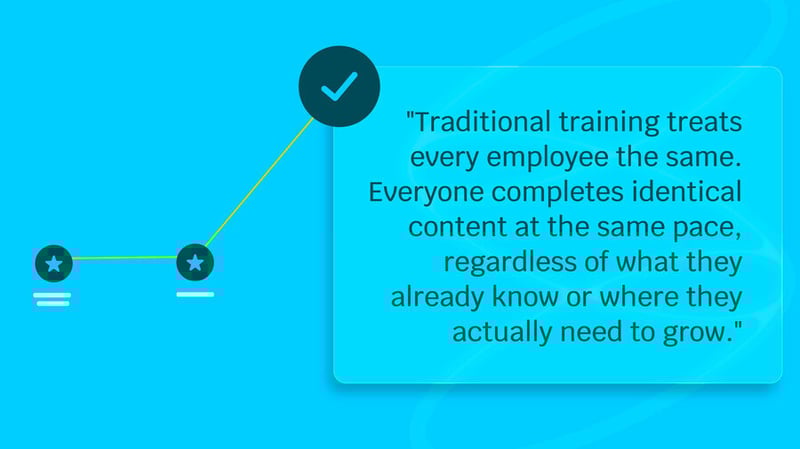
Adaptive learning software takes a fundamentally different approach. It personalizes the experience based on individual performance, adjusting content, pacing, and focus in real time.
In essence, learners spend time on skills they need to develop—not material they've already mastered.
For organizations evaluating skills training software, understanding how adaptive technology works—and what distinguishes it from other AI-powered approaches—shapes every decision about learning strategy.
Adaptive learning is an educational approach that customizes learning experiences based on each learner's unique needs, current proficiency, and performance patterns. Instead of following a fixed curriculum, the training adjusts dynamically as the learner progresses.
Adaptive systems continuously assess learner performance and use that data to modify the learning pathway. Someone struggling with a concept gets additional practice and support. Someone demonstrating mastery moves quickly to more advanced content.
This creates a feedback loop: assessment informs content delivery, performance data refines the pathway, and the experience becomes increasingly personalized over time.
The results speak volumes. Organizations implementing adaptive learning solutions consistently see 40% faster upskilling compared to traditional approaches. Employees develop capabilities more efficiently because training focuses on actual gaps rather than generic content.
When adaptive learning incorporates verified skills data captured during immersive simulations, personalization becomes even more powerful.
The system doesn't just track quiz scores—it understands how employees perform in realistic scenarios and adjusts pathways accordingly.
Adaptive learning technology refers to the platforms and systems that make personalized learning possible at scale. These tools use algorithms, data analytics, and increasingly, artificial intelligence to create customized experiences for each learner.
Traditional learning management systems deliver content and track completions. Everyone receives the same materials in the same sequence. The system measures who finished, not who developed the capability.
Adaptive technology fundamentally changes this model:
The best adaptive learning platforms offer several key features:
Modern tools can generate branching simulations in minutes without requiring technical expertise. This allows organizations to create realistic scenarios quickly and update content as needs evolve.
For new hires, adaptive systems can design personalized 30-60-90 day journeys based on role requirements and initial proficiency assessments. This accelerates time to productivity while ensuring employees develop the specific skills their positions require.
When adaptive technology combines with simulation-based learning, employees practice in realistic environments while the system captures performance data to inform ongoing personalization.
Adaptive AI learning integrates artificial intelligence—specifically machine learning—into adaptive learning systems.
This technology analyzes learner behavior, predicts needs, and continuously refines the learning experience.
Adaptive AI learning proves valuable across quite a few professional contexts–showing just how powerful this type of learning can be, no matter your industry or focus.
The common thread? Adaptive AI ensures training remains relevant and targeted, regardless of the skill being developed or the industry context.
Understanding the distinction between generative AI and adaptive AI is crucial for organizations building their learning technology strategy. Both leverage advanced algorithms, but they serve fundamentally different purposes.
Generative AI focuses on creating new content. Technologies like GPT-4 and other large language models produce human-like text, images, simulations, and other materials.
In learning contexts, generative AI can:
Generative AI reduces the time and resources required to develop eLearning courses, allowing L&D teams to scale educational programs quickly.
Adaptive AI centers on analyzing data and optimizing experiences based on that analysis. In learning contexts, it uses machine learning algorithms to understand learner behavior and adjust content delivery accordingly.
The key distinction: adaptive AI uses machine learning to analyze and respond, while generative AI uses large language models to create.
Adaptive AI in learning contexts can:
These systems employ algorithms to dynamically adjust content delivery based on individual learner performance, preferences, and progress—ensuring personalized experiences that optimize engagement and retention.
The most powerful learning platforms combine both technologies:
Generative AI creates the content—branching simulations, realistic scenarios, assessment questions, feedback narratives.
Adaptive AI personalizes the delivery—determining which content each learner receives, when they're ready to advance, and how pathways should adjust based on performance.
This combination enables organizations to rapidly develop relevant training content while ensuring each employee receives a personalized experience that builds genuine capability.
At Skillwell, we leverage both technologies. AI-powered authoring tools generate immersive simulations quickly, while adaptive learning algorithms ensure each learner follows a pathway optimized for their specific development needs.
Adaptive learning encompasses various methods that enhance the training experience. The most effective approaches include:
Learners navigate through different paths based on their choices and performance. Each decision leads to different consequences, creating dynamic learning environments that develop critical thinking and decision-making skills.
This method is particularly powerful because it mirrors real-world complexity. Employees don't just learn the "right answer"—they develop judgment through experiencing how different approaches play out.
Rather than advancing based on time spent, learners progress when they demonstrate mastery of specific skills. This ensures genuine proficiency before moving to more advanced content.
Competency-based approaches prevent the common problem of employees "passing" training without developing actual capability. The system requires demonstrated performance, not just completion.
Realistic simulations put learners in scenarios that mirror their actual work environments. They practice handling situations—difficult conversations, complex decisions, high-pressure moments—in safe environments where mistakes become learning opportunities.
When combined with adaptive technology, simulations become even more powerful. The system captures verified performance data and uses it to personalize subsequent learning pathways.
Incorporating features like progress tracking, achievements, and challenges transforms learning into an engaging experience. These elements increase motivation and participation without sacrificing educational rigor.
The key is ensuring gamification serves learning objectives rather than becoming a distraction. The best implementations use game mechanics to reinforce skill development and maintain engagement through challenging content.
Skillwell combines AI-powered adaptive learning with immersive simulation training to create personalized experiences that build verified capability.
Rather than relying solely on quiz scores or completion metrics, our platform captures detailed performance data during immersive simulations. This verified skills data shows how employees actually handle realistic scenarios—and informs personalized pathway adjustments.
Subject matter experts can generate branching simulations in minutes without technical expertise. This allows organizations to respond quickly to emerging skill needs and keep training aligned with evolving requirements.
For new employees, adaptive assessments create personalized 30-60-90 day journeys based on role requirements and demonstrated proficiency. New hires develop the specific capabilities their positions require—faster.
The platform generates evidence-based records demonstrating employee capability. This documentation supports compliance requirements while providing organizations with confidence in workforce readiness.
Organizations across healthcare, retail, professional services, life sciences, and technology use Skillwell to develop workforce capability. The combination of adaptive personalization and immersive practice consistently delivers:
Choosing the right platform requires evaluating several factors:
How sophisticated is the adaptive algorithm? Does it adjust based on simple quiz scores, or does it analyze deeper performance data from realistic scenarios?
Can your team create and update content quickly? Look for AI-powered authoring that enables subject matter experts to build training without technical dependencies.
Does the platform work alongside your current LMS? The best adaptive learning software enhances your existing infrastructure rather than replacing it.
What visibility do you get into learner progress and skill development? Look for platforms that provide actionable insights, not just completion metrics.
Can the platform generate audit-ready records proving employee competence? This capability matters especially in regulated industries.
Implementation is just the beginning. Evaluate what ongoing support, best practices guidance, and customer success resources vendors provide.
Adaptive learning software transforms how organizations develop their people.
Instead of one-size-fits-all content delivery, employees receive personalized experiences that target their specific development needs and build verified capability.
The most effective platforms combine adaptive AI—which personalizes pathways based on machine learning analysis—with generative AI that enables rapid content creation. Add immersive simulation for realistic practice, and you have a complete system for developing workforce capability.
At Skillwell, we've built our platform around this integrated approach. AI-powered tools create engaging content quickly. Adaptive algorithms personalize every learning journey. Immersive simulations build capability through practice. Verified skills data proves what employees can actually do.
The result? Training that develops real capability—personalized, efficient, and measurable.
Want to take a look at adaptive learning in action? Check out how Skillwell combines AI-powered personalization with immersive simulation to transform workforce development.
Here is the uncomfortable truth about AI in learning today: ...
Adaptive learning promises personalized pathways and measurable gains. Seasoned buyers know no technology arrives without ...
Remote and hybrid higher education changed what "hands-on" can mean.
Here is the uncomfortable truth about AI in learning today: ...
Adaptive learning promises personalized pathways and measurable gains. Seasoned buyers know no technology arrives without ...
Remote and hybrid higher education changed what "hands-on" can mean.