

Build Life Science Skills: Immersive & ...
Events
Discover how Skillwell helps companies like Merck and AstraZeneca build critical compliance and ...

The technology question comes first in most conversations about immersive learning — which VR platform, which authoring tool, what hardware.
But the harder question is how to weave immersive techniques into a curriculum in a way that actually improves outcomes rather than just adding novelty.
Let's look at what works, what gets in the way when it comes to immersive learning in higher education.
Immersive learning is a teaching approach that places students inside realistic, interactive scenarios — using tools like VR, AR, and simulation — where they engage with content through participation rather than passive consumption. The method shifts learning from something that happens to students into something they actively do.
Active involvement changes how learners relate to material. A 2025 study found that 71% of educators believe immersive technology tools have improved student engagement.
When students are making decisions and seeing consequences rather than listening to a lecture, focus and motivation stay higher — and that sustained engagement is what creates the conditions for genuine learning.
Immersive learning creates ongoing interaction with content, not one-way delivery of it. A study found that immersive VR has a positive impact on learning compared to other media types — particularly in environments that prioritize active engagement and practical application.
When combined with AI-powered adaptive learning, that interaction becomes personalized — adjusting to each learner's actual performance rather than routing everyone through the same path.
The closer a scenario mirrors the actual situation a learner will face, the more directly the skill transfers.
This is the variable that separates well-designed immersive learning from experiences that are engaging but don't actually improve performance.
What separates immersive learning from traditional instruction isn't the technology — it's the learning model. Students explore, experiment, and make mistakes in a context where those mistakes generate insight rather than consequence.
That's what builds genuine capability alongside knowledge.
The most effective integrations share a few common features regardless of which technologies are involved. Let's look at the formats instructors use most, and what makes each one work in a curriculum context.
VR creates fully immersive environments where students practice in conditions that closely mirror real-world situations.
A 2025 study found that VR gamification teaching significantly enhances student engagement and knowledge retention by making the experience active and emotionally engaging.
For subjects where context is everything — clinical medicine, engineering, history — putting students inside the environment rather than describing it changes how they learn.
AR overlays digital content onto real-world environments, enabling interactive learning in the actual workspace rather than a separate simulated one.
By 2023, there were approximately 1.4 billion active AR user devices globally, with rapid projected growth. The accessibility of AR on standard mobile devices means it doesn't require significant hardware investment to implement.
Branching simulations — where learner choices shape the scenario's path — are the most widely used immersive format in education and corporate training alike.
Skillwell Simulate allows instructors and subject matter experts to build these scenarios in minutes without technical expertise, making it practical to create course-specific simulations rather than adapting generic ones.
Across all three formats, three integration principles apply: align the immersive activity directly to a specific learning objective, build in a structured debrief after the experience, and use the performance data it generates to inform what comes next.
An immersive activity that isn't connected to a clear outcome — and isn't followed up on — delivers engagement without learning.
These challenges are real and worth addressing honestly — not as reasons to avoid adoption, but as design problems to solve before they become obstacles.
The upfront cost of high-fidelity VR is significant. That said, the barrier has dropped considerably.
AI-powered authoring tools now let educators build effective branching simulations quickly and without specialized development expertise, making simulation-based immersive learning accessible at a fraction of the traditional cost.
And institutions that have measured outcomes — 40% faster upskilling, 27% average skill improvement — find it easier to build the ROI case for continued investment.
Instructors who haven't worked with immersive tools before need practical experience with them before deploying them in a course — not just documentation. Institutions that build hands-on faculty training into their adoption plan see stronger uptake than those that assume instructors will self-teach.
For a closer look at how this works, the question of how instructors can be trained to use immersive tools effectively is worth exploring in its own right.
Reliable internet access, device compatibility, and platform integration with existing LMS systems are all prerequisites that need to be confirmed before launch.
Simulation platforms that run on standard browsers or mobile devices address access equity more effectively than hardware-dependent formats.
And platforms that integrate with existing LMS infrastructure rather than requiring a replacement remove a major friction point for institutional adoption.
Institutions that have worked through these challenges consistently find that the outcomes justify the effort. Graduates who've practiced their field through realistic simulation — and whose competency is backed by verified skills data — arrive at their careers measurably better prepared than those who haven't.
The evidence base for immersive learning spans industries and institutions. Here are a few programs worth noting.
A university implemented VR simulations for nursing student training, building scenarios around patient care interactions that would be difficult to replicate safely in clinical settings.
Students developed both clinical skills and communication confidence before transitioning to real patient care.
Research has confirmed that immersive VR gamification teaching significantly enhances learning outcomes through increased engagement and knowledge retention.
Medical professionals trained on AR-based surgical simulations showed enhanced procedural accuracy when moving to live surgery.
The ability to practice high-stakes techniques in a risk-free environment — and receive immediate feedback on each decision — produces a level of preparedness that observation-based training can't replicate.
In healthcare training programs more broadly, this translates directly to patient outcomes and reduced procedural error rates.
A multinational company replaced a significant portion of its onboarding program with immersive simulation, reducing time-to-competency and improving retention rates for new employees.
IVR has a positive impact on learning compared to other media formats — particularly where active engagement and practical application are the design priority.
For onboarding programs, the combination of realistic scenarios and adaptive pathways means new hires get a personalized introduction to the role rather than a one-size orientation.
What these programs share is a design commitment to realism and follow-through. The immersive activity is tightly mapped to a specific outcome, performance data is captured and used, and the experience connects to broader learning and development strategy rather than sitting as a standalone initiative.
Skillwell combines AI-powered adaptive learning with immersive simulation to give instructors a practical, scalable way to build experiences that develop real capability — not just course completion. Want to see what that looks like in a curriculum context?
Explore the Skillwell platform with a guided tour.
Start by identifying one specific learning objective where practice in a realistic scenario would clearly outperform lecture or reading.
Choose a format matched to what you're trying to build — VR for procedural or contextual learning, branching simulation for decision-making and interpersonal skills.
Align the immersive activity directly to a curriculum standard or learning outcome — not just to engagement.
Build a structured debrief into the lesson plan after the immersive experience to consolidate what students did and why it mattered.
Use the performance data generated during the activity to inform what you do next — which students need more support, which concepts to revisit.
VR headsets create fully immersive environments for high-stakes procedural training and contextual learning that benefits from being inside the scenario.
AR platforms overlay digital content onto real-world settings, enabling interactive learning in the actual workspace without requiring separate simulated environments.
Branching simulation platforms let instructors build scenario-based learning experiences where learner choices shape the path — no technical expertise required on modern platforms.
AI-powered adaptive systems adjust the difficulty and focus of immersive experiences in real time based on each learner's performance.
Mobile-compatible platforms extend immersive learning to distributed student populations without requiring hardware investment.
Upfront technology costs can be significant, though AI-powered authoring tools have lowered the barrier to building simulation-based experiences substantially.
Faculty training is essential — instructors who haven't used immersive tools need hands-on experience before deploying them, not just documentation.
Technical infrastructure requirements — device access, internet reliability, LMS integration — need to be confirmed before any program launches.
Curriculum alignment requires that immersive activities map to specific learning objectives, not just add interactive novelty.
Ongoing institutional support matters — instructors who hit problems without support tend to revert to familiar methods rather than troubleshoot.
Georgia State University's business simulation program produced a 30% increase in student engagement and stronger understanding of complex course concepts.
University of Southern California's VR medical training program resulted in higher student competency rates at the point of transition to live clinical practice.
Corporate onboarding programs using immersive simulation have reduced time-to-competency significantly while improving new hire retention rates.
Research shows immersive learning produces 40% faster upskilling and 27% average skill improvement compared to traditional training formats.
Students trained through immersive simulation are 275% more confident applying what they've learned than those trained through conventional methods.
Discover how Skillwell helps companies like Merck and AstraZeneca build critical compliance and ...

Here is the uncomfortable truth about AI in learning today: ...
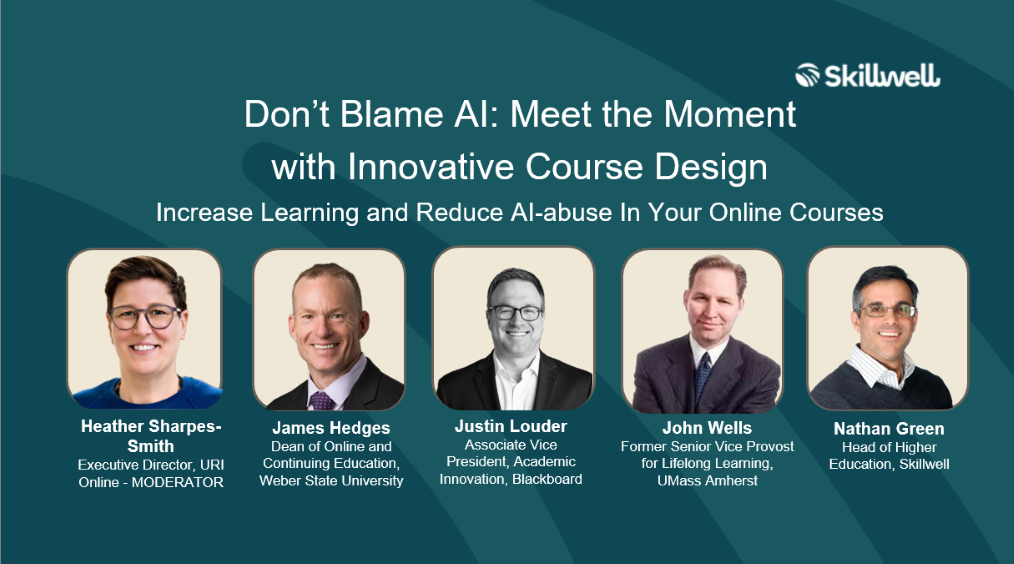
Join our webinar panel discussion to learn how to use formative and immersive elements to increase learning and reduce ...
Discover how Skillwell helps companies like Merck and AstraZeneca build critical compliance and ...
Here is the uncomfortable truth about AI in learning today: ...
Join our webinar panel discussion to learn how to use formative and immersive elements to increase learning and reduce ...