

Build Life Science Skills: Immersive & ...
Events
Discover how Skillwell helps companies like Merck and AstraZeneca build critical compliance and ...
Higher education has a persistent problem: graduates who know the theory but struggle when the real situation arrives.
Lecture-based instruction builds knowledge. What it often doesn't build is the judgment, confidence, and practical skill that come from actually doing something — navigating a difficult scenario, making a decision under pressure, seeing what follows.
Immersive learning in higher ed exists to close that gap. Let's look at what it is, why it works, how it's being applied across institutions, and what stands in the way of broader adoption.
Immersive education is an approach that places students inside realistic, interactive environments rather than in front of passive content.
The goal isn't just deeper engagement — it's experience that transfers to the situations students will actually face after graduation.
Three principles define how it works:
Students aren't passive recipients of information — they're navigating scenarios, making decisions, and building understanding through the act of doing. A VR-based engineering simulation where students design and test prototypes.
A business case study where choices branch into different consequences. A medical simulation where a clinical decision affects the patient outcome. In each case, the learner is the agent, not the audience.
Research backs this up: a study of VR-based learning with engineering students found notable improvements in test scores compared to traditional instruction.
A systematic review of presence in virtual reality environments found that immersive interfaces consistently enhance learning outcomes through deeper engagement and motivation.
Scenarios that mirror real job situations create stronger skill transfer than abstract instruction.
The closer the training environment matches where the skill will actually be used, the more reliably it carries over. This is why well-designed immersive experiences outperform generic ones — relevance isn't incidental to the method, it's central to it.
When AI-powered adaptive learning is layered in, the real-world context becomes personalized, too.
Content and difficulty adjust based on each student's actual performance — so learners aren't sitting through material they've already mastered or moving past concepts they haven't truly absorbed.
Many of the most valuable immersive experiences are social. Group-based simulation activities that require teams to navigate shared challenges build interpersonal skills alongside the specific competencies being trained.
For disciplines where collaboration is core — healthcare, business, law — this isn't a nice-to-have, it's part of what needs to be developed.
The best way to think about immersive learning in higher ed isn't as a replacement for traditional instruction — it's as what fills the gap that traditional instruction leaves. Lectures and readings build foundational knowledge. Immersive experiences build the capacity to apply it.
Let's look at how the integration plays out in practice.
When learning is interactive and connects directly to future job contexts, students participate differently.
A study on immersive VR field trips in social studies classrooms found that the experiences positively impacted both academic achievement and student engagement (Springer, 2025). Active involvement in a scenario creates a fundamentally different relationship to the material than receiving it passively.
Immersive experiences create stronger memory encoding than lecture-based instruction. Students remember what they did and decided, not just what they were told.
Studies show adaptive learning combined with immersive simulation produces a 27% average skill improvement — and that improvement shows up in performance, not just assessment scores.
No two students come in with the same knowledge gaps or learning pace. Immersive platforms that incorporate personalized learning pathways adapt to where each individual actually is rather than routing everyone through the same experience at the same speed.
AI-powered adaptive systems make this scalable — continuous real-time assessment and content adjustment happen automatically, without requiring one-on-one instructor attention for every learner.
Beyond engagement and learning quality, verified skills data captured during immersive experiences gives institutions something traditional assessment rarely provides: evidence of what students can actually do.
That shift from completion tracking to demonstrated competence is what connects higher education outcomes to workforce readiness in a meaningful way.
One of the practical advantages of immersive learning that doesn't get discussed enough is what it reveals about students. Performance data captured during simulations gives educators a far richer picture of where each learner is struggling than formative quizzes or observation alone.
Combine that with AI-driven adaptive systems that continuously adjust based on performance, and institutions gain a genuinely responsive tool for meeting diverse learning needs.
Rather than identifying gaps at the end of a semester — when there's little time to address them — educators can see where individual students are in real time and adjust accordingly.
Immersive formats also address the range of learning styles within a classroom more naturally than uniform instruction:
Interactive simulations and graphic-rich environments engage students who learn best by seeing — and by seeing things in context, not just in diagrams.
Hands-on simulation activities give tactile learners the active engagement they need. For students who struggle to absorb information through listening or reading, doing something — even in a simulated environment — is a fundamentally more effective encoding mechanism.
Collaborative immersive projects create the interpersonal learning context that social learners thrive in. Group-based scenario navigation builds communication and teamwork skills alongside disciplinary competencies — outcomes that show up in student performance and in how graduates function in teams after they leave.
Higher education institutions across disciplines have implemented immersive learning programs and documented their outcomes. A few worth noting:
USC's medical training program incorporated VR to give students hands-on simulation of clinical scenarios before working with actual patients.
The result was higher competency rates among students — a meaningful outcome in a field where unpreparedness carries real risk. The program has since become a model for how simulation-based training can complement clinical rotations rather than replace them.
Georgia State implemented branching simulations in business courses, giving students the chance to navigate realistic workplace scenarios with real decision consequences.
The program produced a 30% increase in student engagement and measurably stronger understanding of complex business concepts. Students reported that working through scenario outcomes made the material significantly more relevant to the careers they were preparing for.
Harvard's law school integrated interactive case studies that moved beyond reading and discussion into scenario-based application.
Student retention of legal principles improved, and the program's use of structured feedback gave faculty clearer insight into where individual students were struggling — enabling more targeted support.
What these programs share isn't the technology — it's the design philosophy. Students are placed in situations that require applying knowledge under realistic conditions, their performance generates useful data, and that data informs what comes next.
That's the loop that makes immersive learning and development genuinely effective rather than just engaging.
None of this happens without friction. Institutions considering immersive learning should go in clear-eyed about the challenges — not because they're insurmountable, but because anticipating them makes implementation significantly smoother.
High-fidelity VR experiences carry real upfront costs. That said, the barrier has dropped substantially.
AI-powered authoring tools now allow educators to build branching simulations in minutes rather than months — without requiring technical expertise or significant production budgets.
The ROI case also gets easier to make when student outcomes and workforce readiness are factored in alongside training costs.
Ensuring consistent student access to the tools required for immersive learning is a genuine challenge, particularly for institutions with diverse student populations and varying levels of device access.
Simulation platforms that run on standard web browsers or mobile devices address this more effectively than hardware-dependent formats. The practical question isn't 'do we use immersive learning?' — it's 'which format best fits our students and infrastructure?'
Faculty who have built their courses around conventional instruction sometimes approach immersive formats with skepticism — understandably so, given that adopting new methodologies requires real time and effort.
Pilot programs that start small, demonstrate clear outcomes, and involve faculty in the design process tend to build more durable adoption than institution-wide mandates. Seeing the approach work in a limited context is usually more persuasive than any external case study.
For institutions that work through these challenges, the upside is considerable. Graduates who've practiced their field through realistic simulation arrive in the workforce more confident, more capable, and better prepared for the gap between classroom and career. And institutions gain a richer picture of student competency — one that speaks to employers and accreditors alike. For a broader look at how these challenges show up in organizational L&D strategy, the patterns are similar regardless of whether the context is academic or corporate.
Whether you're building a new simulation-based program or looking to enhance what's already in place, Skillwell combines AI-powered adaptive learning with immersive simulation to create experiences that build real capability — in higher education and beyond.
Discover what Skillwell can do for your institution.
Immersive learning in higher education places students inside realistic, interactive scenarios rather than passive content — building the applied skills that traditional instruction often leaves underdeveloped.
It uses tools like VR, branching simulations, and AI-powered adaptive platforms to create environments that mirror real job situations.
Students make decisions, experience consequences, and receive immediate feedback — building judgment and confidence alongside disciplinary knowledge.
AI-powered adaptive systems personalize the experience to each student's actual performance level, not a one-size assumption about where they are.
Verified skills data captured during immersive experiences gives institutions evidence of student competency beyond completion rates or standardized test scores.
Research shows immersive VR environments produce measurably higher test scores and comprehension compared to traditional instruction across disciplines.
Studies on immersive simulation in higher ed report a 27% average skill improvement — outcomes that show up in performance, not just assessment.
Retention is significantly higher because students encode experience, not just information — what they did and decided stays with them longer than what they were told.
Students who practice in realistic scenarios arrive at real professional situations more confident and better prepared for the gap between classroom and career.
Immersive programs at institutions like Georgia State have produced 30% increases in student engagement and stronger grasp of complex subject matter.
High-fidelity VR carries real upfront costs, though AI-powered authoring tools have lowered the barrier to building simulation-based experiences substantially.
Ensuring equitable student access to required technology is a genuine design consideration, particularly for web- or mobile-dependent formats.
Faculty adoption is easier through pilot programs that demonstrate outcomes in context than through institution-wide mandates.
Curriculum alignment requires that immersive activities be tightly mapped to specific learning objectives — poorly designed scenarios deliver engagement without learning.
Technology integration with existing LMS infrastructure needs to be confirmed early — immersive platforms should enhance what's in place, not require rebuilding it.
Students who've practiced their field through realistic simulation arrive in the workforce more confident and capable than those who've only encountered it in theory.
Verified skills data generated during immersive experiences gives employers and accreditors evidence of graduate competency, not just credentials.
The 275% confidence advantage that immersively trained learners demonstrate over traditionally trained peers shows up directly in early career performance.
Disciplines with high stakes for unpreparedness — healthcare, law, engineering, business — have the clearest case for immersive simulation as a graduation readiness tool.
Institutions that connect student performance data to workforce outcomes build a stronger case for program value to both students and institutional stakeholders.
Discover how Skillwell helps companies like Merck and AstraZeneca build critical compliance and ...

Here is the uncomfortable truth about AI in learning today: ...
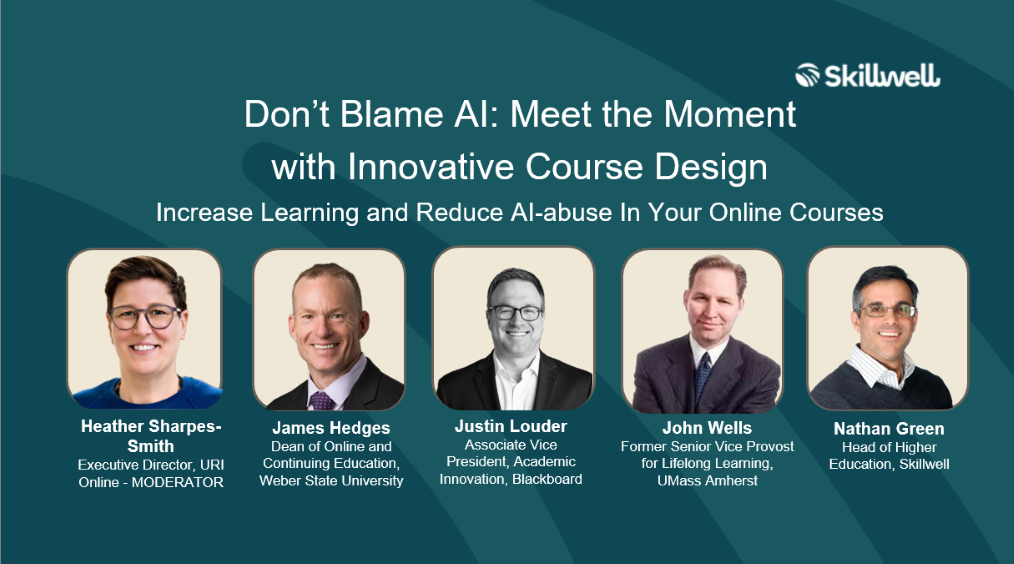
Join our webinar panel discussion to learn how to use formative and immersive elements to increase learning and reduce ...
Discover how Skillwell helps companies like Merck and AstraZeneca build critical compliance and ...
Here is the uncomfortable truth about AI in learning today: ...
Join our webinar panel discussion to learn how to use formative and immersive elements to increase learning and reduce ...