

Build Life Science Skills: Immersive & ...
Events
Discover how Skillwell helps companies like Merck and AstraZeneca build critical compliance and ...

Adopting immersive learning tools isn't just a technology decision — it's a teaching practice decision.
An instructor who doesn't feel confident with the tools, or isn't sure how to integrate them into a lesson meaningfully, is unlikely to use them well.
Getting instructor training right is what separates a pilot program that sticks from one that quietly gets abandoned after a semester. Let's look at what effective immersive learning in higher education looks like.
Immersive learning in education is a teaching approach that places students inside realistic, interactive scenarios — rather than in front of passive content — using technologies like VR, AR, and simulation to create environments that mirror real-world challenges.
The value isn't the technology itself. It's what the technology enables: active participation, decision-making under realistic conditions, and immediate feedback that connects to what a student just did.
When those elements are designed well, learning outcomes improve significantly. When they're not, a VR headset is just an expensive distraction.
Let's look at a few formats that instructors work with most commonly:
Students explore historical sites, scientific environments, or workplace scenarios without leaving the classroom.
For subjects where context and scale matter — geography, history, clinical medicine — the ability to place a learner inside the environment rather than describing it changes how they engage with the material.
Adaptive learning in higher education programs that incorporate VR consistently show stronger comprehension and retention than lecture-only approaches.
Instructors build scenarios where students navigate ethical dilemmas, business decisions, or professional conversations.
The branching structure — where choices lead to different outcomes — creates genuine decision-making practice rather than a quiz with a correct answer at the end.
Tools like Skillwell Simulate allow educators to build these scenarios in minutes without technical expertise, putting authoring capability in the hands of the subject matter expert.
Science and engineering programs use virtual labs to conduct experiments that would be too dangerous, too costly, or simply impractical to run in a physical setting.
Students get the hands-on engagement that builds real understanding — without the logistical or safety constraints of traditional lab environments.
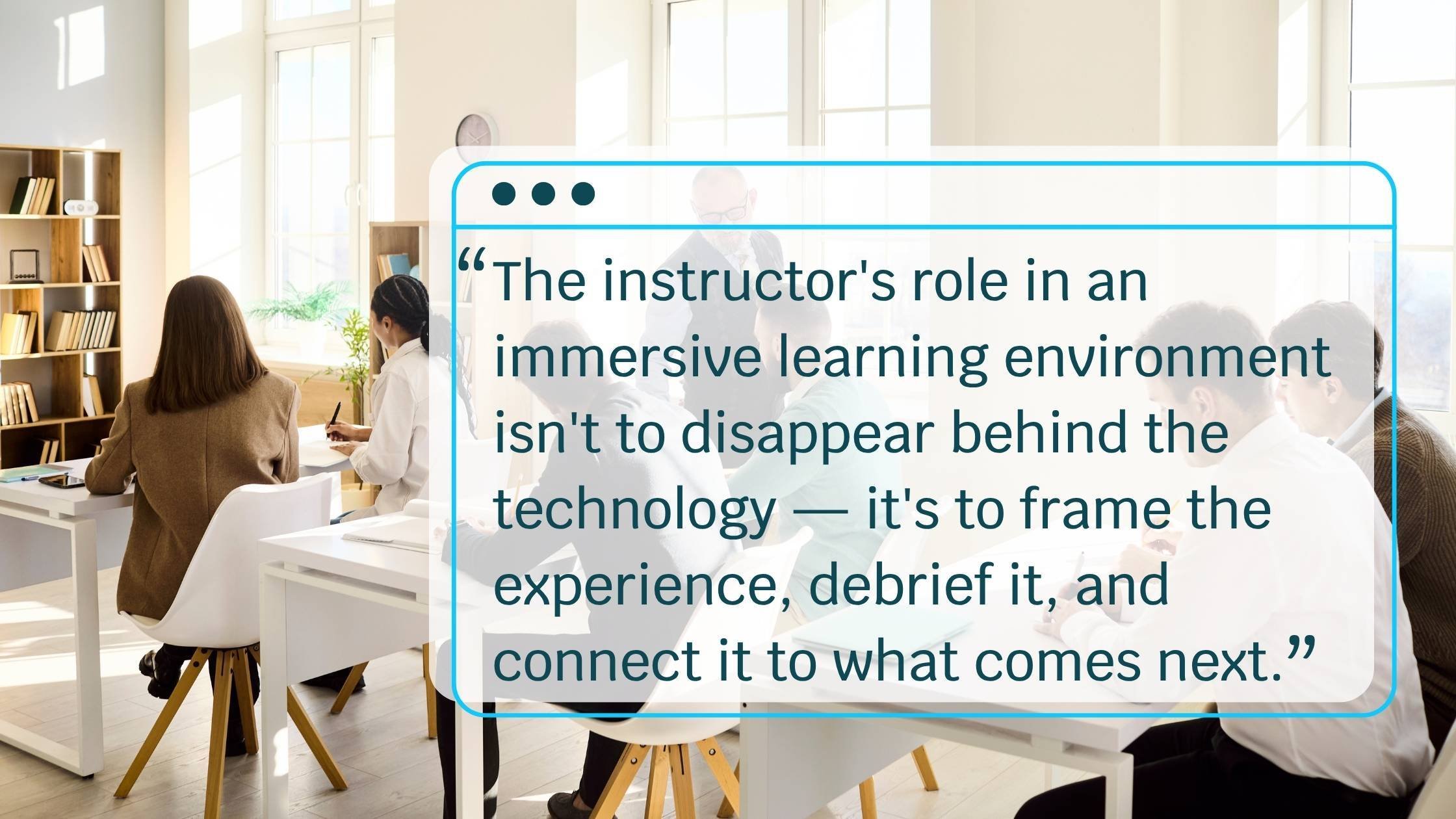
The instructor's role in an immersive learning environment isn't to disappear behind the technology — it's to frame the experience, debrief it, and connect it to what comes next. A few approaches that make a meaningful difference:
Immersive experiences land harder when they're embedded in a story or context that matters to the learner.
An ethical dilemma scenario that mirrors a real industry challenge hits differently than a generic decision tree. Instructors who invest time in making scenarios feel authentic — with real stakes and recognizable situations — see stronger engagement and retention.
Real-time feedback is one of immersive learning's strongest advantages — but only if instructors use it.
Verified skills data captured during simulations tells instructors exactly where each student made a different choice, where they struggled, and what they've demonstrated mastery of. That data should inform what the instructor does next — which concepts to revisit, which students need targeted support, which pathways worked.
The performance data from immersive experiences enables a kind of responsiveness that traditional assessment doesn't. Instructors who check in on student performance data during a course — rather than only at end-of-term — can adjust pacing, add targeted practice, and personalize instruction in ways that fixed course schedules don't normally allow.
This is where AI-powered adaptive learning makes a real difference — it handles continuous adjustment automatically, so instructors can focus on the teaching rather than the logistics.
Simulations are the most versatile immersive format — and the one where instructor design decisions matter most. The quality of the scenario determines the quality of the learning. Let's look at how different simulation types are used, and what makes each one work.
Students manage virtual organizations, make resource allocation decisions, respond to market changes, and see the downstream consequences of their choices.
These work well in MBA programs, undergraduate business courses, and corporate leadership development training — anywhere that judgment and strategic thinking are what's being built.
Future healthcare professionals practice procedures, patient conversations, and clinical decisions in a safe environment.
In healthcare training, the ability to make a mistake in a simulation — and understand why — is what prepares practitioners for the real thing. The audit-ready competence records generated during these simulations also matter for accreditation and regulatory documentation.
Students and employees navigate emergencies, ethical dilemmas, and high-pressure decision moments.
Compliance and risk training delivered through simulation is significantly more effective than policy acknowledgment — because learners have to actually apply the policy under realistic pressure, not just confirm they read it.
Across all simulation types, three instructor practices make the biggest difference: aligning the scenario tightly to a specific learning objective, running a structured debrief after the experience to consolidate what happened, and using performance data to shape what comes next.
The most effective instructor training for immersive tools shares something with good immersive learning itself: it's hands-on, not just instructional.
Instructors who go through a simulated teaching experience — rather than just reading documentation about it — develop the confidence and practical intuition that carries into the classroom.
Structured sessions that focus on specific tools — not general technology adoption — give instructors the practical fluency they need.
The goal is for instructors to arrive at their first immersive lesson having already built something, already navigated the feedback interface, and already made mistakes in a safe context.
Technology evolves. Instructors who receive training once and are left to figure out changes on their own tend to disengage.
Institutions that build ongoing development into their support structure — regular updates, peer learning communities, access to new scenario templates — see stronger sustained adoption.
For broader context on building this kind of continuous development culture, learning and development strategy frameworks that emphasize ongoing learning rather than one-time certification are directly applicable here.
Instructors learn from each other. Formal or informal structures that let faculty share what worked, what didn't, and how they adapted particular scenarios to their course context accelerate adoption across a department or institution more effectively than top-down mandates.
Yes — and the quality of that partnership matters considerably to adoption outcomes. Immersive learning providers that work closely with institutions to understand specific curriculum goals, faculty skill levels, and student populations are significantly more useful than those offering generic onboarding documentation.
The most effective collaborations between institutions and immersive learning providers involve joint curriculum design — not just platform licensing.
Providers who help faculty build their first scenarios, run training sessions alongside institutional staff, and offer ongoing support as programs scale tend to see much stronger faculty buy-in.
Institutions evaluating provider-offered training programs should look beyond instructor satisfaction scores.
The real metrics are downstream: student engagement, demonstrated skill improvement, and whether faculty continue using the tools after the initial training period.
Providers who can show their platform delivers 40% faster upskilling and 27% average skill improvement — and connect that to how instructors are using the tools — are making a meaningful case for the training investment.
For a look at what's shaping the broader future of these technologies in education, emerging technologies in learning and development is worth exploring — the trajectory matters for any institution making multi-year decisions about immersive tool adoption.
Skillwell combines AI-powered adaptive learning with immersive simulation to create training experiences that are practical to build, easy to deploy, and designed to generate the skills data that makes development measurable.
If you want to see what instructor-friendly immersive learning looks like in practice, take a tour of the Skillwell platform.
Hands-on workshops focused on specific tools — not general technology adoption — give instructors the practical fluency that translates to classroom confidence.
Instructors should build and navigate a scenario themselves before using one with students — experience with the format matters more than documentation.
Peer collaboration structures that let faculty share what worked and what didn't accelerate adoption more effectively than top-down mandates.
Ongoing professional development — not one-time training — is what sustains adoption as tools and curricula evolve.
Partnerships with immersive learning providers that include joint curriculum design and ongoing support produce stronger faculty buy-in than platform licensing alone.
Scenarios aligned tightly to specific learning objectives outperform generic simulations regardless of production quality.
The branching structure — where learner choices lead to different outcomes — creates genuine decision-making practice rather than a quiz with a fixed answer.
Structured debriefs after simulations consolidate what happened and connect the experience to the broader learning objective.
Performance data captured during simulations tells instructors exactly where each student struggled and what they demonstrated mastery of.
Well-designed simulations build judgment and confidence, not just knowledge — which is what actually transfers to real professional performance.
Instructors who haven't experienced immersive learning themselves often underestimate how different it feels from conventional instruction — hands-on training closes that gap.
Scenario design takes more thought than selecting a textbook — instructors need support mapping learning objectives to specific simulation choices.
Technical issues with hardware or platform access can derail early experiences and erode confidence in the format.
Without ongoing support, instructors who encounter problems are likely to revert to familiar methods rather than troubleshoot.
The data generated by immersive platforms is only useful if instructors know how to read it and act on it — data literacy training is part of effective adoption.
Leading providers offer joint curriculum design support — not just platform access — to help faculty build their first effective scenarios.
Provider-led training sessions that run alongside institutional staff tend to produce stronger faculty engagement than self-directed onboarding.
Ongoing provider support as programs scale is what distinguishes a sustainable adoption from a pilot that fades.
Platforms that make scenario authoring fast and intuitive — branching simulations in minutes, not months — reduce the barrier for instructors who aren't technically inclined.
The best immersive learning companies can demonstrate downstream outcomes — skill improvement, engagement rates, time to competency — not just instructor satisfaction scores.
Discover how Skillwell helps companies like Merck and AstraZeneca build critical compliance and ...

Here is the uncomfortable truth about AI in learning today: ...
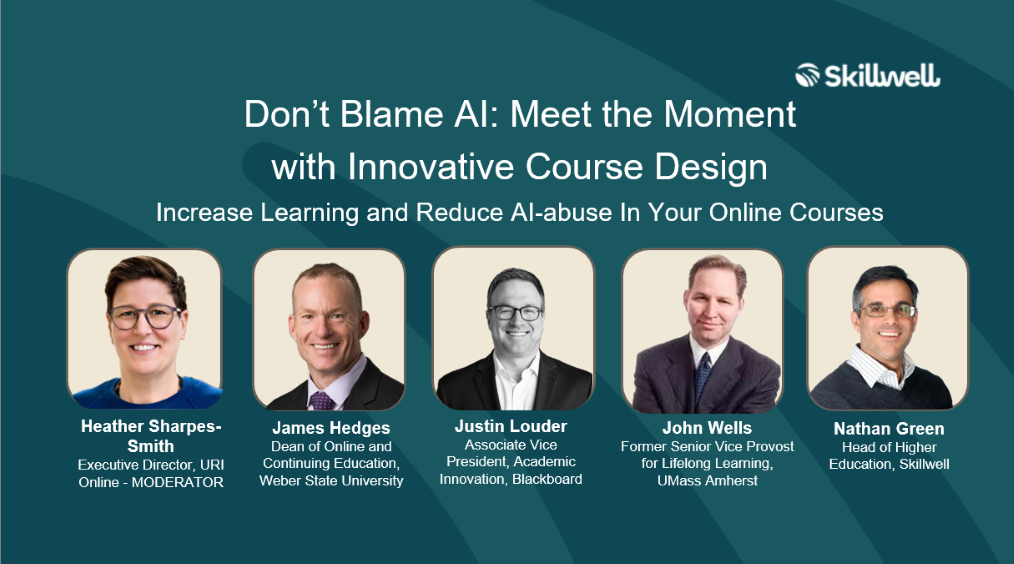
Join our webinar panel discussion to learn how to use formative and immersive elements to increase learning and reduce ...
Discover how Skillwell helps companies like Merck and AstraZeneca build critical compliance and ...
Here is the uncomfortable truth about AI in learning today: ...
Join our webinar panel discussion to learn how to use formative and immersive elements to increase learning and reduce ...