

Build Life Science Skills: Immersive & ...
Events
Discover how Skillwell helps companies like Merck and AstraZeneca build critical compliance and ...

The platform you choose shapes everything downstream — what experiences are possible, how quickly your team can build them, and whether the data generated is actually useful.
With more options than ever on the market, the practical question isn't which platform sounds most impressive.
It's which one fits your learning objectives, your authors' skill levels, and your measurement needs. Let's look at what's available in immersive learning and how to think about the tradeoffs.
Immersive learning platforms create environments where learners build skills through active practice — navigating realistic scenarios, making decisions, and receiving immediate feedback — rather than passively consuming information.
The format varies considerably depending on the platform and use case.
VR platforms like Oculus and HTC Vive create fully immersive 3D environments where learners interact with content in simulated physical space.
The immersion level is high, which creates strong emotional and cognitive engagement — particularly valuable for high-stakes procedural training where the emotional reality of a situation matters.
AR tools like Google AR and Microsoft HoloLens overlay digital content onto the real world, enabling learning in actual work contexts rather than separate simulated ones.
The key advantage of AR over VR is context — learners access guidance exactly where and when they need it, without stepping away from the actual task.
Simulation platforms — particularly those that support branching scenarios where learner choices shape the path — are the most widely deployed format in corporate training and higher education.
Skillwell Simulate is built specifically for this use case: subject matter experts can create branching simulations in minutes without technical expertise, and the platform integrates with existing LMS infrastructure rather than requiring a separate system. Captured verified skills data shows what learners can demonstrate, not just what they've completed.
For online and hybrid learning contexts, a few platforms stand out for how well they create active engagement rather than passive consumption.
For organizations building scenario-based training that develops real workplace skills, Skillwell Simulate is purpose-designed for rapid authoring and meaningful measurement. Branching simulations can be created in minutes by subject matter experts with no development background.
The platform captures verified skills data — evidence of demonstrated competence that goes beyond completion records — and integrates with existing LMS systems without requiring infrastructure replacement.
A comprehensive suite for creating interactive eLearning content, including branching quizzes and scenario-based simulations.
Articulate has wide adoption in corporate L&D and is well-supported with authoring tools like Storyline and Rise. It's a strong choice for organizations that want polished eLearning with scenario elements, though it requires more production investment than purpose-built simulation platforms.
An interactive platform that integrates VR field trips and 3D objects into lessons alongside formative assessments and real-time feedback.
Nearpod is particularly well-suited for academic settings where instructors want to add immersive moments to existing lesson structures rather than building full simulation programs from scratch.
An open-source LMS that supports a wide range of immersive learning activities — forums, quizzes, simulations — through plugins and integrations.
Moodle's strength is flexibility and low licensing cost. Its limitation is that building genuinely immersive experiences typically requires integrating third-party tools rather than native capabilities.
|
Platform |
Best for |
Authoring complexity |
LMS integration |
Skills data capture |
|---|---|---|---|---|
|
Skillwell Simulate |
Branching simulation, workplace scenarios, rapid authoring |
Low — built for SMEs, no dev skills needed |
Yes — standard LMS integration |
Yes — verified skills data captured per learner |
|
Skillwell Adapt |
Personalized soft skills development at scale |
Low — AI-driven pathway creation |
Yes |
Yes — adaptive performance data throughout |
|
Articulate 360 |
Polished interactive eLearning with scenario elements |
Medium — requires dedicated L&D authoring time |
Yes — SCORM/xAPI |
Limited — completion and quiz scores |
|
Nearpod |
Adding immersive moments to existing classroom lessons |
Low — instructor-friendly |
Partial |
Limited — engagement and formative data |
|
Moodle |
Flexible open-source LMS with immersive plugin support |
Medium — requires plugin configuration |
Native LMS |
Limited — depends on plugins used |
|
Unity |
Custom high-fidelity VR/3D educational applications |
High — requires software developers |
Requires custom build |
Requires custom build |
|
H5P |
Adding interactive content to existing LMS courses |
Low — open source, embeddable |
Yes — embeds in most LMS |
Limited — basic interaction tracking |
Across all of these, the practical differentiator is authoring speed and measurement quality. A platform that requires technical expertise to build content will see lower adoption regardless of its capabilities.
And a platform that only tracks completion — not what learners demonstrated — leaves L&D teams without the evidence they need to connect training investment to business outcomes. For a broader view of how learning and development strategy connects to platform selection, what you're trying to measure should drive the tool you choose.
Soft skills — communication, leadership, conflict resolution, customer empathy — are where the gap between knowing and doing is widest.
The platform question for soft skills development is whether the experience creates enough psychological realism for genuine practice to happen.
For organizations that need soft skills training at scale, Skillwell Adapt uses AI-powered adaptive learning to tailor the experience to individual performance data.
Learners practice interpersonal scenarios — difficult conversations, leadership moments, customer interactions — in branching environments where their choices shape the outcome.
Personalized learning pathways continuously adjust based on how each person is actually performing, so the experience gets more targeted over time rather than repeating the same scenarios regardless of progress.
Known primarily for VR training solutions, Viveport offers simulation environments designed for soft skills development including communication and teamwork.
The VR format creates high emotional engagement — particularly useful for scenarios where the interpersonal stakes need to feel real — though it requires hardware investment that limits deployment at scale.
Kognito specializes in role-playing simulations for interpersonal skills in educational and healthcare contexts. Its virtual human interactions are designed for scenarios where empathy and communication are the primary skill being developed — effective for contexts like mental health conversations, patient communication, and difficult feedback situations.
When evaluating soft skills platforms, look closely at two things: how realistic the interaction actually feels, and how specifically the feedback addresses the quality of decisions made.
Platforms that treat all completions as equivalent — without measuring the depth or quality of learner responses — miss the point of soft skills training.
The right authoring tool depends on who's building content and what they're trying to create. Let's look at the main options.
The fastest path from learning objective to deployed simulation. Subject matter experts build branching scenarios without technical expertise, and the platform handles everything from scenario logic to skills data capture.
For organizations that need to create and update training quickly — and prove that it's working — Skillwell Simulate is built for that use case specifically.
A robust tool for creating interactive eLearning content with simulation and quiz capabilities, integrating well with most LMS platforms.
Captivate offers more production flexibility than purpose-built simulation tools, but requires more authoring skill and time investment. It's a strong choice for L&D teams with dedicated content developers rather than subject matter experts building their own scenarios.
A powerful game engine used to build custom immersive educational applications, particularly in VR.
Unity offers the highest ceiling for visual fidelity and interaction complexity, but requires genuine software development expertise. It's appropriate for institutions with technical development resources, not instructors or L&D practitioners authoring their own content.
An open-source tool for creating interactive content — quizzes, branching scenarios, interactive video — that can be embedded in LMS platforms including Moodle and Canvas.
H5P is accessible, free, and well-suited for educators who want to add interactivity to existing course content without significant authoring investment. Its simulation capabilities are more limited than purpose-built platforms, but it's a useful entry point.
The pattern across all of these: higher production capability typically means higher authoring complexity.
Organizations that want subject matter experts — rather than dedicated developers — to build and update content will get the strongest adoption from platforms designed for fast, accessible authoring.
How immersive learning fits into your broader adaptive learning platform strategy should drive that decision.
Skillwell combines AI-powered adaptive learning with immersive simulation in a platform built for rapid authoring, meaningful measurement, and seamless LMS integration.
If you want to see what it looks like for your specific training use cases, explore the Skillwell platform with a guided tour.
Skillwell Simulate is built for fast branching simulation creation by subject matter experts, with verified skills data capture and LMS integration.
Articulate 360 is widely used in corporate L&D for creating polished interactive eLearning with scenario and quiz capabilities.
Nearpod integrates VR content and formative assessments into classroom lessons, well-suited for academic settings.
VR platforms like Oculus and HTC Vive create high-immersion environments for procedural and contextual training that benefits from physical presence in the scenario.
Moodle supports a wide range of immersive activities through plugins and integrations, with the flexibility of open-source infrastructure.
Skillwell Adapt uses AI-powered adaptive learning to personalize soft skills practice to each individual's actual performance data.
Kognito specializes in empathy-driven interpersonal simulations for healthcare and education contexts where emotional realism matters most.
Viveport's VR format creates high emotional engagement for communication and teamwork scenarios where the stakes need to feel real.
The most important evaluation criteria is feedback specificity — platforms that distinguish between the quality of decisions made outperform those that treat all completions as equivalent.
Scale matters too: platforms requiring VR hardware limit deployment in ways that web-based simulation platforms don't.
Authoring speed — tools that let subject matter experts build scenarios without technical expertise see significantly higher adoption and content currency.
Measurement capability — the tool should capture verified skills data showing demonstrated competence, not just completion.
LMS integration — content should flow into existing infrastructure rather than requiring a separate system for tracking.
Scenario update flexibility — training needs evolve; tools that make updating scenarios quick preserve the relevance of your program over time.
The production capability ceiling matters less than authoring accessibility for most L&D teams — the best tool is the one your authors will actually use.
Immersive platforms like Skillwell integrate with LMS systems via standard protocols — the LMS handles administration and completion tracking, Skillwell creates the experience.
SCORM and xAPI standards allow most simulation platforms to pass data back to the LMS, keeping records in a single system of record.
Integration protects existing LMS investment rather than requiring replacement — immersive capability is added, not substituted.
Verified skills data generated in immersive platforms can flow back to the LMS, giving administrators a complete picture of learner progress in one place.
Organizations should confirm integration compatibility with their specific LMS before committing to a platform — this is a standard evaluation step, not an afterthought.
Discover how Skillwell helps companies like Merck and AstraZeneca build critical compliance and ...

Here is the uncomfortable truth about AI in learning today: ...
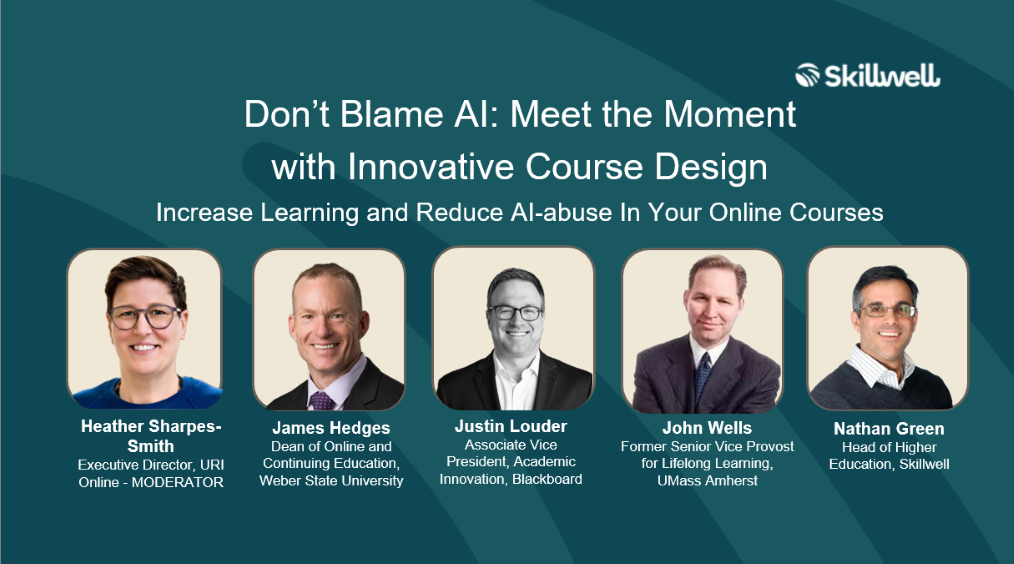
Join our webinar panel discussion to learn how to use formative and immersive elements to increase learning and reduce ...
Discover how Skillwell helps companies like Merck and AstraZeneca build critical compliance and ...
Here is the uncomfortable truth about AI in learning today: ...
Join our webinar panel discussion to learn how to use formative and immersive elements to increase learning and reduce ...