

Build Life Science Skills: Immersive & ...
Events
Discover how Skillwell helps companies like Merck and AstraZeneca build critical compliance and ...

One of the strongest advantages of immersive learning over traditional instruction is also one of its least discussed: the quality of data it generates.
When students are actively navigating scenarios — making decisions, responding to situations, choosing paths — every interaction produces signal. That’s the goal of immersive learning in higher education.
The question for instructors isn't whether to assess; it's how to make sense of what the environment is already capturing. Let's look closer at what that looks like in practice.
Immersive learning environments make it possible to measure dimensions of student performance that traditional assessments miss entirely. Here are the metrics that matter most:
A baseline metric — useful for identifying access or motivation issues — but not sufficient on its own. A student who completes every scenario isn't necessarily learning. Completion rate is a floor, not a ceiling, for what immersive learning assessment can tell you.
Time-on-task, frequency of interaction, and whether students are actively navigating or passively clicking through all reveal something about how deeply learners are engaging with the material.
High time-on-task combined with strong performance suggests a learner who is working through the challenge seriously. High time-on-task with poor performance suggests someone who is struggling, not breezing through.
How students perform on scenario-embedded assessments — not just end-of-course quizzes — tells instructors whether learners are building the competencies the scenario was designed to develop.
Verified skills data captures this in a form that goes beyond completion records: evidence of demonstrated capability in a realistic context.
This is where immersive assessment becomes genuinely powerful.
Which decision points caused the most students to pause or make unexpected choices? Where did learners consistently diverge from the intended path? What patterns show up across a cohort that suggest a concept hasn't landed?
A study from the University of Michigan found that students receiving AI-driven formative assessments demonstrated 25% better retention rates than those in traditional learning environments. Behavioral data is what enables that kind of responsive instruction.
The best assessment strategies in immersive environments combine what the platform captures automatically with deliberate instructor-designed checkpoints. Let's dig into a few approaches that work well together.

Rather than tacking a quiz onto the end of a simulation, effective immersive learning integrates assessment moments throughout — branching decision points that reveal understanding, short reflection prompts between scenario sections, or performance checkpoints that adjust what content a learner sees next.
The feedback is immediate, the assessment feels like part of the experience rather than separate from it, and the data reflects how a student thinks under realistic conditions.
This is where AI-powered adaptive learning makes a real difference.
Rather than every student encountering the same assessment regardless of their performance, adaptive systems route learners to the content and challenges that match where they actually are. The assessment becomes a mechanism for personalized instruction, not just measurement.
Group-based simulation activities that require students to evaluate each other's decisions and reasoning develop critical thinking alongside the specific competencies being trained.
Peer assessment also gives instructors insight into how students conceptualize the material — what they consider a good decision, and why — that performance scores alone don't reveal.
Asking students to document their experience after a simulation — what they chose, what happened, what they'd do differently — promotes the kind of metacognitive reflection that deepens learning. Journals also give instructors qualitative insight into how students are making sense of the experience, which complements the quantitative data the platform generates.
Points, progression markers, and challenge-based assessments built into the immersive experience increase motivation and create a clear sense of where a learner stands relative to their development goals.
When these elements are connected to personalized learning pathways rather than arbitrary scoring, they reinforce the skill development that the simulation is designed to build.
Most modern immersive learning platforms do — and this is one of the format's most practically valuable features. Here's what real-time adaptive assessment actually enables:
Learners see the consequence of their choices as they make them. That immediate connection between action and outcome is what creates the memory encoding that traditional assessment — where feedback arrives days after the fact — simply can't match.
When a learner consistently struggles with a particular type of decision or concept, an adaptive platform routes them to additional practice in that area rather than moving them forward on a fixed schedule.
Conversely, learners who demonstrate mastery quickly don't have to sit through material they've already absorbed. The result is 40% faster upskilling and a 27% average skill improvement compared to static training formats.
Instructors don't have to wait for end-of-term grades to understand how their students are doing. Performance data updates continuously, giving instructors the ability to identify who's struggling early, intervene before a gap becomes entrenched, and adjust pacing for the cohort as a whole.
For learning and development strategy at an institutional level, this kind of real-time visibility into learning progress changes what's possible in program design.
This is where the practical value of immersive assessment really lands. Let's look at what instructors can actually learn from the data these environments generate.
Performance data from simulations tells instructors not just whether a student completed the course, but which specific competencies they've demonstrated and which need further work.
That granularity is what makes verified skills data genuinely useful for instructional planning — and for communicating to employers or accreditors what graduates can actually do.
Every student comes in with a different knowledge baseline and moves through material at a different pace. Immersive assessment data reveals the shape of each learner's development — where they accelerated, where they stalled, which formats or scenario types worked for them.
That profile enables personalized learning pathways that adapt to individuals rather than averaging across a cohort.
When engagement drops at a specific point in a course — a particular scenario, a concept, a module — that's a signal about the instructional design, not just the students.
Cohort-level analytics let instructors identify where the curriculum itself might need revision, making immersive learning data a tool for program improvement, not just individual assessment.
The audit-ready documentation generated by platforms like Skillwell also addresses compliance and accreditation requirements directly — providing evidence of competence that satisfies external stakeholders in regulated industries and academic settings alike.
Skillwell combines AI-powered adaptive learning with immersive simulation to give instructors real-time visibility into how their students are learning — and the tools to act on it. If you want to see what that looks like for your program, take a tour of the Skillwell platform.
Behavioral analytics capture how students make decisions at each scenario branch — revealing where understanding breaks down in context, not just on a test.
Performance scores on scenario-embedded assessments reflect demonstrated competence under realistic conditions, not just knowledge recall.
Formative checkpoints built into the simulation provide continuous assessment rather than a single end-of-course measurement.
Peer assessment in group-based simulations gives instructors insight into how students conceptualize the material and evaluate each other's reasoning.
Reflective journals after simulation experiences provide qualitative context that complements the quantitative data the platform generates.
Completion rates provide a baseline for identifying access or motivation issues, though they're not sufficient measures of learning on their own.
Engagement levels — time-on-task, interaction frequency — reveal how deeply learners are working through material rather than passing through it.
Performance scores on embedded assessments measure whether specific competencies are being developed, not just whether content was viewed.
Behavioral analytics show patterns across decision points — which concepts cause the most difficulty, where learners diverge from expected paths.
Students receiving AI-driven formative assessments demonstrate 25% better retention rates than those in traditional learning environments (ASEE, 2025).
Most modern immersive learning platforms provide immediate feedback on decisions as learners make them — connecting action to consequence in real time.
Adaptive pathways adjust automatically based on performance — routing struggling learners to additional practice rather than moving them forward on a fixed schedule.
Instructor dashboards update continuously so educators can identify who's struggling early and intervene before gaps become entrenched.
Real-time adaptive assessment is what enables the 40% faster upskilling and 27% skill improvement that immersive learning programs consistently report.
Audit-ready competence records generated during simulations satisfy compliance and accreditation requirements without additional administrative work.
Which specific competencies each student has demonstrated mastery of — and which need further development — at a granular level traditional grading doesn't provide.
Where individual learners stalled or accelerated, enabling truly personalized instruction rather than averaged-across-cohort pacing.
Cohort-level engagement trends that reveal where the instructional design itself may need revision, not just where individual students are struggling.
Evidence of demonstrated competence that communicates meaningfully to employers and accreditors beyond degree completion or GPA.
Real-time visibility into learning progress that enables in-course adjustments rather than end-of-term retrospective fixes.
Discover how Skillwell helps companies like Merck and AstraZeneca build critical compliance and ...

Here is the uncomfortable truth about AI in learning today: ...
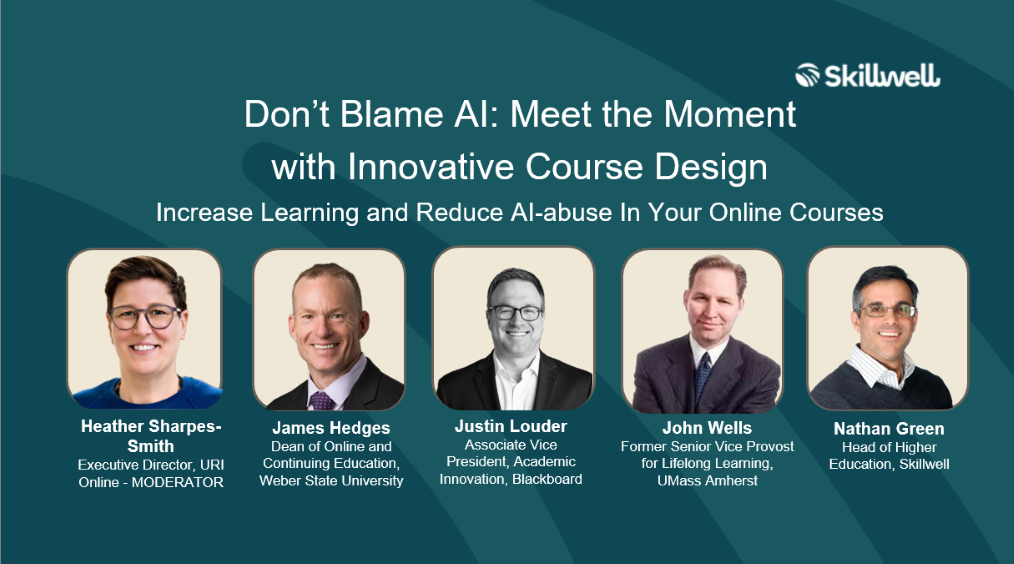
Join our webinar panel discussion to learn how to use formative and immersive elements to increase learning and reduce ...
Discover how Skillwell helps companies like Merck and AstraZeneca build critical compliance and ...
Here is the uncomfortable truth about AI in learning today: ...
Join our webinar panel discussion to learn how to use formative and immersive elements to increase learning and reduce ...