

Build Life Science Skills: Immersive & ...
Events
Discover how Skillwell helps companies like Merck and AstraZeneca build critical compliance and ...

Understanding the technology landscape for immersive learning is useful — but only if it connects to a practical question: which of these technologies is right for what you're trying to build?
Each immersive learning platform has genuine strengths, real tradeoffs, and contexts where it outperforms the alternatives. Let's dig into what's actually being used, why it works, and how to think about the choices.
Immersive learning technology is any tool or platform designed to create realistic, interactive educational environments — where learners build skills by doing rather than by observing.
The technologies involved range from high-fidelity VR headsets to web-based simulation platforms, and each sits at a different point on the spectrum of immersion, accessibility, and authoring complexity.
VR delivers complete immersion — learners are inside a fully simulated environment with no physical world visible.
The high immersion level creates strong emotional and cognitive engagement, which is why VR produces particularly strong results for high-stakes procedural training and scenarios where the emotional reality of the situation matters as much as the procedure itself.
AR overlays digital information onto the physical world rather than replacing it.
Learners see the real environment enhanced with digital content — step-by-step guidance appearing over actual equipment, patient data in a clinician's field of view, historical context superimposed on a real location.
The advantage of AR over VR is context: learning happens in the actual workspace, which creates stronger transfer to real performance.
Mixed reality blends physical and digital environments, allowing real-time interaction with both simultaneously.
It's the most technically sophisticated of the three formats, and also the most demanding to deploy at scale.
Organizations typically encounter MR in specialized contexts — advanced engineering, complex surgical training — where the ability to interact with both physical and virtual elements simultaneously is the specific capability being developed.
All three formats are significant because they address different learning needs. The integration of AI-powered adaptive learning across all of them adds the personalization layer — adjusting content and difficulty based on how each learner performs — that turns immersive experience into a genuinely responsive training system.
Let's look more closely at how each major immersive technology actually functions in training contexts.
VR's complete immersion makes it particularly effective for training where real-world practice would be risky, expensive, or logistically impossible.
Medical students practicing surgical procedures. Safety officers navigating hazardous environments. Clinical staff working through high-pressure patient scenarios.
The ability to create branching simulations that route learners based on their choices adds decision-making practice on top of procedural realism — the combination that produces the strongest outcomes.
AR enhances existing environments with interactive content rather than replacing them. In engineering and maintenance training, AR can surface diagnostic data and repair guidance in context.
In education, AR brings static materials to life — diagrams that animate, historical overlays that appear in real locations, complex molecular structures that learners can view from any angle.
For healthcare training specifically, AR supports skills development in the actual clinical environment without requiring learners to step away from real equipment or real patients. The context fidelity AR provides is its primary advantage over formats that require a separate simulated environment.
Gamification applies game mechanics — progression, challenge, reward, competition — to learning content. It doesn't replace the substance of training; it changes how learners engage with it.
A 2025 arXiv study on gamified virtual laboratories in high-voltage engineering found that the format significantly improved both learning outcomes and safety training effectiveness compared to conventional methods.
Gamification works best when the mechanics are connected to the skill being developed — progress markers that reflect real competency development, not arbitrary point accumulation.
Beyond VR, AR, and gamification, two formats are worth understanding separately because of how widely they're deployed and how clearly their outcomes are documented.
Simulation platforms — particularly branching simulations where learner choices determine the scenario's path — are the most widely deployed immersive format in corporate training.
They're accessible without hardware investment, authorable by subject matter experts without development expertise, and scalable to large workforces consistently.
Its growth reflects adoption across industries — not just technology-forward sectors but also compliance and risk training, sales and service, leadership development, and onboarding programs where the case for simulation over traditional training is clear.
The verified skills data captured during simulations is what transforms training from a cost center into a measurable investment — showing not just who completed training, but what each person can actually demonstrate.
When gamification is combined with AI adaptation, the experience adjusts not just the difficulty of challenges but also which challenges appear based on where each learner's performance data shows gaps.
For adaptive learning platforms that integrate gamification, the result is a learning experience that stays appropriately challenging as learners develop — neither too easy to create complacency nor too hard to create frustration.
This is worth addressing directly, because the answer is more nuanced than the technology conversation sometimes suggests.
Role-playing exercises, group problem-solving activities, and scenario-based case studies can all create genuinely immersive experiences without VR headsets or simulation software.
These methods are accessible, low-cost, and often highly effective for developing interpersonal skills and collaborative judgment — particularly in settings where the social dynamics of real team interactions are part of what's being practiced.
High-tech formats offer capabilities that low-tech methods can't match: consistent scenario delivery at scale, verified skills data capture, immediate personalized feedback, and the ability to simulate high-stakes situations that are difficult to replicate live.
They're more effective for procedural training, compliance documentation, and any situation where consistent measurement across a large learner population matters.
The practical conclusion is that the best programs typically combine both. Low-tech methods for collaborative, interpersonal practice where social dynamics matter. High-tech simulation for consistent, measurable skill development at scale.
The choice should follow the learning objective, not the technology budget or the technology trend.
Skillwell brings together AI-powered adaptive learning and immersive simulation in a platform designed for real-world deployment — fast to author in, built to measure what matters, and integrated with your existing LMS.
See what Skillwell's immersive learning platform can do for your teams.
Virtual Reality (VR) creates fully immersive 3D environments — most effective for high-stakes procedural training where emotional realism and physical context matter.
Augmented Reality (AR) overlays digital content onto real-world settings, enabling context-specific learning in the actual workspace.
Simulation platforms — especially branching scenarios — are the most widely deployed format in corporate training because they're accessible without hardware investment.
Gamification mechanics increase motivation and persistence, particularly when tied to AI-driven adaptive systems that adjust challenge level to individual performance.
AI-powered adaptive learning personalizes pathways based on real-time performance data — making any of these formats significantly more effective at scale.
VR replaces the physical environment entirely — ideal for training where the full context of a simulated situation needs to feel real.
AR enhances the real environment with digital content — ideal for training that should happen in the actual workspace with real equipment.
VR typically requires dedicated hardware; AR is increasingly accessible on standard mobile devices and smart glasses.
VR creates stronger emotional immersion; AR creates stronger contextual transfer because learning happens in the actual performance environment.
Both formats can integrate verified skills data capture and AI-powered adaptive pathways — the choice is about which physical context serves the training objective best.
Simulation platforms are generally more accessible — no hardware investment required, authorable by subject matter experts, deployable to large workforces via standard browsers.
VR delivers higher immersion, which creates stronger emotional engagement — valuable for scenarios where the emotional reality of a situation is part of what's being developed.
Branching simulations excel at decision-making and interpersonal skills training; VR excels at procedural and high-context training.
The global immersive simulation market is projected to grow from USD 3.84 billion in 2024 to USD 18.63 billion by 2030 — signaling strong and sustained corporate adoption of simulation-based formats.
Many organizations use both: simulation platforms for scalable skill development programs, VR for specific high-stakes scenarios that benefit from full immersion.
Yes — role-playing, group problem-solving, and scenario-based case studies can create genuinely immersive experiences without any technology investment.
Low-tech methods are particularly effective for interpersonal and collaborative skills where the social dynamics of real human interaction are part of what needs to be practiced.
High-tech formats outperform low-tech on consistent measurement, scalable delivery, and scenarios that can't be replicated live without significant logistics or risk.
The strongest programs typically combine both: low-tech for collaborative judgment development, high-tech simulation for consistent, measurable skills building at scale.
The format should follow the learning objective — the question isn't 'high-tech or low-tech?' but 'what does this specific skill require to be developed effectively?'
Discover how Skillwell helps companies like Merck and AstraZeneca build critical compliance and ...

Here is the uncomfortable truth about AI in learning today: ...
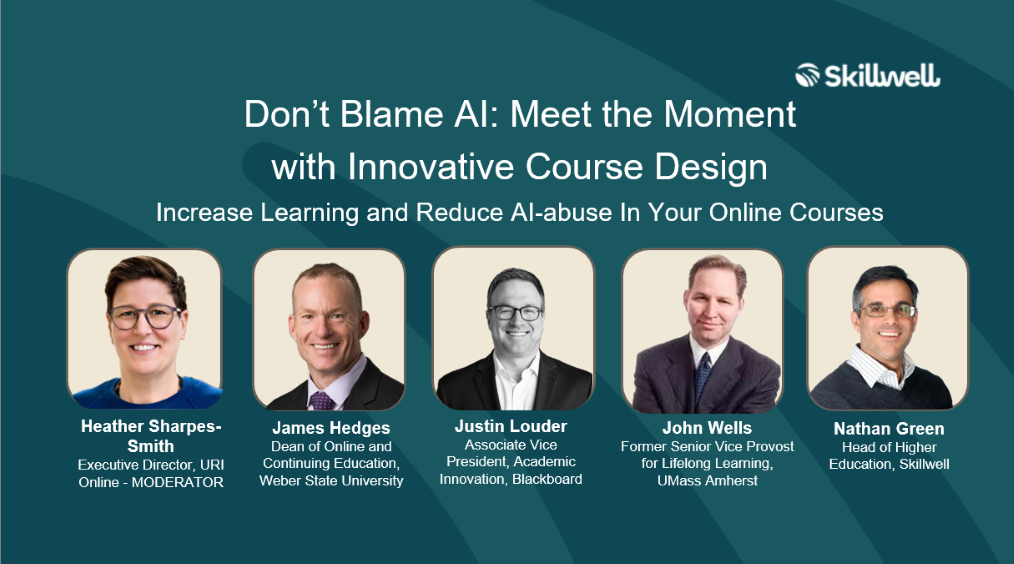
Join our webinar panel discussion to learn how to use formative and immersive elements to increase learning and reduce ...
Discover how Skillwell helps companies like Merck and AstraZeneca build critical compliance and ...
Here is the uncomfortable truth about AI in learning today: ...
Join our webinar panel discussion to learn how to use formative and immersive elements to increase learning and reduce ...