

Build Life Science Skills: Immersive & ...
Events
Discover how Skillwell helps companies like Merck and AstraZeneca build critical compliance and ...
These two terms get used interchangeably in learning and development conversations — and they're related, but they're not the same thing.
Understanding the difference matters when you're choosing training formats, evaluating platforms, or making the case internally for a new approach. Let's dig into what sets them apart and where they overlap.
Immersive learning is a training approach that places learners inside realistic, interactive scenarios — environments where they make decisions, experience consequences, and build skills through direct practice.
It often uses technology like simulations, virtual reality, or branching scenarios to create those environments, but the technology is the delivery mechanism, not the definition.
What makes learning truly immersive is the quality of the experience: it mirrors real-world situations closely enough that the skills built inside transfer to the job outside. That's the standard that matters.
When paired with AI-powered adaptive learning, immersive experiences also adjust to each individual learner — so people aren't sitting through content they've already mastered or moving past material they haven't truly absorbed.
The measurable outcomes are worth noting: organizations using immersive learning report 40% faster upskilling and an average 27% skill improvement compared to traditional methods.
Experiential learning is the broader concept — learning through experience rather than passive instruction. The most influential framework comes from David Kolb, whose learning cycle describes four stages that effective experiential learning moves through:
The learner engages directly with an activity or situation — doing something, not just hearing about it. A science lab experiment, a customer role-play, a simulation scenario. This is the entry point into the cycle.
After the experience, the learner steps back and considers what happened. What worked? What didn't? What were the consequences of the choices made? This reflection is what separates experience from genuine learning.
The learner draws conclusions and forms principles from their reflection. They're building a mental model — 'when X happens, Y tends to follow' — that they can carry forward into new situations.
The learner applies their new understanding in another real or simulated situation, testing and refining what they've built. This is where learning becomes capability.
The integration of verified skills data into this cycle adds an important layer: rather than relying on self-reporting or recall-based assessments, organizations can capture evidence of how learners actually perform at each stage and build training pathways from there.
Here's the simplest way to think about it: experiential learning is the theory; immersive learning is one powerful application of it.
Experiential learning encompasses any approach where learners build knowledge through direct experience — internships, workshops, project-based learning, on-the-job coaching. It doesn't require technology. It can happen in a classroom, a meeting room, or out in the field.
Immersive learning takes the same core principle and applies it through technology-enabled environments that replicate real-world situations with high fidelity.
The goal is still experience-first learning — but immersive formats can deliver that experience consistently, at scale, to thousands of learners simultaneously, with performance data captured along the way.
A few key differences worth calling out:
|
Experiential Learning |
Immersive Learning |
|
|---|---|---|
|
Definition |
Learning through direct experience — internships, workshops, projects, reflection |
Technology-enabled environments that replicate real-world scenarios at scale with measurable outcomes |
|
Engagement strategy |
Real or near-real activities designed by the instructor |
Digitally engineered scenarios with branching decision paths and immediate feedback |
|
Methodology |
Varied and often less structured — mentoring, stretch assignments, case studies |
Deliberately designed to specific objectives; feedback and consequences built in |
|
Scalability |
Logistically difficult to run consistently across large groups |
Scales to thousands of learners simultaneously with consistent scenario delivery |
|
Measurement |
Hard to standardize — relies on observation, self-reporting, or general assessment |
Captures verified skills data showing demonstrated competence for each individual |
|
Technology required |
None — can happen in any setting |
Simulation platforms, VR/AR tools, or AI-powered authoring environments |
|
Best used for |
Mentoring, collaborative judgment, stretch development over time |
Decision-making practice, compliance, onboarding, sales, leadership at scale |
Experiential learning relies on the design of real or near-real activities. Immersive learning uses simulation-based tools to create those activities digitally — allowing for consistent scenario delivery, branching paths based on learner choices, and immediate feedback.
Experiential learning takes many forms and is often less structured — a mentoring relationship, a stretch assignment, a case study discussion.
Immersive learning is more deliberately engineered: scenarios are mapped to specific learning objectives, feedback is built in, and outcomes are measurable. A well-designed branching simulation can be completed and refined in ways that a real-world experience simply can't be.
This is where immersive learning has a clear practical edge.
Running 50 people through a meaningful experiential activity at the same time is logistically hard.
Running 5,000 people through a branching simulation that captures verified skills data for each of them is entirely feasible with the right platform.
Across all four stages of Kolb's cycle, active engagement with material produces better retention than passive exposure. Let's look at why each stage contributes.
Hands-on engagement creates stronger initial memory encoding than hearing or reading about the same content. Learners remember what they did.
Reflection consolidates the experience — it turns a moment into a lesson. Without this stage, even strong experiences tend to fade. Building reflection prompts into immersive scenarios preserves this benefit at scale.
When learners form their own mental models from experience, they own the understanding in a way that transferred knowledge doesn't achieve. It's more durable and more transferable.
Applying newly formed understanding in another context — particularly a realistic simulated one — reinforces both retention and confidence. Research shows immersive adaptive learning environments that cycle learners through practice and feedback consistently outperform one-time training events on both engagement and long-term skill retention.
The practical upshot is this: when immersive learning is designed to move learners through all four experiential stages — not just put them in a scenario — the outcomes are significantly stronger. That's what separates a well-built simulation from a fancy quiz.
Skillwell combines the principles of experiential learning with AI-powered simulation to create training that builds real capability — not just completion records.
If you want to see what that looks like for your organization's specific training needs, take a tour of the Skillwell platform.
They're related but not identical — experiential learning is the broader educational principle, and immersive learning is one of its most powerful applications.
Experiential learning covers any approach that centers direct experience — internships, workshops, project-based work.
Immersive learning specifically uses technology-enabled environments to replicate real-world scenarios at scale.
All immersive learning is experiential, but not all experiential learning is immersive.
Immersive learning adds measurability — verified skills data captured during simulations gives organizations evidence of actual capability.
Kolb's learning cycle describes four stages that effective experiential learning moves through: concrete experience, reflective observation, abstract conceptualization, and active experimentation.
Concrete experience is the entry point — the hands-on activity or scenario the learner engages with directly.
Reflective observation is the step back — considering what happened and why.
Abstract conceptualization is where conclusions form — learners build mental models they can carry forward.
Active experimentation closes the loop — applying new understanding in another situation to test and refine it.
Retention improves when learning happens through doing rather than passive observation — immersive formats are built on that principle.
Learners form stronger memories from experiences they actively navigate than content they passively receive.
Immediate, contextual feedback reinforces the right behavior and corrects errors before they become habits.
Branching simulations require learners to make decisions and live with consequences — that's a more demanding cognitive process than answering recall questions.
Research shows learners retain information at a 75% higher rate through immersive experience than conventional instruction.
For most organizations, the right answer is both — immersive formats complement and scale experiential learning rather than replacing it entirely.
Immersive simulations are ideal for scenarios that are hard to replicate in person — high-stakes conversations, compliance dilemmas, leadership decisions.
Real-world experiential activities like mentoring and stretch assignments remain valuable for developing judgment over time.
Many organizations use immersive learning for foundational skill-building and live experiential activities for advanced development.
The strongest programs use verified skills data from simulations to inform where in-person coaching or mentoring is most needed.
Discover how Skillwell helps companies like Merck and AstraZeneca build critical compliance and ...

Here is the uncomfortable truth about AI in learning today: ...
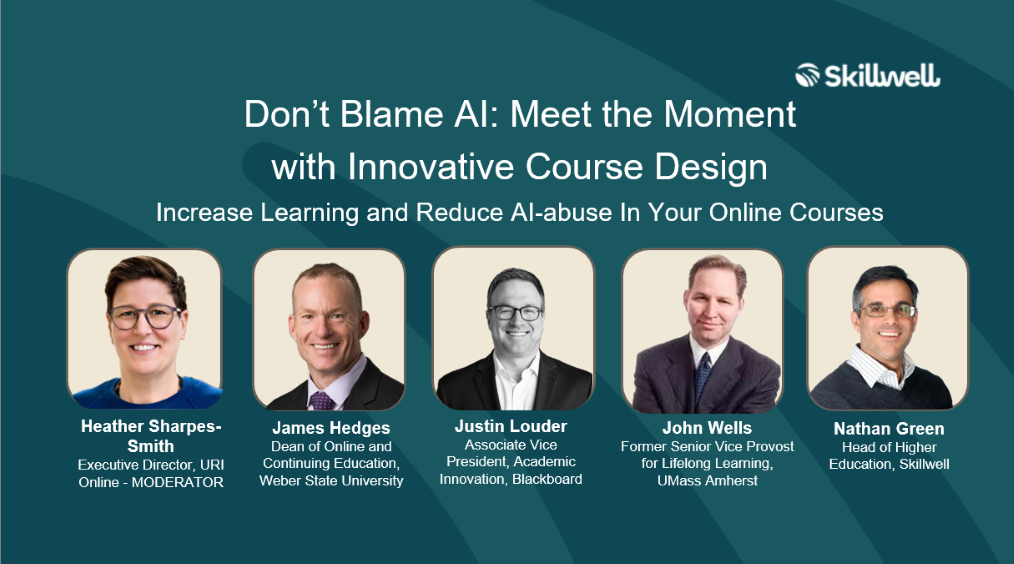
Join our webinar panel discussion to learn how to use formative and immersive elements to increase learning and reduce ...
Discover how Skillwell helps companies like Merck and AstraZeneca build critical compliance and ...
Here is the uncomfortable truth about AI in learning today: ...
Join our webinar panel discussion to learn how to use formative and immersive elements to increase learning and reduce ...