

Build Life Science Skills: Immersive & ...
Events
Discover how Skillwell helps companies like Merck and AstraZeneca build critical compliance and ...

Definitions of immersive learning are easy to find. What's harder to find are concrete examples that show what it actually looks like in practice — and why it produces different outcomes than traditional training.
Let's dig into some real immersive learning examples, what the research shows about how learners respond, and where immersive learning is making the biggest difference across fields.
Immersive learning is an educational approach that places learners inside realistic, interactive environments where they make decisions and experience consequences — rather than passively receiving information about what they should do.
Three things define the experience:
The scenario needs to mirror actual job situations closely enough that the skills built inside transfer to the real version. Generic or sanitized scenarios underdeliver — relevance and realism are what create the transfer effect.
Learners make choices and see what follows. That cause-and-effect structure is what creates genuine decision-making practice — not just awareness of what the right answer is. Tools like Skillwell Simulate make it straightforward to build branching simulations where every choice shapes the scenario's outcome, creating a practice environment that feels consequential.
The more senses involved in an experience, the stronger the memory encoding. Immersive formats — particularly VR and high-fidelity simulation — engage learners in ways that text and video simply can't match, which is a significant part of why retention rates are so much higher.
The research is consistent, and the learner response is measurably different. Here's what the evidence shows.
Learners in immersive environments are more focused, more motivated, and more willing to persist through difficult material.
The integration of VR technology is driving structural changes in teaching paradigms, with significant improvements in student engagement and motivation.
When you're actively navigating a scenario rather than watching someone else do it, staying engaged isn't optional — the format demands it.
A 2025 study demonstrated improved learning outcomes in VR-based educational environments compared to traditional instruction.
The underlying reason is straightforward: learners remember experiences they actively participated in far better than information they passively received.
Adaptive learning pathways extend this further — when content adjusts based on actual performance rather than assumed progression, learners are always working in their optimal zone of development.
This one is underappreciated. Learners in immersive environments report heightened emotional engagement with the material — and emotion is one of the strongest predictors of long-term memory.
A history student walking through a VR simulation of a historical event doesn't just learn facts; they form an experience they're unlikely to forget.
The same principle applies directly to corporate training: an employee who has navigated a difficult leadership conversation in a realistic simulation remembers it. One who read a case study about someone else doing it probably doesn't.
Beyond engagement and retention, immersive learning generates verified skills data that proves what learners can actually do — not just whether they completed a module. That shift from completion tracking to demonstrated competence is what connects L&D investment to business outcomes.
Healthcare gets most of the press when it comes to immersive learning — but the method's reach is considerably broader. Let's look at a few other fields where it's making a real difference.
Organizations use immersive simulation for leadership development, sales and service training, compliance and risk, and onboarding.
Employees navigate realistic workplace scenarios before encountering them in the field — building confidence and decision-making ability in a context where mistakes are lessons rather than incidents.
A report from the Immersive Learning Research Network highlights growing adoption of immersive learning across corporate sectors, driven by measurable improvements in training efficiency.
The practical results track to the same numbers across industries: organizations report 40% faster upskilling and an average 27% skill improvement when immersive methods replace traditional training formats.
Artists and performers use immersive environments to explore creative work in ways that aren't possible with conventional instruction.
Simulated performance environments allow rehearsal and critique without the pressure — or cost — of real-world production. A 2025 study found that immersive VR gamification significantly enhances learning outcomes in creative fields by increasing engagement and motivation in ways that traditional formats struggle to match.
Immersive language programs place learners inside simulated environments — virtual marketplaces, workplaces, social situations — where they practice conversation in context rather than through abstract drills.
The skills data captured during these sessions gives educators a real picture of where each learner is struggling and what additional practice they need, enabling truly personalized learning pathways.
Let's look at a few specific programs where immersive learning has delivered documented results.
A university used VR technology to build a virtual laboratory where students could conduct experiments safely and repeatedly — without the cost or risk of physical lab materials. The program improved both student understanding and satisfaction.
A 2025 arXiv study on gamified VR learning in high-voltage environments demonstrated that immersive formats significantly improve learning outcomes and safety training in high-risk disciplines.
A middle school developed an immersive history curriculum where students explored different time periods through interactive simulations rather than textbooks.
Both educators and students reported higher engagement and a noticeably stronger grasp of historical context. A related 2025 arXiv study on VR tours in language learning found that the same format consistently enhanced learner motivation and contextual understanding.
A language school built immersive conversation scenarios set in virtual everyday environments — markets, workplaces, social settings. Students practiced real interactions in context, with immediate feedback.
Skills data from those sessions gave instructors actionable insight into where each student was progressing and where they needed more practice.
What these programs have in common isn't the technology — it's the design principle. Learners are placed in situations that require them to apply knowledge actively, and their performance generates data that informs what comes next.
That's the loop that makes immersive learning and development strategies genuinely effective rather than just engaging.
The examples above show what's possible when immersive learning is designed with clear objectives and built on realistic scenarios. Skillwell combines AI-powered adaptive learning with immersive simulation to create training that builds real capability across your teams. Want to see what that looks like for your organization?
Take a tour of the Skillwell platform.
A healthcare organization uses VR simulation to prepare clinical leaders for high-pressure patient conversations before they happen in real care settings.
A sales team practices difficult customer objection scenarios through branching simulations before encountering them in the field.
A university builds a virtual lab where students conduct experiments safely and repeatedly, without cost or physical risk.
A language school creates virtual marketplace environments where students practice conversation in realistic everyday contexts.
A corporate compliance program puts employees inside realistic ethical dilemmas with branching consequences rather than asking them to read and acknowledge a policy.
Engagement levels are consistently higher — active participation in a scenario demands attention in ways passive content delivery doesn't.
Retention rates are 75% higher through immersive methods than through conventional instruction, according to multiple research studies.
Learners report stronger emotional connection to immersive content, which is one of the strongest predictors of long-term memory.
Confidence improves because learners have already practiced the real situation, not just read about it.
Verified skills data captured during simulations gives organizations evidence of demonstrated competence, not just completion.
Corporate training teams use immersive simulation for leadership, sales, compliance, onboarding, and customer service.
Educational institutions use VR and simulation to make complex subjects — history, science, language — tangible and interactive.
The arts use immersive environments for rehearsal, creative exploration, and audience engagement development.
Language learning programs use immersive virtual environments to practice real conversation in context rather than through abstract drills.
Technology and life sciences organizations use simulation for technical training and regulatory compliance documentation.
Scenarios are tightly matched to real job situations — generic or overly simplified scenarios underdeliver on transfer.
Feedback is immediate and contextual — tied to the specific decision the learner just made, not delivered days later.
Performance data is captured and used to shape what comes next, not just stored as a completion record.
The experience is built into a broader learning pathway rather than treated as a standalone event.
The platform integrates with existing LMS infrastructure — adding immersive capability without requiring a full rebuild of the training stack.
Discover how Skillwell helps companies like Merck and AstraZeneca build critical compliance and ...

Here is the uncomfortable truth about AI in learning today: ...
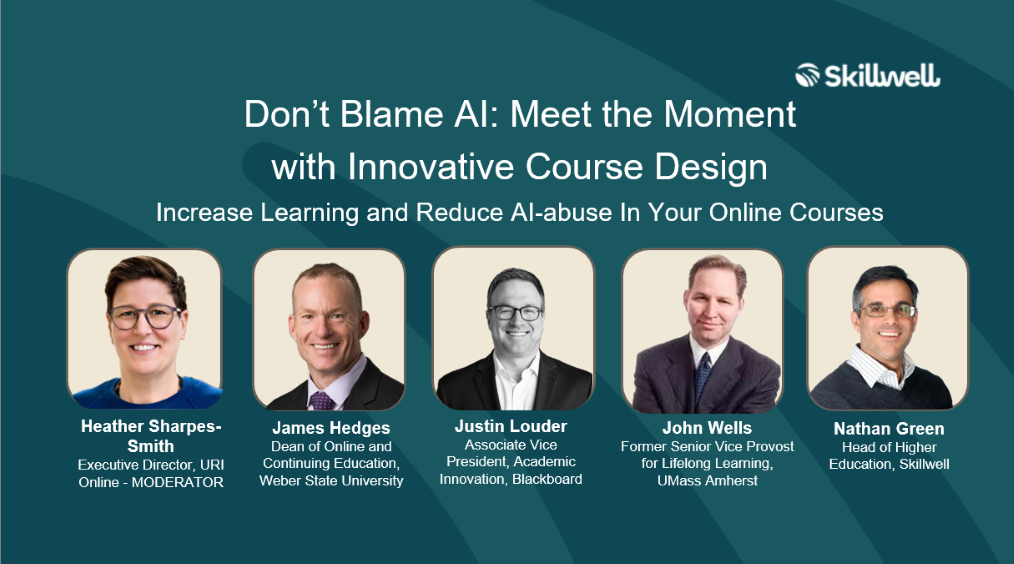
Join our webinar panel discussion to learn how to use formative and immersive elements to increase learning and reduce ...
Discover how Skillwell helps companies like Merck and AstraZeneca build critical compliance and ...
Here is the uncomfortable truth about AI in learning today: ...
Join our webinar panel discussion to learn how to use formative and immersive elements to increase learning and reduce ...