

Build Life Science Skills: Immersive & ...
Events
Discover how Skillwell helps companies like Merck and AstraZeneca build critical compliance and ...

The case for immersive learning is easier to make in the abstract than to visualize in practice.
What does it actually look like when an organization deploys it well? What outcomes show up, and why?
Let's dig into some specific immersive learning examples from medicine, engineering, the arts, and corporate training — and then look at what the research says about where the field is heading.
Immersive learning is an educational approach that places learners inside realistic, interactive environments — using tools like VR, AR, and simulation — where they make decisions and experience consequences rather than passively receiving instruction.
The defining characteristics are interactivity, realism, and the ability to practice in a safe environment before doing something in a real one. A medical student performing a simulated surgery.
A sales rep navigating a difficult customer conversation through a branching scenario. A new hire working through a realistic first week on the job before their actual first week starts. Each of these is immersive learning — the format differs, but the principle is the same.
Tools like Skillwell Simulate have made building these experiences significantly more accessible — subject matter experts can create branching simulations in minutes without technical expertise, removing the production barrier that used to make immersive learning practical only for large organizations with large budgets.
Immersive learning tends to outperform traditional instruction most clearly when the gap between knowing and doing is wide — when the skill being trained requires judgment, practice, or emotional readiness that reading about it simply can't build.
Medical training was one of the earliest adopters, for obvious reasons: the cost of unpreparedness is high, and real-world practice on patients carries inherent risk.
VR simulation for surgical training — including programs at institutions like the University of Illinois College of Medicine — allows students to perform procedures in risk-free environments, make mistakes, learn from them, and build confidence before the stakes are real. The outcomes are measurable: improved performance, reduced errors, and stronger confidence when transitioning to live practice.
In healthcare training more broadly, immersive simulation also addresses the documentation requirements of regulated environments. Audit-ready competence records generated during simulation provide evidence of capability — not just completion of a training module.
Employees trained through immersive simulation are 275% more confident applying what they've learned compared to those trained through traditional methods.
That confidence gap matters in sales and service roles, leadership development, and compliance training — anywhere that how someone handles a moment under pressure determines the outcome.
Organizations using immersive learning and development strategies consistently report 40% faster upskilling and an average 27% skill improvement. The verified skills data captured during simulations turns those outcomes into a business case — connecting L&D investment to measurable performance change.
Across academic settings, immersive environments make abstract subjects tangible.
Research shows that lessons involving immersive scenarios produce 80% retention of information after two weeks, compared to just 20% with traditional lecture methods.
History, science, and language — subjects that often struggle to hold learner attention in conventional formats — become interactive experiences that students actively engage with rather than passively sit through.
In higher education, adaptive learning in higher ed combined with immersive formats gives institutions a genuinely different way to assess student capability — not through standardized tests alone, but through demonstrated performance in realistic scenarios.
Let's look at a few specific programs that have delivered documented results.
The University of Illinois College of Medicine uses VR simulations for surgical training, allowing students to practice procedures in a controlled environment before working with real patients.
The result is improved performance and noticeably higher confidence at the point of transition to live surgery. The model has since been adopted across medical education more broadly as evidence of its effectiveness has accumulated.
Purdue University built immersive simulations for engineering students to design and test prototypes in virtual environments before committing to physical builds.
The hands-on experience accelerated learning and developed problem-solving skills in a way that static coursework doesn't. Participants showed a 27% average skill improvement — consistent with the broader outcomes data for immersive learning formats.
The Royal Academy of Arts in London implemented immersive experiences that let students interact with artworks and their historical contexts directly.
Rather than studying pieces from a distance, students engaged with them in context — developing a deeper appreciation for artistic technique and cultural significance that traditional gallery-based instruction rarely achieves.
The comparison comes down to three dimensions that L&D teams and educators consistently prioritize.
Immersive environments demand active participation — learners are making decisions, not watching someone else make them. Traditional methods rely heavily on passive consumption, which creates lower engagement ceilings regardless of how well the content is designed.
Learners in immersive environments form stronger memories because they're encoding experience, not just information.
The 80% vs. 20% two-week retention comparison is one of the most cited data points in the field — and it holds across a wide range of subjects and learner populations.
Adaptive learning platforms extend this further by ensuring learners revisit material at the right intervals and in the right contexts based on their own performance data.
Skills developed through immersive practice transfer to real-world performance more reliably than knowledge acquired through conventional instruction.
Organizations consistently report faster time to competency and measurable improvement in on-the-job performance. That combination — better outcomes in less time — is what makes immersive learning an investment rather than a cost.
Two developments are worth paying close attention to as the field continues to mature.
AI-powered adaptive learning and increasingly sophisticated VR and AR tools are making immersive experiences more personalized and more realistic.
The direction of travel is toward experiences that feel genuinely indistinguishable from real situations — which raises the ceiling on what skill transfer is possible.
For organizations building personalized learning strategies, this means training that adapts in real time to each learner rather than routing everyone through the same path.
The upfront investment in high-fidelity VR has historically been a barrier for smaller organizations. That's changing.
AI-powered authoring tools have reduced the time and cost of building simulation-based training dramatically — branching simulations that used to take months to develop can now be created in minutes.
As accessibility improves, the organizations that will have the strongest advantage are those that build measurement into their programs from the start, so they can demonstrate ROI as the technology scales.
The examples in this piece show what's possible when immersive learning is designed well and measured properly.
Skillwell combines AI-powered adaptive learning with immersive simulation to help organizations build genuine capability across their teams — at scale, with the data to prove it.
See how it works with a guided platform tour.
The University of Illinois College of Medicine uses VR surgical simulation that produces measurably improved performance and confidence at the transition to live practice.
Purdue University's engineering simulation program produced a 27% average skill improvement among participants.
Delta Airlines expanded VR training to over 1,800 technicians annually, reducing physical training costs by 30% while improving safety ratings.
The Royal Academy of Arts uses immersive environments to help students engage directly with artworks and their historical contexts.
Corporate compliance programs use branching simulation to put employees inside realistic ethical dilemmas rather than asking them to read and acknowledge policy.
Immersive learning produces 80% information retention after two weeks versus 20% for traditional lecture methods.
Learners are 275% more confident applying what they've learned after immersive training than after traditional instruction.
Organizations report 40% faster upskilling and 27% average skill improvement with immersive training approaches.
Immersive learning measures demonstrated competence; traditional methods primarily measure completion and recall.
The engagement gap is significant — active decision-making in a scenario holds attention in ways passive content delivery can't match.
The gap between training completion and real-world performance is a recognized problem — immersive learning is specifically designed to close it.
AI-powered authoring tools have made building high-quality simulations dramatically faster and more accessible.
Verified skills data from simulations creates the evidence base that connects L&D investment to business outcomes.
Industries with high stakes for unpreparedness — healthcare, life sciences, corporate compliance — have the clearest ROI case.
Immersive platforms integrate with existing LMS infrastructure, so adoption doesn't require rebuilding the entire training stack.
Start with a high-priority skill gap where immersive learning has a clear advantage over what's currently being used.
Choose formats matched to the skill — VR for procedural high-stakes training, branching simulation for decision-making and interpersonal skills.
Build measurement in from the start — verified skills data is what turns a training initiative into a defensible business case.
Confirm that the platform integrates with your existing LMS before committing — you shouldn't have to rebuild infrastructure to add immersive capability.
Plan to scale what works — programs that start with a focused use case are significantly easier to expand than organization-wide rollouts.
Discover how Skillwell helps companies like Merck and AstraZeneca build critical compliance and ...

Here is the uncomfortable truth about AI in learning today: ...
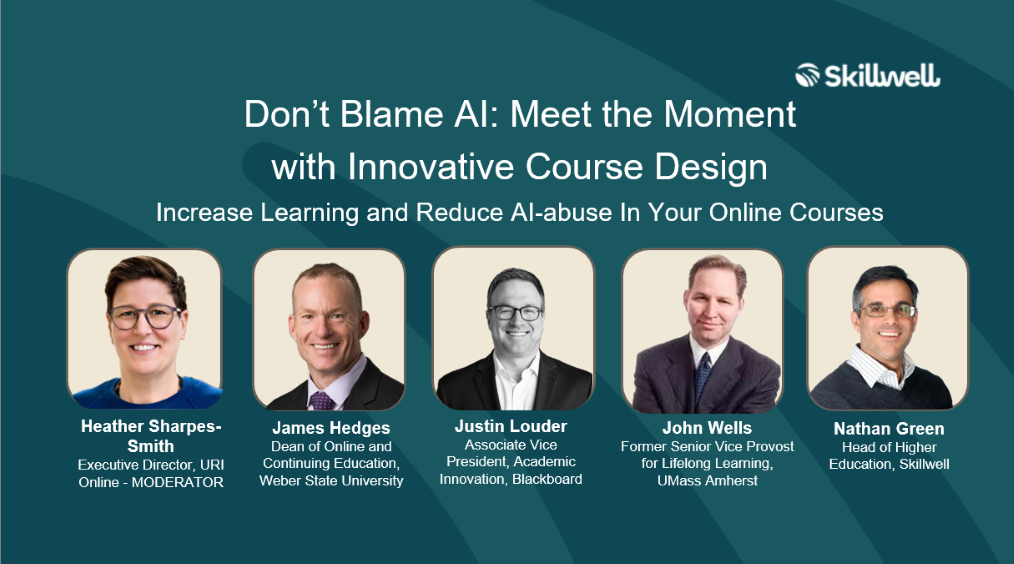
Join our webinar panel discussion to learn how to use formative and immersive elements to increase learning and reduce ...
Discover how Skillwell helps companies like Merck and AstraZeneca build critical compliance and ...
Here is the uncomfortable truth about AI in learning today: ...
Join our webinar panel discussion to learn how to use formative and immersive elements to increase learning and reduce ...