

Build Life Science Skills: Immersive & ...
Events
Discover how Skillwell helps companies like Merck and AstraZeneca build critical compliance and ...

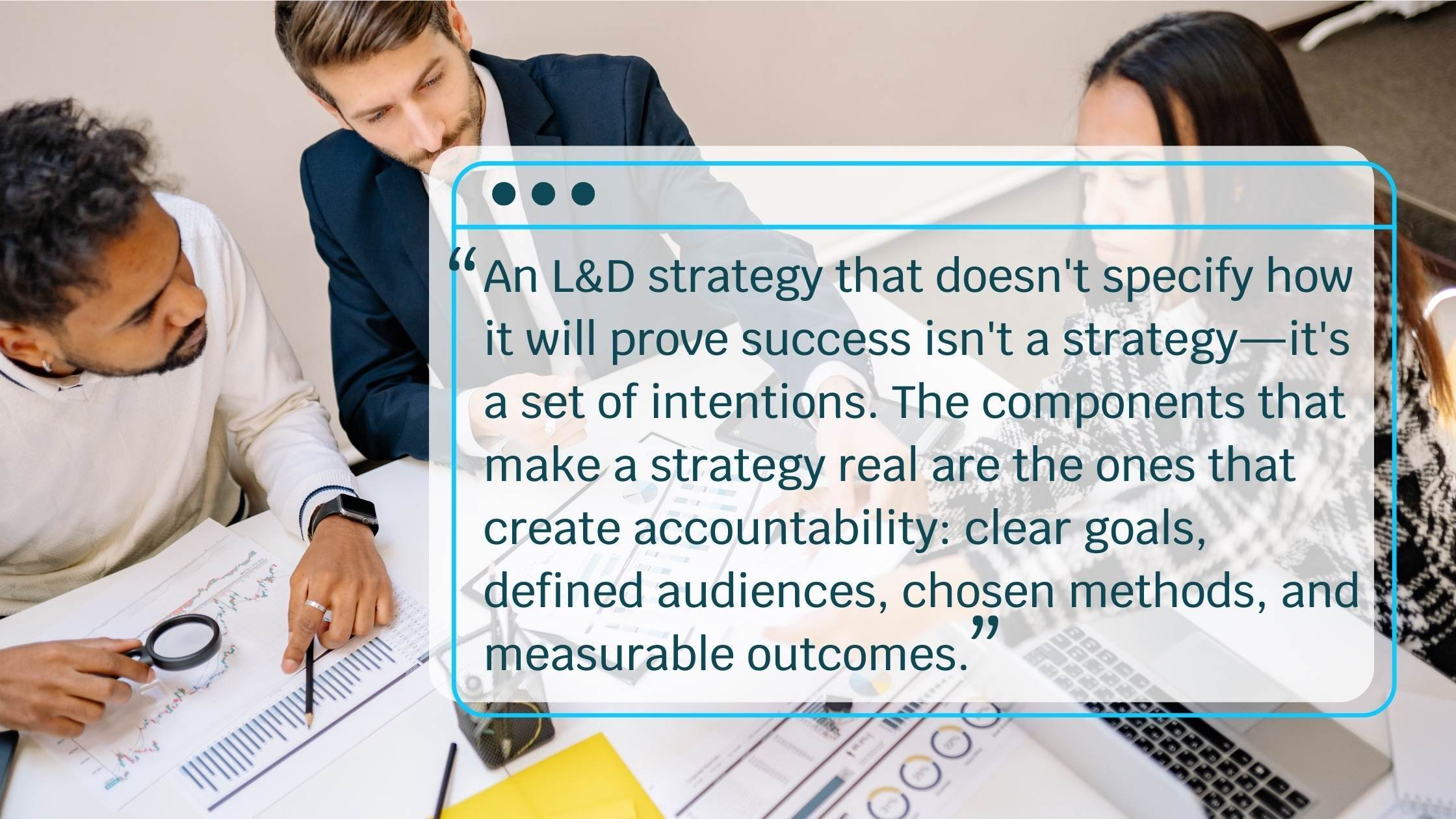
Many organizations have learning and development programs but not L&D strategies.
The difference isn't a matter of documentation sophistication. It's whether the learning and development effort is anchored to specific business outcomes, designed for defined audiences, delivered through chosen methods, and measured against objective evidence of impact.
This article covers what a learning and development strategy framework actually contains, how to prioritize the competencies it targets, and how to align it with organizational culture so it takes root rather than gets filed away.
An effective learning and development strategy framework is structured around four interconnected components that work together to connect learning investment to business performance.
Strategic goals define what capability the organization needs to build and why it matters to business outcomes.
These aren't training completion targets—they're statements about the performance improvement that learning is designed to produce. Objectives that can't be tied to observable business outcomes don't belong in a strategy; they belong in a training plan.
Knowing who needs to develop what—and why—shapes every downstream decision in the strategy.
This includes understanding current competency levels, role-specific requirements, learning preferences, and the business context in which skills will be applied.
Organizations that invest in rigorous audience analysis before designing programs consistently build more relevant content and see stronger engagement.
The right delivery method depends on the skill being built and the learner's context.
A learning and development strategy example that defaults to e-learning for everything misses the applied practice that some skills require; one that relies entirely on in-person instruction misses the scalability and personalization that technology enables.
Effective strategies use a deliberate mix: adaptive digital content for knowledge-intensive learning, simulation-based practice for skills requiring judgment and application, and in-person or virtual cohort experiences for collaborative and relationship-dependent development.
A strategy without defined measurement criteria can't be evaluated, improved, or defended.
Assessment mechanisms should be built into program design from the start—not added as an afterthought. Verified skills data that captures competency evidence beyond completion provides the most credible foundation for evaluating whether the strategy is working.
A complete L&D strategy template incorporates elements that address both the strategic and operational dimensions of learning investment.
The opening section of any L&D strategy roadmap should articulate exactly how learning investment connects to organizational priorities.
Which business objectives require capability development? What skill gaps are preventing performance? What would improved competency make possible?
This alignment statement is what makes the rest of the document a strategy rather than a training menu.
Not all skills are equally strategic. A prioritized capability map identifies which competencies most directly drive business outcomes, which have the largest current gaps, and which are most urgent given the organization's trajectory.
This prioritization is where skills data analytics becomes particularly valuable—objective performance data surfaces capability gaps that self-assessment and intuition routinely miss.
The strategy should specify which programs will be delivered through which methods, at what scale, and through which platforms.
This includes decisions about adaptive learning platform infrastructure, simulation environments, content authoring approaches, and how different delivery modalities will be sequenced to build from foundational knowledge through applied competence.
Who owns the execution of each element? How will progress be tracked? What decisions require escalation to senior leadership?
Strategies that don't answer these questions produce diffuse accountability—and diffuse accountability produces inconsistent execution.
The strategy should specify what success looks like and how it will be measured: which KPIs matter, how often they'll be reviewed, and what evidence of impact will be used in budget and investment conversations.
An L&D strategy template that omits evaluation design guarantees that strategy updates will be driven by opinion rather than evidence.
Competency prioritization should flow from the intersection of three inputs: what the business strategy requires, where current capability gaps are largest, and which skills are most difficult to hire for externally.
Technical proficiency in the tools, systems, and methodologies central to organizational performance is the clearest category to prioritize. These skills have the most direct connection to business outcomes and the most objective measurement criteria.
In rapidly changing environments, the ability to learn new skills—not just any specific current skill—becomes itself a strategic priority.
L&D programs that build meta-learning capability alongside specific competencies produce workforces that adapt faster when business requirements shift.
Communication, cross-functional collaboration, and leadership judgment are consistently among the top gaps identified by employers yet among the hardest to develop through traditional content delivery.
Scenario-based simulations that place employees in realistic interpersonal and professional situations provide the only scalable method for building these capabilities with the depth of practice they require.
Before designing programs, evaluate how learning is actually valued in the organization's daily practice—not just in its stated values.
Does management protect time for development? Are mistakes treated as learning opportunities or performance failures? Do leaders visibly invest in their own growth?
This honest assessment reveals cultural constraints that program design needs to account for.
Training that reflects the organization's actual values—through the scenarios it uses, the competencies it prioritizes, and the behaviors it reinforces—feels more legitimate to participants than programs that arrive from HR as generic content.
Involving team leaders in content development and using real organizational examples as learning scenarios both strengthen this alignment.
L&D programs built with employee input are more likely to address genuine development needs and to be perceived as investments rather than requirements.
Employee involvement in program design signals that the organization takes development seriously enough to build it collaboratively—which itself reinforces the learning culture the strategy is trying to create.
Organizations that use personalized learning pathways that adapt to individual needs further strengthen cultural alignment—because employees who experience training as relevant and respectful of their existing knowledge are far more likely to see L&D as a valued part of their professional life, not an obligation to be completed.
The most effective learning and development strategy frameworks combine strategic clarity with the technology to execute at scale.
Skillwell provides adaptive learning and immersive simulation training that connect your L&D strategy roadmap to measurable capability development—with personalized learning strategies that scale across your workforce without sacrificing relevance or depth.
A framework is the conceptual structure: what dimensions every L&D strategy must address — business alignment, audience definition, delivery design, measurement, and governance.
A template is the document format that organizes those dimensions into a usable planning tool.
The framework is the thinking; the template is the container for it.
Organizations that start with a template often produce well-formatted documents that aren't actually strategic — because structure without the underlying framework just gives form to underdeveloped thinking.
A business alignment statement connecting learning investment directly to specific organizational priorities and performance gaps.
A prioritized capability map identifying which competencies most directly drive business outcomes and have the largest current gaps.
A delivery architecture specifying which methods — adaptive digital content, simulation-based practice, cohort experiences — will be used for which skills and why.
A measurement framework that defines what success looks like and how it will be evaluated, built in from the start rather than added as an afterthought.
Start at the intersection of three inputs: what business strategy requires, where current capability gaps are largest, and which skills are hardest to hire for externally.
Use objective performance data to surface gaps that self-assessment and manager intuition routinely miss — people don't always accurately identify what they don't know.
Distinguish between urgent priorities (gaps limiting current performance) and strategic priorities (capabilities needed for future direction) — both belong in the strategy, sequenced appropriately.
Detailed enough to drive accountability and resource allocation — vague roadmaps produce diffuse ownership and inconsistent execution.
Not so detailed that it becomes obsolete as conditions change; tactical flexibility should be preserved within a clear strategic frame.
A useful roadmap specifies capability priorities, timeframes, delivery approaches, investment levels, and success metrics — while leaving room for adjustment as evidence accumulates.
Start with an honest cultural assessment before designing programs: does management protect time for development, or does training always lose to immediate deadlines?
Embed organizational values into program design through the scenarios used, competencies prioritized, and behaviors reinforced — generic content that doesn't reflect real organizational context feels like a compliance requirement, not an investment.
Involve employees as co-designers; programs built with employee input address genuine needs and signal that the organization takes development seriously enough to build it collaboratively.
Leaders who visibly invest in their own growth set the cultural tone that determines whether L&D programs succeed regardless of how well they're designed.
Discover how Skillwell helps companies like Merck and AstraZeneca build critical compliance and ...

Here is the uncomfortable truth about AI in learning today: ...

Join our webinar panel discussion to learn how to use formative and immersive elements to increase learning and reduce ...
Discover how Skillwell helps companies like Merck and AstraZeneca build critical compliance and ...
Here is the uncomfortable truth about AI in learning today: ...
Join our webinar panel discussion to learn how to use formative and immersive elements to increase learning and reduce ...