

Build Life Science Skills: Immersive & ...
Events
Discover how Skillwell helps companies like Merck and AstraZeneca build critical compliance and ...

The learning and development technology landscape has expanded dramatically. With it, the gap between organizations that use technology to genuinely improve learning outcomes and those that use it primarily to automate administrative tasks.
The distinction matters: technology that makes training more efficient without making it more effective doesn't advance learning and development strategy.
Let’s examine where technology for L&D creates real value—and what it takes to select and use it in ways that deliver measurable improvements in capability.
Technology serves three core functions in modern learning and development: personalizing the learning experience to individual needs, enabling scalable delivery without sacrificing quality, and generating the data that makes continuous improvement possible.
The most significant shift that L&D technology enables is moving from standardized content delivery to personalized learning pathways.
AI-powered adaptive learning platforms build individual learner models that adjust content, pacing, and difficulty based on demonstrated performance—so each employee receives training calibrated to their actual knowledge level rather than an assumed baseline.
This isn't personalization as a feature—it's personalization as the mechanism by which training produces development.
When content is relevant to where a learner actually is, engagement and retention follow. When it isn't, completion rates are the only thing that goes up.
Modern learning and development platforms capture verified skills data that goes beyond course completion to track actual competency development.
This shift from activity tracking to outcomes tracking transforms how L&D teams evaluate programs, identify gaps, and make investment decisions—moving from intuition and satisfaction surveys to evidence about what's actually being learned.
Technology makes it possible to deliver consistent, high-quality training to distributed workforces at a fraction of the cost and logistical complexity of in-person programs.
Platforms that can scale training delivery 10x—without proportional increases in instructor time or content development cost—change the economics of L&D for large organizations.
Rather than routing all learners through identical content sequences, Skillwell Adapt uses an AI-powered engine to adjust learning pathways in real time based on each learner's demonstrated knowledge.
Employees who test out of material they've already mastered through pre-assessment spend more time on genuine development—and less time on repetition that erodes engagement without building capability.
For skills that require judgment, communication, or high-stakes decision-making, Skillwell Simulate provides realistic practice environments that passive content delivery cannot replicate.
The ability to build complex branching simulations in minutes—not months—means L&D teams can deploy simulation-based training at the pace business needs demand, rather than waiting for lengthy development cycles.
Technology platforms that provide continuous performance data allow L&D teams to identify struggling learners before they disengage, surface content that's not working, and demonstrate impact to stakeholders with objective evidence. This feedback loop is what separates L&D technology investments that improve over time from those that plateau after initial deployment.

The most effective L&D technology stacks combine adaptive delivery, practice environments, and integration with existing infrastructure.
Platforms like Skillwell Adapt move beyond LMS functionality by actively personalizing the learning experience.
Where a traditional LMS tracks what employees completed, an adaptive platform tracks what they actually know—building a continuous, data-driven picture of capability development that serves both individual learners and organizational decision-makers.
Simulation tools that enable rapid authoring and realistic scenario design—like Skillwell Simulate—allow organizations to build applied practice experiences without requiring dedicated instructional design teams or long development timelines.
When employees can practice skills in scenarios that mirror their actual work, the transfer from training to performance is direct and measurable.
Organizations with existing learning experience platform infrastructure can extend its capabilities through integrations that bring adaptive and simulation-based learning into established workflows.
Skillwell's Degreed integration is an example of how the right technology partnership makes adaptive learning the missing piece of an LXP stack rather than a replacement for it.
Instructional designers rely on authoring tools to build interactive e-learning content, branching scenarios, and assessment-driven modules.
The most effective tools combine ease of use—enabling rapid creation without deep technical expertise—with the flexibility to build complex adaptive experiences.
Canvas-based authoring environments that enable simulation design in minutes rather than months represent the current standard for high-productivity instructional design.
LMS platforms remain the administrative backbone of most corporate training operations, handling content delivery, completion tracking, and compliance reporting. Their limitation—treating all learners identically regardless of knowledge level—is what adaptive platforms are designed to address.
Tools that support assessment-driven delivery—including pre-assessments that route learners appropriately, formative assessments that adjust content in real time, and summative assessments that verify competency—are increasingly central to effective instructional design.
Verified skills data captured through these assessment layers provides the evidence base that makes program evaluation meaningful and improvement actionable.
The right technology for learning and development isn't the most feature-rich platform—it's the combination of tools that personalizes learning, enables applied practice, and generates the data that proves capability is being built.
Skillwell delivers adaptive learning and immersive simulation training as an integrated solution that connects personalized pathways to real-world practice—backed by skills data that shows exactly what your workforce knows and where it needs to grow.
The ability to personalize the learning experience based on demonstrated performance — platforms that treat all learners identically ignore the variable that matters most: what each person already knows.
Personalization isn't a luxury feature; it's the mechanism by which training produces development rather than just completion records.
Look for pre-assessment capability that routes learners past content they've mastered and toward genuine skill gaps — that's where development time produces the highest return.
Any platform that can't answer "what does this employee actually know?" is tracking activity, not capability.
An LMS is organizational infrastructure: it stores content, tracks completions, manages compliance reporting, and delivers the same experience to every learner.
An adaptive platform builds individual learner models: it adjusts content, pacing, and difficulty based on what each person demonstrates they know — in real time, not at course completion.
The practical difference: an LMS tells you who finished the training; an adaptive platform tells you who actually developed the capability.
Most organizations need both — an LMS for administrative management and an adaptive layer for the learning experience itself.
Does it improve learning outcomes, or just administrative efficiency? Technology that makes training faster without making it more effective doesn't advance L&D strategy.
Can it generate objective competency evidence — verified skills data — rather than just completion rates and satisfaction scores?
Can it scale to serve your entire workforce without proportional increases in administration cost or content development time?
Does it integrate with your existing infrastructure, or does it require replacing systems that are already embedded in workflows?
Simulation tools address the gap that no other delivery format can: skills requiring judgment, decision-making, and high-stakes application need practiced repetition in realistic conditions before professional stakes are real.
The best simulation tools enable rapid authoring — building branching scenarios in minutes rather than months — so L&D teams can deploy practice environments at the pace business needs demand.
Simulation generates performance data that passive content delivery can't: what decisions employees make, where they hesitate, and what they get wrong under realistic pressure.
In a complete stack, simulation is the practice layer that converts content knowledge into applied competence.
Competency evidence: what employees can actually demonstrate, not just what modules they completed or how long they spent in the platform.
Individual skill gap maps: where each learner has genuine deficits versus areas of existing mastery — the foundation for personalized pathways.
Performance change data: skill proficiency before and after training, linked where possible to business metrics like error rates, productivity, and time to competency.
Program-level analytics: which content is working, where learners are dropping off, and what's producing the strongest capability outcomes — the feedback loop that makes continuous improvement possible.
Discover how Skillwell helps companies like Merck and AstraZeneca build critical compliance and ...

Here is the uncomfortable truth about AI in learning today: ...
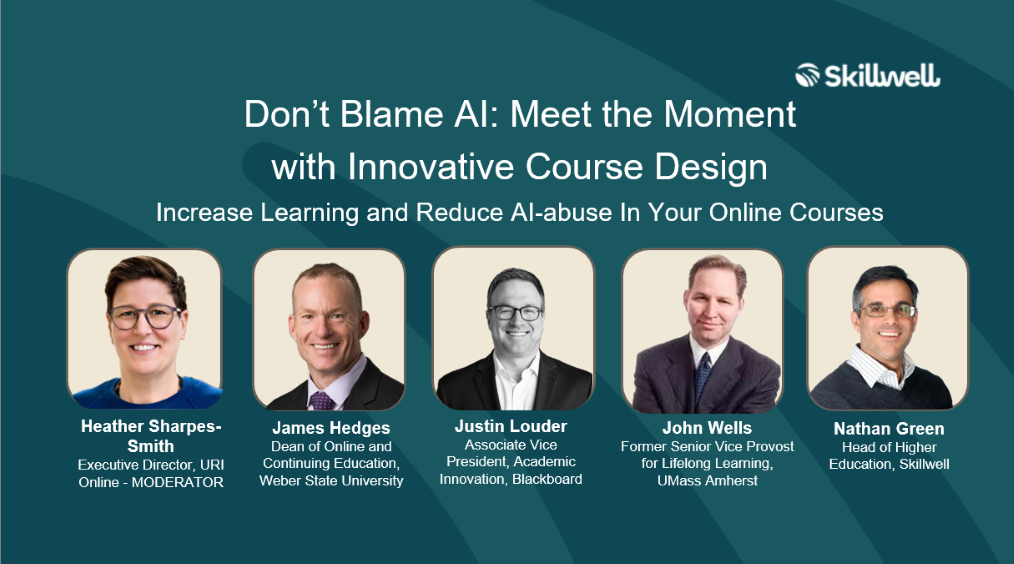
Join our webinar panel discussion to learn how to use formative and immersive elements to increase learning and reduce ...
Discover how Skillwell helps companies like Merck and AstraZeneca build critical compliance and ...
Here is the uncomfortable truth about AI in learning today: ...
Join our webinar panel discussion to learn how to use formative and immersive elements to increase learning and reduce ...