

Build Life Science Skills: Immersive & ...
Events
Discover how Skillwell helps companies like Merck and AstraZeneca build critical compliance and ...
The role of technology in higher education has shifted fundamentally over the past decade.
What began as supplementary infrastructure has evolved into the core architecture of how courses are designed, delivered, and assessed.
Today's educational technology tools don't just support instruction; they enable learning approaches that weren't possible before: AI-personalized pathways, immersive simulation environments, real-time skills verification, and scalable delivery that reaches thousands of learners simultaneously.
This article examines how technology facilitates student learning and development today and where the most important developments are heading.
Technology serves higher education across three interlocking functions: expanding access, enabling personalization, and generating the evidence institutions need to continuously improve.
Online platforms and digital learning environments extend quality education to students who can't attend traditional in-person programs—whether because of geography, work schedules, financial constraints, or caregiving responsibilities.
This democratization of access is one of the most significant benefits of technology in the classroom and beyond: it means the quality of instruction a student receives is less tightly bound to where they live or whether they can relocate.
According to the EDUCAUSE Higher Ed Innovation Index 2025 study, 99% of schools report using technology to cut costs, and the majority report benefits from AI initiatives.
Personalized learning was once achievable only in small, resource-intensive settings—one-on-one tutoring or small seminar environments.
AI-powered adaptive learning changes this by building individual learner models that adjust content delivery, pacing, and difficulty based on each student's demonstrated performance.
The result is an experience that responds to the individual—not the average student—without requiring instructors to manually differentiate instruction for every person in a large course.
Learning management systems, collaborative workspaces, and virtual classroom platforms have made it possible for students to work together across locations and time zones.
This distributed collaboration mirrors the professional environments most graduates will enter, building the teamwork and communication skills that employers consistently prioritize.
The best technology in the classroom examples share a common characteristic: they don't just deliver content more efficiently—they create conditions for deeper learning that passive instruction can't produce.
LMS platforms like Canvas and Moodle provide the organizational backbone for modern courses—centralizing materials, tracking progress, and managing assessments. Their strength is administrative efficiency and consistency.
Their limitation is that most treat all learners identically, delivering the same content at the same pace regardless of individual knowledge levels or learning needs.
For skill development that requires judgment, practice under pressure, and learning from realistic consequences,
Skillwell Simulate provides what lecture and case study alone can't. Students engage in branching simulations that adapt based on their decisions—building applied competence in environments where mistakes are learning opportunities rather than professional consequences.
Institutions that have implemented simulation-based training report significant improvements in student engagement and demonstrated skill mastery.
Unlike static e-learning, adaptive platforms continuously adjust the learning experience based on performance data.
Skillwell Adapt’s features allow students to demonstrate existing competency and skip material they've already mastered—ensuring their time is spent on genuine development rather than repetition.
This responsiveness makes the learning experience both more efficient and more motivating.
Well-produced multimedia content—explanatory videos, interactive diagrams, recorded demonstrations—supports diverse learning styles and enables asynchronous instruction that students can revisit at their own pace.
Combined with assessment and feedback mechanisms, multimedia becomes a genuine learning tool rather than a passive viewing experience.
As educational technology tools trends 2026 and beyond continue to develop, higher education institutions face a choice about how to integrate new capabilities.
The institutions that use technology most effectively will be those that align it with clear learning outcomes rather than adopting it for novelty or cost-cutting alone.
AI will continue to deepen its role in personalizing learning pathways, identifying at-risk students before they disengage, and generating actionable insights from skills data.
The question for institutions isn't whether to integrate AI—it's how to do so in ways that genuinely improve student outcomes rather than simply automate existing processes.
Skills data analytics will become increasingly central to how institutions assess program quality and make curriculum decisions. Institutions that can demonstrate, through verified performance data, that their programs produce job-ready graduates will hold a significant advantage in student recruitment and employer partnerships.
The hybrid model—combining in-person and digital learning in ways that leverage the strengths of both—is becoming the default rather than the exception.
Institutions that have built the technology infrastructure to deliver high-quality online learning can create hybrid experiences that serve more students more effectively than either pure modality alone.
New technology in the education system continues to expand what's possible for student learning.
VR and AR create fully immersive environments for skills practice that would be impossible or prohibitively expensive to replicate in physical settings—surgical procedures, emergency response scenarios, complex industrial operations.
As hardware costs decline, these technologies are becoming more accessible to institutions that previously couldn't afford them.
Tools that enable educators to build adaptive, simulation-based course materials in minutes—not months—are changing the economics of quality course development.
Rapid authoring capabilities mean institutions can keep curricula current with industry requirements without waiting years for traditional development cycles.
Blockchain-based credential verification systems provide employers with tamper-proof records of student achievements that are easier to verify than traditional transcripts.
As skills-based hiring continues to grow, these systems will become more valuable—particularly when paired with verified competency data that goes beyond course completion to demonstrate applied capability.
The technology to deliver personalized, simulation-enhanced, data-driven learning and development at scale is available now.
Skillwell combines AI-powered adaptive learning with immersive simulation training to give higher education institutions the tools they need to build genuinely job-ready graduates—with personalized learning strategies and verified competency evidence that serves both students and the employers who hire them.
Expanded access — digital platforms extend quality instruction to students who can't attend traditional in-person programs due to geography, work schedules, or financial constraints.
Personalization at scale — adaptive learning technology builds individual learner models and adjusts content delivery based on demonstrated performance, something only possible in small-group settings before AI.
Objective competency verification — verified skills data captures what students can actually do, not just what courses they completed, giving employers a more useful signal of graduate readiness.
Simulation-based practice environments for skills that require applied experience before professional stakes are real.
An LMS is organizational infrastructure: it stores content, tracks completions, and manages assessments — but treats every learner identically.
Adaptive platforms build individual learner models: they adjust difficulty, pacing, and content focus based on what each student demonstrates they know.
Features like Determine Knowledge™ allow students to test out of content they've already mastered — so development time goes to genuine gaps, not repetition.
The difference in outcome: LMS measures whether students showed up; adaptive platforms generate evidence of whether they actually learned.
Does it improve learning outcomes, or just operational efficiency? Tools that only save time without improving what students learn have limited long-term value.
Can it personalize the experience for individual learners — or does it deliver the same content to everyone regardless of their starting point?
Does it generate usable competency data, or just activity logs (completions, time-on-module)?
Tools that score well on all three — adaptive platforms and simulation environments especially — justify sustained investment.
AI-powered adaptive learning that personalizes pathways at scale without requiring instructors to manually differentiate instruction for every student.
Simulation and immersive learning environments that give students applied practice before professional stakes are real — especially valuable for high-consequence fields like healthcare, finance, and operations.
Rapid authoring tools that let educators build adaptive, branching course materials in minutes rather than months — making it possible for curricula to stay current with industry changes.
Competency verification systems that give employers objective, tamper-resistant evidence of what graduates can actually do.
Deeper personalization: AI will continue improving individual learner models, making adaptive pathways more precise and more responsive to real-time performance data.
Early identification of at-risk students: pattern recognition across engagement and performance data can surface disengagement before it becomes dropout.
Faster content development: AI-assisted authoring tools are reducing the time and cost of building high-quality, adaptive course materials — lowering the barrier for institutions to keep curricula current.
The central question for institutions isn't whether to integrate AI — it's whether the integration improves student outcomes or just automates existing processes.
Align technology adoption to clear learning outcomes first — tools that don't map to specific competency goals are adoption for novelty's sake.
Pilot with programs where the need is clearest and results are measurable before institution-wide rollout; visible early outcomes build faculty buy-in.
Invest in faculty readiness alongside technology deployment — educators who understand why adaptive and simulation-based approaches work implement them more effectively.
Treat academic rigor and technology innovation as complementary, not competing; the strongest implementations embed new tools within existing quality frameworks rather than around them.
Discover how Skillwell helps companies like Merck and AstraZeneca build critical compliance and ...

Here is the uncomfortable truth about AI in learning today: ...
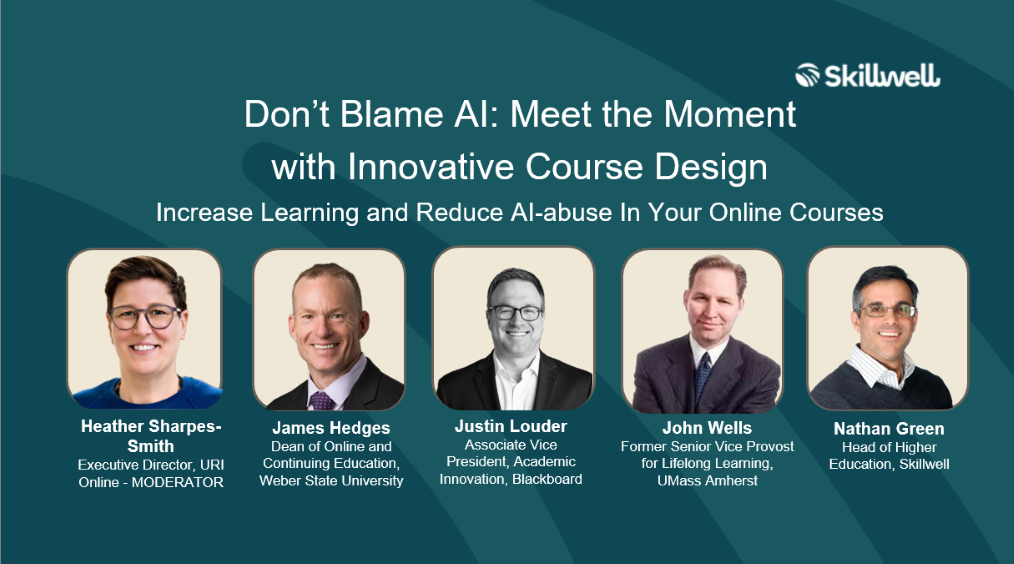
Join our webinar panel discussion to learn how to use formative and immersive elements to increase learning and reduce ...
Discover how Skillwell helps companies like Merck and AstraZeneca build critical compliance and ...
Here is the uncomfortable truth about AI in learning today: ...
Join our webinar panel discussion to learn how to use formative and immersive elements to increase learning and reduce ...