

Build Life Science Skills: Immersive & ...
Events
Discover how Skillwell helps companies like Merck and AstraZeneca build critical compliance and ...

The institutions preparing tomorrow's workforce aren't waiting for students to arrive in industry—they're embedding the skills, adaptive thinking, and real-world readiness directly into the curriculum.
Higher education has always been about preparing students for what comes after graduation—but the skills the modern workforce demands are changing faster than traditional curricula can keep up with.
Learning and development in higher education is no longer a supplementary concern for career services or student affairs; it's a core institutional responsibility that shapes graduate employability, institutional reputation, and long-term student outcomes.
This guide covers why L&D matters in higher education, what strategies educators can implement in the classroom, how institutions can support professional development alongside academic instruction, and how technology is transforming what's possible in online and hybrid learning environments.
The case for embedding L&D principles into higher education is both practical and strategic. Students who experience structured learning and development during their academic programs enter the workforce with demonstrated competencies—not just credentials.
A rapidly changing job market demands more than academic knowledge. Employers consistently report that they're looking for graduates who can apply skills under real-world conditions, adapt to new challenges quickly, and continue learning throughout their careers.
A 2025 survey by the U.S. Chamber of Commerce found that hiring managers prioritize candidates who can think critically, solve problems, communicate effectively, and adapt quickly—competencies that academic instruction alone rarely develops to the standard employers expect.
The gap between what institutions believe they're producing and what employers are finding is significant.
A 2025 General Assembly study found that 27% of VPs and directors report they would not hire today's entry-level candidates, citing deficits in both technical and interpersonal competencies. Learning and development in higher education courses that incorporate adaptive methodologies and hands-on practice are the institutions' most direct lever for closing that gap.
Engaged students retain information better and are more likely to complete their programs successfully.
Research published in Smart Learning Environments found that integrating adaptive learning strategies with diverse instructional techniques leads to meaningfully better student outcomes—reinforcing the case for personalization over uniform content delivery.
Integrating AI-powered adaptive learning into higher ed courses enables institutions to create personalized learning pathways that respond to each student's demonstrated knowledge level—keeping content relevant and pacing appropriate throughout the course.
When students aren't forced through material they already know, or left struggling without targeted support, engagement follows naturally.
Institutions that produce job-ready graduates strengthen their reputations, improve alumni employment outcomes, and build the industry partnerships that attract funding and create opportunities for the next cohort of students.
L&D investment isn't just a student benefit—it's a competitive differentiator for institutions navigating an enrollment environment where outcomes matter more than prestige alone.
Translating cognitive science into classroom practice doesn't require a complete curriculum overhaul. It requires intentional design choices that align instruction with how people actually learn.
Passive lecture-based instruction consistently underperforms active learning approaches in long-term retention and skill transfer.
Educators can shift this balance through group problem-solving sessions, case-based discussions, peer teaching, and interactive simulations that require students to apply—not just absorb—course content. The goal is to replace passive consumption with deliberate practice before students face real-world stakes.
Rather than moving all students through the same content at the same pace, assessment-driven approaches use what students already know to determine where to focus instruction next.
Skillwell Adapt's features apply this principle directly—allowing students to test out of material they've already mastered and focus development time on genuine skill gaps. This approach respects existing competence, reduces redundancy, and improves overall learning efficiency.
Distributing learning over time and regularly returning to previously covered material dramatically improves retention compared to massed practice.
Educators who build retrieval practice—low-stakes quizzes, application exercises, and scenario reviews—into their course design see stronger long-term outcomes than those relying on end-of-term assessments alone.
The research here is unambiguous: retrieval practice enhances retention far more than restudying the same material.
Moving from theory to practice requires a framework for integrating learning and development principles systematically—not just applying them in isolated lessons.
Students who engage in collaborative projects develop communication skills, learn to navigate different perspectives, and build the teamwork competencies employers prioritize.
Collaborative design also creates peer accountability that strengthens individual commitment to learning outcomes.
For online and hybrid courses especially, structured collaboration—rather than optional peer interaction—is what makes the difference between an isolated and a genuinely developmental learning experience.
Timely, specific, and actionable feedback is one of the most powerful levers for learning. Verified skills data provides educators with objective evidence of student competence—moving feedback conversations beyond subjective impressions to measurable outcomes.
When students can see their specific strengths and gaps reflected in data, they're better positioned to direct their own development and take ownership of their learning trajectory.
For skills that require judgment and application under realistic conditions—clinical reasoning, business decision-making, customer interaction, technical problem-solving—immersive simulation training provides the practice environment that case studies and lectures alone cannot.
Students engage with realistic workplace scenarios, make decisions with consequences, learn from outcomes, and build the applied confidence that matters when they enter professional environments.
Different types of simulations serve different learning objectives, from branching decision exercises to full-scenario role-plays.
Career readiness doesn't have to wait for the job search. Educators who intentionally integrate professional development into their course design give students a measurable advantage before graduation.
Aligning course content with specific industry competencies—not just academic learning outcomes—ensures that skills students develop map directly to what employers seek in entry-level hires.
According to a 2025 NACE survey, 83.3% of institutions are now formally implementing career readiness competencies, marking a significant shift toward outcome-oriented curriculum design.
The institutions leading this shift aren't retrofitting career readiness as an add-on—they're building it into course architecture from the start.
Real-world projects sponsored by industry partners, internship experiences, and applied capstone work give students firsthand exposure to workplace dynamics.
The same NACE report found that 97% of institutions have integrated career development presentations directly into academic classes, with 73% doing so in the most recent academic year—evidence that career readiness is being embedded into instruction, not outsourced to career services.
When these experiences are combined with skills-based training that builds the specific competencies employers value, students graduate with both real experience and demonstrated capability.
Critical thinking, communication, adaptability, and collaboration are consistently among the top competencies employers report as missing in entry-level hires.
A study found that 49% of executives and 37% of employees identified a lack of soft skills as the top reason entry-level workers seem unprepared—a gap that academic coursework, without intentional design, rarely closes.
Educators can address this systematically through virtual workshops, role-playing exercises, group projects, and scenario-based simulations that give students realistic practice with the interpersonal dynamics they'll face in professional settings.
Professional development in higher education isn't only about students. Faculty who continue developing their own capabilities—in pedagogy, technology, and industry knowledge—deliver stronger learning experiences that keep pace with evolving workforce needs.
Instructors who engage in ongoing professional development bring current industry practices, updated research, and refined teaching methodologies into the classroom. This continuous improvement cycle benefits every cohort of students and helps institutions maintain the relevance of their programs even as industries evolve around them.
As online courses for learning and development become standard across higher education, educators need proficiency with the tools that make those courses effective.
Canvas-based authoring tools, adaptive learning platforms, and simulation environments are no longer optional—they're the infrastructure of modern course design. Faculty who aren't fluent in these tools are disadvantaged in designing the learning experiences students now expect.
When faculty visibly engage in their own professional development, they model the continuous learning mindset that higher education is meant to cultivate.
Students who see their instructors treating learning as ongoing—not complete—are more likely to internalize that orientation themselves. In a labor market that demands adaptability above almost all else, this modeling may be one of the most durable things an institution can teach.
Learning and development in higher education reaches its full potential when institutions have the technology to support personalized, skills-based learning at scale.
Skillwell delivers adaptive learning and immersive simulation training that gives educators the tools to build competence—not just content completion—into every course.
With personalized learning strategies that respond to each student's demonstrated knowledge and verified skills data that proves readiness, institutions can move from outputs to outcomes.
Request a Sample Simulation Today
Higher education L&D focuses on building foundational competencies and the adaptive thinking students need to enter a profession; corporate L&D focuses on closing specific skill gaps that affect current job performance.
The timeline differs: higher ed works across semesters and degree programs, while corporate L&D often targets faster results tied to business cycles.
The audience differs too: students are building professional identity for the first time; employees are refining and expanding existing professional capability.
The core principles overlap—both benefit from personalized pathways, assessment-driven delivery, and simulation-based practice.
Applied technical skills tied to the specific competencies employers hire for in each field—not just foundational academic knowledge.
Soft skills: communication, collaboration, adaptability, and critical thinking consistently top employer lists of what entry-level hires lack.
Learning agility—the ability to acquire new skills quickly—may be the most valuable competency of all given how fast job requirements are evolving.
Decision-making under realistic conditions, which passive content delivery doesn't develop; simulation-based practice is the most direct path to building this.
Adaptive learning platforms automatically adjust content delivery based on student performance, reducing the need for instructors to manually differentiate for every student.
Pre-assessment features that test existing competency before assigning content mean students skip what they already know—cutting redundancy and focusing time on genuine gaps.
Technology handles the personalization layer; instructors focus on facilitation, coaching, and high-value interaction rather than content delivery.
Well-designed online courses can match or exceed in-person outcomes when they incorporate active learning, regular feedback loops, and realistic simulation environments—not just recorded lectures.
The key variable is design quality, not delivery modality; passive online content underperforms for the same reason passive in-person lecture does.
Collaborative tools, peer learning channels, and scenario-based simulations preserve the social and experiential elements of learning that distance alone can't eliminate.
Students practice applying skills in realistic scenarios before facing them in professional settings—building applied confidence that case studies and readings alone can't develop.
Simulation creates a low-stakes environment for high-stakes decisions: students can make mistakes, see consequences, and learn from outcomes without real-world cost.
The gap simulation addresses is precisely what employers most often report in new graduates: theoretical knowledge without the judgment to apply it under real conditions.
Simulation outcomes also provide verifiable skills data that demonstrates readiness in ways GPA and course completion cannot.
Discover how Skillwell helps companies like Merck and AstraZeneca build critical compliance and ...

Here is the uncomfortable truth about AI in learning today: ...
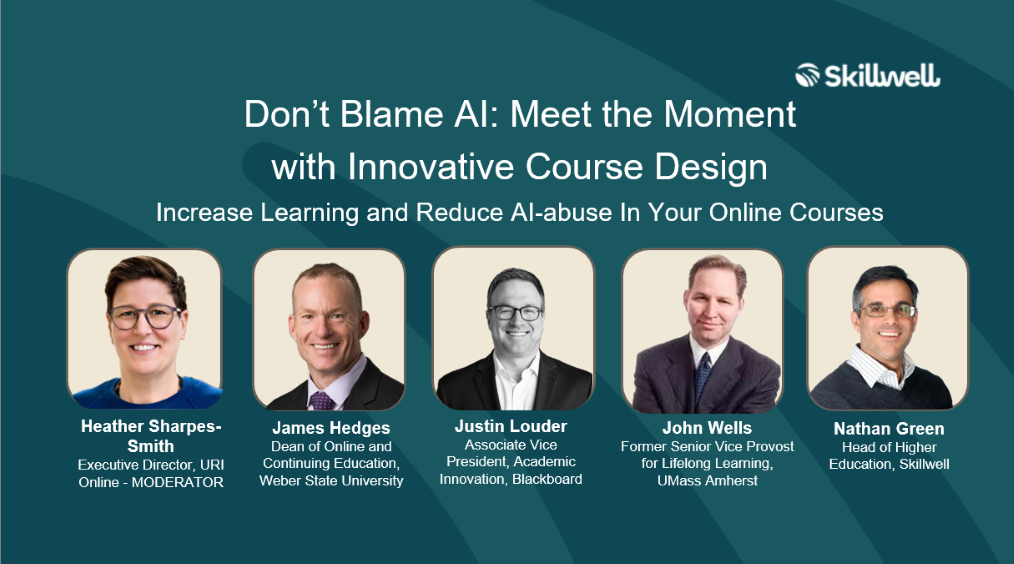
Join our webinar panel discussion to learn how to use formative and immersive elements to increase learning and reduce ...
Discover how Skillwell helps companies like Merck and AstraZeneca build critical compliance and ...
Here is the uncomfortable truth about AI in learning today: ...
Join our webinar panel discussion to learn how to use formative and immersive elements to increase learning and reduce ...