

Build Life Science Skills: Immersive & ...
Events
Discover how Skillwell helps companies like Merck and AstraZeneca build critical compliance and ...

In an era of rapid technological change and shifting workforce expectations, workplace learning and development has moved from a support function to a strategic imperative.
It's no longer enough to onboard employees and hope they figure out the rest—organizations need systematic approaches to building and maintaining the skills their workforce needs to execute today's strategy and adapt to tomorrow's challenges.
Let’s define workforce learning and development and explore real-world examples. When you can begin to build out a proper training system, you’ll be ready to expand your potential.
Workforce learning and development is the systematic process of building employee skills, knowledge, and competencies through structured training, experiential learning, and ongoing development opportunities.
It encompasses everything from formal certification programs to informal mentoring relationships—any deliberate effort to enhance the capability of people in the organization.
The goals go beyond skill acquisition. Effective learning and development for employees aims to improve individual performance, increase job satisfaction, foster innovation, and build the organizational agility needed to respond to market changes.
When done well, L&D creates a culture of continuous learning where growth is expected, supported, and rewarded—not treated as an occasional event.
Organizations that invest strategically in L&D experience measurable returns: higher retention rates, stronger engagement scores, and better business performance.
This isn't aspirational—it's documented. The critical shift is from treating L&D as a cost center to treating it as a capability-building engine that drives competitive advantage.
Leveraging AI-powered adaptive learning enhances these initiatives by creating personalized learning pathways that adapt to each employee's demonstrated knowledge—ensuring training is relevant, efficient, and produces verified evidence of capability growth rather than just completion records.
Learning and development examples span a wide range of formats, each with distinct strengths depending on the skills being built and the audience being served.
Workshops, instructor-led training, and online courses provide consistent, scalable knowledge transfer. These programs work well for baseline skills, compliance requirements, and foundational knowledge—areas where every employee needs to reach a defined standard.
Pairing less experienced employees with seasoned professionals creates knowledge transfer that formal programs can't replicate. Mentorship builds institutional knowledge, accelerates cultural assimilation, and develops the relationship skills that drive collaboration across teams.
Online learning platforms give employees the flexibility to develop skills on their own schedule and at their own pace.
The most effective e-learning goes beyond passive content consumption to include interactive assessments, case studies, and application exercises that test whether learning is actually sticking.
For skills that require judgment, decision-making, and performance under realistic conditions, immersive simulation training provides experiential learning that content alone can't deliver.
Employees practice skills in realistic scenarios—building the applied competence that matters most on the job. Different types of simulations serve different learning objectives, from branching decision-making exercises to full-scenario role-plays.
Rotating employees through different departments or functions broadens their business understanding, builds empathy across teams, and develops the systems-level thinking that future leaders need.
These programs require more coordination but produce uniquely versatile employees. And it works: 83% of employees reported receiving sufficient training from their employers, indicating a strong commitment to employee development.
One-size-fits-all L&D strategies underperform because different teams face different challenges, use different tools, and need different skills. Tailoring requires a deliberate process.
Before designing any program, understand where each team's capability gaps actually are.
This means conducting skills assessments, reviewing performance data, gathering input from team leaders about recurring challenges, and analyzing the specific competencies needed for each team's objectives.
Assumptions about what teams need—without data to support them—lead to training that feels irrelevant.
A customer service team, a software engineering team, and a sales team all need development—but the content, format, and delivery approach should differ significantly.
Technical teams may benefit most from hands-on labs and peer code reviews. Customer-facing teams may need scenario-based practice and communication skills development. Leadership teams may require coaching, strategic simulations, and cross-functional exposure.
Training programs should evolve based on participant input and measured outcomes—not remain static once launched.
Regular check-ins with team leaders, post-training performance data analysis, and ongoing skills assessment ensure that programs stay relevant as team needs change.
Incorporating adaptive learning technology makes tailoring more scalable. Rather than building entirely separate programs for each team, adaptive platforms personalize the learning pathway for each individual based on their demonstrated knowledge—automatically adjusting difficulty, content focus, and pacing without requiring manual customization for every learner.
Organizations that consistently produce strong L&D outcomes share five foundational elements. These pillars don't operate independently—they reinforce each other, and weakness in any one area limits the effectiveness of the others.
Without genuine executive sponsorship, L&D programs operate at the margins. Leadership support means more than approving budgets—it means visibly prioritizing learning, protecting time for development, and holding managers accountable for supporting their team's growth. When leaders model continuous learning themselves, the signal is unmistakable.
A culture that values learning creates an environment where employees actively seek development opportunities rather than viewing them as mandatory distractions.
This culture manifests in how mistakes are treated (as learning opportunities or as failures), how knowledge sharing is rewarded, and whether employees feel safe admitting skill gaps.
The right technology stack—from adaptive learning platforms to content authoring tools to LXP integrations—makes scalable, personalized learning possible. Technology should reduce friction between employees and learning, not add administrative burden.
Organizations that can measure learning outcomes—through verified skills data, performance correlation, and business impact metrics—make better investment decisions and can continuously improve their programs.
Measurement also creates accountability: when L&D can demonstrate results, it earns the organizational credibility and budget to do more.
L&D programs that align with strategic priorities earn ongoing investment because their impact is visible. Programs that exist independently of business goals—no matter how well-designed—eventually lose organizational support. The strongest L&D functions operate as strategic partners, not service providers, actively shaping the capability agenda that drives business outcomes.
When these five pillars are strong, L&D becomes a genuine competitive advantage. When they're weak, even the best training content and technology will underperform. Organizations looking to build a skills-based training approach should evaluate their foundation across all five pillars before investing heavily in any single area.
Workplace learning and development works when it's strategic, personalized, and measurable. Skillwell delivers adaptive learning and immersive simulation training that builds verified skills across your workforce—with personalized learning strategies that meet every employee where they are.
Training builds specific skills for current job performance—closing immediate capability gaps in defined, measurable ways.
Development takes a longer view: building competencies that prepare employees for future roles, leadership responsibilities, and evolving organizational needs.
Training asks "can this person do the job today?" Development asks "what will this person need to grow into tomorrow?"
The strongest L&D programs integrate both rather than treating them as separate initiatives.
Structured onboarding programs that bring new hires to productivity faster than sink-or-swim approaches.
Simulation-based training where employees practice high-stakes decisions—customer complaints, safety scenarios, leadership conversations—in realistic environments before facing them on the job.
Mentorship pairings that transfer institutional knowledge from experienced employees to newer ones.
Cross-functional rotations that broaden business understanding and develop future leaders.
Self-directed e-learning platforms that let employees build skills on their own schedule without pulling them out of work.
Prioritize digital-first, asynchronous learning options that don't require employees to be in the same place at the same time.
Maintain the experiential and social elements of learning—virtual simulations, collaborative tools, peer learning channels—not just video versions of classroom content.
Use adaptive learning platforms that personalize each employee's experience regardless of location, ensuring consistent quality without in-person facilitation.
Track engagement and completion data closely for remote learners; lower visibility means problems surface later if you're not monitoring proactively.
Leadership support: executives who visibly prioritize learning and protect time for it, not just approve budgets.
Organizational culture: an environment where skill gaps are admitted openly, mistakes are treated as learning opportunities, and knowledge sharing is rewarded.
Technology and infrastructure: platforms that reduce friction between employees and learning rather than adding administrative burden.
Measurement and accountability: verified skills data and business impact metrics that prove whether programs are working.
Strategic alignment: L&D priorities that map directly to business objectives, so investment is defensible and impact is visible.
Employees who see a clear investment in their growth are significantly more likely to stay—development opportunity consistently ranks among the top factors in retention decisions.
The inverse is equally true: generic, infrequent training signals that the organization views development as an obligation rather than a genuine commitment.
Personalized learning pathways that connect to visible career advancement generate stronger engagement than programs positioned as mandatory or compliance-driven.
Retention gains compound: organizations with strong L&D cultures lose fewer senior employees, preserving the institutional knowledge that's hardest to replace.
What's the most common reason workplace L&D programs underperform?
Misalignment with actual business needs—programs designed around what's easy to deliver rather than what the organization needs employees to do better.
Lack of leadership support beyond initial budget approval; development that's consistently deprioritized in favor of short-term deadlines sends a clear message.
Measuring activity instead of outcomes—tracking completions and hours rather than verified skill growth and performance improvement.
One-size-fits-all content that doesn't account for what employees already know, making training feel like a waste of time rather than a genuine investment.
Discover how Skillwell helps companies like Merck and AstraZeneca build critical compliance and ...

Here is the uncomfortable truth about AI in learning today: ...
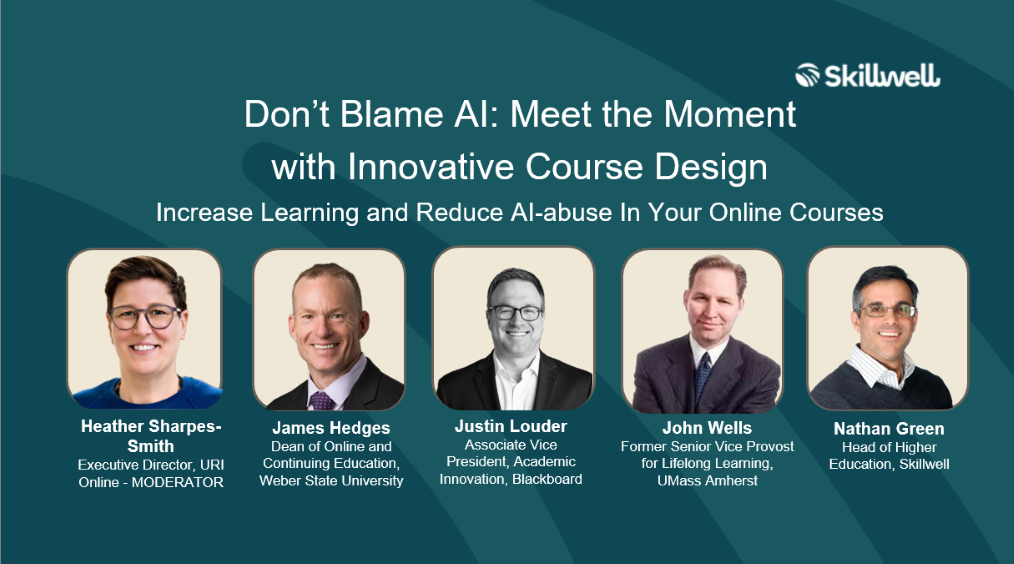
Join our webinar panel discussion to learn how to use formative and immersive elements to increase learning and reduce ...
Discover how Skillwell helps companies like Merck and AstraZeneca build critical compliance and ...
Here is the uncomfortable truth about AI in learning today: ...
Join our webinar panel discussion to learn how to use formative and immersive elements to increase learning and reduce ...