

Build Life Science Skills: Immersive & ...
Events
Discover how Skillwell helps companies like Merck and AstraZeneca build critical compliance and ...
As organizations navigate the complexities of the modern workplace, the emphasis on learning and development for employees has moved from a perk to a strategic necessity.
Continuous learning doesn't just build skills—it drives engagement, retention, and the organizational adaptability that separates market leaders from everyone else.
This guide covers the essential facets of employee L&D: why it matters, how formal and informal learning work together, the manager's critical role, common challenges and how to solve them, emerging trends reshaping the field, and effective assessment methods that prove whether programs are actually working.
The importance of learning and development for employees comes down to three interconnected outcomes: performance, engagement, and organizational resilience.
Continuous learning enhances employee performance by closing skill gaps that limit productivity. It's not just about teaching new techniques—it's about keeping the workforce current as tools, processes, and market demands evolve.
Employees who receive relevant, ongoing development are measurably more effective in their roles than those who receive onboarding training and nothing since.
L&D also drives engagement and retention. Employees who see a clear growth trajectory are significantly more likely to stay—and their daily engagement reflects that investment.
Organizations that prioritize development consistently report lower turnover, reduced recruiting costs, and stronger institutional knowledge retention.
Organizations that integrate AI-powered adaptive learning into their L&D programs take this further. Adaptive systems create personalized learning pathways that adjust to each employee's demonstrated knowledge and performance—ensuring training is relevant, efficient, and produces verified skills data that goes beyond simple completion metrics.
Understanding how formal and informal learning complement each other is essential for building effective learning and development activities for employees.
Formal training includes structured programs designed to build specific skills or knowledge—workshops, seminars, certification courses, and online learning modules. These programs have defined objectives, timelines, and measurable outcomes.
Their strength is consistency and scalability: every participant gets a baseline level of knowledge, and the organization can track completion and competency systematically.
The trade-off is flexibility. Formal programs can be time-consuming to develop and may not adapt well to individual learning speeds or preferences without adaptive technology.
Informal learning happens organically through day-to-day work—peer mentorship, on-the-job problem-solving, self-directed research, and collaborative knowledge sharing. It's flexible, immediate, and often where the deepest practical learning occurs.
The limitation is measurability. Informal learning is harder to track and its outcomes are difficult to quantify without systems designed to capture that data.
The most effective organizations design learning and development examples for employees that blend both approaches. Immersive simulation training bridges this gap by providing structured yet flexible scenarios that reflect realistic workplace challenges—combining the consistency of formal training with the experiential depth of informal learning.
Managers are the single most influential factor in whether L&D programs translate into actual behavior change. The best technology and content in the world won't produce results if managers don't actively support the learning process.
Managers who communicate the importance of learning and development activities for employees—and model that commitment themselves—create teams where development is a shared priority rather than an afterthought.
Ensuring employees have access to the tools, platforms, and protected time they need for development removes the most common barrier to participation.
Development that's always deprioritized in favor of immediate deadlines sends a clear message about organizational values—regardless of what the L&D team communicates.
Creating an environment where employees discuss what they're learning, how they're applying it, and where they need more support turns training from an isolated event into an ongoing conversation.
Managers who use skills data analytics from adaptive platforms can have more informed coaching conversations—identifying specific strengths and gaps rather than relying on general impressions.
By actively supporting development, managers enhance team engagement and build a culture where growth is expected, supported, and rewarded.
L&D professionals consistently encounter several challenges that can limit the effectiveness of even well-designed programs.
Limited financial resources force difficult trade-offs between the breadth and depth of training programs. Organizations that can demonstrate measurable L&D outcomes—through verified skills data and clear business impact metrics—are better positioned to secure and defend their budgets.
Getting employees to engage meaningfully with training—rather than completing it as a checkbox exercise—requires programs that feel relevant and respectfully designed. Generic content that doesn't account for what employees already know is the fastest path to disengagement.
Quantifying the impact of training on actual performance remains one of L&D's most persistent challenges. Moving beyond completion rates to verified competency measures requires both the right technology and a clear framework connecting training goals and objectives for employees to business outcomes.
Prioritizing development plans for employees, examples that align directly with business needs, ensures resources flow to the highest-impact programs.
By aligning employee development plans with direct business needs, you can ensure that resources are prioritized and directed toward the highest-impact programs.
AI-powered authoring tools that enable rapid content creation reduce development costs while keeping training current.
And simulation-based learning addresses the engagement challenge by providing realistic, interactive experiences that employees find genuinely valuable—because they're practicing decisions they'll actually face on the job.
The L&D landscape is evolving rapidly, driven by technological advancement and changing workplace expectations. HR professionals should be tracking several key trends.
Tailoring training to individual needs and learning patterns is moving from aspiration to expectation. Adaptive learning platforms that adjust in real time based on each learner's demonstrated performance are producing measurably better outcomes than one-size-fits-all programs.
Short, focused learning modules that employees can complete in the flow of work are gaining traction—particularly for reinforcement and just-in-time knowledge. Microlearning works best as a complement to deeper learning experiences rather than a replacement for them.
As the cost of immersive technologies continues to drop, more organizations are integrating VR, AR, and simulation-based training into their L&D strategies.
These technologies create experiential learning opportunities where employees practice skills in realistic scenarios—building the kind of applied judgment that passive content can't develop.
Skills data analytics is transforming L&D from an intuition-based function to an evidence-based one.
Organizations that capture verified skills data can measure actual competency growth, identify skill gaps across the workforce, and make resource allocation decisions based on evidence rather than assumptions.
Peer-to-peer learning platforms and collaborative tools are fostering knowledge sharing that extends beyond formal programs.
When combined with adaptive technology, social learning creates a continuous development ecosystem where employees learn from each other and from the platform simultaneously.
Embedding learning opportunities directly into daily tasks—rather than pulling employees away from work to train—promotes continuous development without the productivity cost of traditional classroom-based programs.
Measuring growth accurately requires assessment methods that capture genuine competency development—not just content exposure.
Comparing knowledge and skill levels before and after training provides a direct measure of learning gains. The most informative assessments test application ability—not just recall—by asking learners to demonstrate skills in realistic contexts.
Evaluating employees through realistic scenarios—such as branching simulations—provides evidence of what they can actually do under conditions that mirror real work. This approach captures verified skills data that's far more predictive of job performance than traditional knowledge tests.
Embedding assessment throughout the learning experience—rather than placing it only at the end—creates a continuous feedback loop. Learners understand their progress in real time, and the system adjusts content delivery based on demonstrated mastery.
Organizations using this approach have achieved 40% faster upskilling and a 27% average skill improvement.
Qualitative feedback from supervisors and colleagues provides context that quantitative assessments can miss—particularly for soft skills, collaboration, and leadership capabilities. Combining this feedback with skills analytics creates the most complete picture of employee growth.
Effective learning and development for employees produces verified capability growth—not just training hours. Skillwell combines AI-powered adaptive learning with immersive simulation training to deliver personalized learning strategies that build skills, accelerate time to competency, and give you the data to prove it.
Effective learning and development goals for employees are specific, measurable, and connected to both individual career aspirations and organizational needs.
Examples include reducing time to competency in a new role, building proficiency in a specific tool or methodology, or developing leadership capabilities for succession planning.
The best goals are framed as outcomes—"demonstrate the ability to handle X scenario independently"—rather than activities—"complete Y course."
Development plans for employees examples include structured onboarding pathways for new hires, leadership development tracks that combine mentoring with simulation-based practice, technical upskilling programs aligned with certification milestones, and cross-functional rotation plans that broaden business understanding.
The strongest development plans include specific milestones, timelines, and measurable competency targets—not just a list of courses to complete.
Measuring ROI requires connecting training outcomes to business metrics—productivity gains, error reduction, time to competency, and retention rates are the most commonly tracked. Organizations that use verified skills data (rather than completion rates) can draw a direct line between learning investment and performance improvement.
A practical framework: establish baseline metrics before training, capture competency data at defined intervals post-training, and calculate the cost of the skill gap versus the cost of closing it. Simulation-based programs accelerate this process by producing quantifiable performance data that traditional assessments don't capture.
Training is a subset of learning and development focused on building specific, near-term skills for a defined role or task. L&D is broader—it encompasses career growth, leadership pipeline development, organizational capability building, and the cultural conditions that make continuous learning possible.
In practice, the distinction matters because organizations that frame everything as "training" tend to underinvest in the longitudinal development that builds bench strength and adaptability. Effective L&D programs include both the immediate skill-building of training and the longer-term growth pathways that retain high-performers.
The honest answer: more frequently than most organizations update them. Programs tied to rapidly evolving skills—technology, compliance, leadership—should be reviewed at least annually, with targeted updates whenever significant role requirements, tools, or market conditions shift. Generic content ages faster than it looks.
AI-powered authoring tools have significantly reduced the cost and time required to keep content current. Organizations using adaptive platforms benefit from an additional layer of currency—because the system continuously adjusts to each learner's demonstrated performance, even static content produces more relevant outcomes than traditional fixed-path programs.
Discover how Skillwell helps companies like Merck and AstraZeneca build critical compliance and ...

Here is the uncomfortable truth about AI in learning today: ...
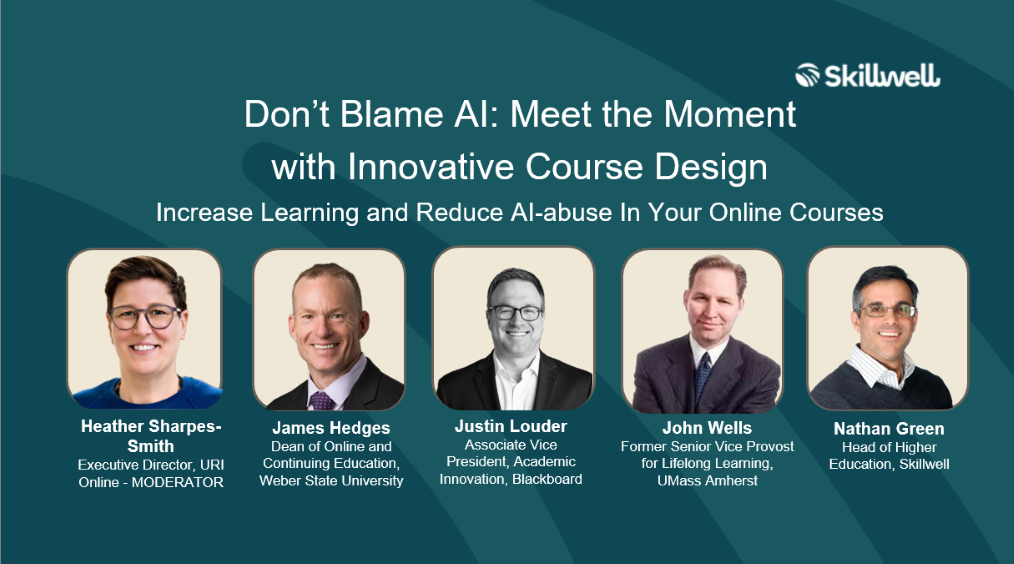
Join our webinar panel discussion to learn how to use formative and immersive elements to increase learning and reduce ...
Discover how Skillwell helps companies like Merck and AstraZeneca build critical compliance and ...
Here is the uncomfortable truth about AI in learning today: ...
Join our webinar panel discussion to learn how to use formative and immersive elements to increase learning and reduce ...