

Build Life Science Skills: Immersive & ...
Events
Discover how Skillwell helps companies like Merck and AstraZeneca build critical compliance and ...

As workplace dynamics evolve and skill requirements shift faster than ever, organizations that treat training as a strategic function—rather than an administrative task—consistently outperform those that don't.
Effective training and development builds a skilled, engaged workforce that can adapt to change and drive results.
Let’s cover core principles of effective training, the tools and technologies that support it, the 5 C's of employee engagement, and how understanding learning needs improves motivation across the organization.
Training best practices standards and guidelines center on three interconnected principles: strategic alignment, continuous feedback, and consistent quality.
Training programs that exist in isolation from business strategy waste resources—no matter how well-designed the content is.
Every significant training initiative should map directly to strategic objectives: if the organization is prioritizing customer retention, training should build the specific skills that drive retention.
If the priority is operational efficiency, training should target the competencies that reduce errors and accelerate processes.
Organizations that leverage AI-powered adaptive learning can further tighten this alignment by ensuring each employee's learning pathway reflects both organizational priorities and individual skill gaps—rather than delivering the same generic content to everyone regardless of their starting point.
Training best practices standards and guidelines emphasize ongoing assessment rather than one-time evaluations.
Regular feedback mechanisms—both from learners about the training and from performance data about the outcomes—allow organizations to refine programs in real time rather than waiting for annual reviews to discover problems.
This means incorporating verified skills data that captures what employees can actually demonstrate—not just what they completed.
The shift from tracking attendance to measuring competence transforms feedback from a compliance exercise into a genuine improvement tool.
Defining clear learning outcomes, assessment criteria, and delivery standards maintains consistency across training programs—particularly important in organizations with distributed teams or high employee turnover.
Assessment-driven content delivery ensures training remains relevant and that quality doesn't degrade as programs scale across departments and geographies.
The types of employee training and development tools available today range from foundational platforms to advanced adaptive systems.
The right combination depends on organizational size, learning culture, and the complexity of skills being developed.
LMS platforms remain the backbone of most corporate training operations—centralizing content delivery, tracking completion, and generating compliance reports.
Their strength is administrative efficiency and standardization. Their limitation is that most LMS platforms treat all learners the same, delivering identical content regardless of individual knowledge levels or learning needs.
Adaptive platforms go beyond the LMS by building individual learner models and adjusting content delivery based on demonstrated performance.
Skillwell Adapt exemplifies this approach—using AI to create personalized learning pathways that respond to each employee's demonstrated knowledge, ensuring training is efficient and targeted rather than one-size-fits-all.
Flexibility is essential for distributed and hybrid workforces. Mobile-compatible platforms allow employees to access training materials on their own schedule, from any location—supporting self-paced development without requiring everyone to be in the same room at the same time.
For skills that require judgment, decision-making, or application under pressure, immersive simulation training provides what passive content delivery can't—realistic practice scenarios where employees build applied competence.
The ability to create branching simulations in minutes rather than months means training can respond quickly to emerging business needs.
Discussion forums, shared workspaces, and peer feedback systems foster knowledge sharing that extends formal training into daily work.
When combined with LXP integrations like Degreed, collaborative tools become part of a connected learning ecosystem rather than isolated point solutions.
Understanding the 5 C's provides a framework for designing training programs that don't just build skills—they build engagement and commitment.
Strong relationships among team members create a sense of belonging that makes employees more receptive to learning. Training programs that include collaborative elements—peer discussions, team-based simulations, mentorship pairings—strengthen connection while building skills.
Employees who feel their work makes a meaningful impact are more motivated to develop the skills that increase their contribution. Training that's clearly connected to meaningful outcomes—not just compliance requirements—reinforces this sense of purpose.
Providing employees with the skills, knowledge, and practice they need to perform effectively builds genuine confidence.
Adaptive platforms that allow employees to demonstrate existing knowledge before assigning training—through features like Determine Knowledge™—build confidence by respecting what employees already know.
Organizations earn credibility through transparent communication, consistent follow-through, and genuine investment in employee growth.
When training programs are well-designed and clearly valuable—rather than perfunctory checkbox exercises—they signal that the organization takes employee development seriously.
A positive organizational culture that values learning creates an environment where training is welcomed rather than resented. Leaders who model continuous learning, celebrate skill growth, and allocate real time for development set the cultural tone that determines whether L&D programs succeed or fail.
The fastest path to disengagement is forcing employees through training that's irrelevant to their role, redundant with what they already know, or disconnected from how they actually learn best.
Employees engage more deeply with training that respects their existing knowledge and adapts to their learning patterns.
Personalized learning pathways that adjust based on demonstrated performance—rather than treating every employee identically—create a learning experience that feels designed for the individual, not mass-produced for the organization.
Learning needs evolve as employees grow, roles change, and business priorities shift.
Organizations that regularly evaluate employee progress and preferences—through performance data, skills assessments, and direct conversations—can adapt their training strategies before gaps become problems.
This proactive approach ensures training remains relevant and demonstrates ongoing organizational commitment to employee growth.
Training that visibly connects to advancement opportunities—promotions, new responsibilities, expanded roles—generates stronger engagement than training positioned as mandatory compliance.
When employees can see how skills-based training translates into career mobility, their motivation to engage deeply with learning increases significantly.
The organizations that understand how to improve training and development start with learning needs—not training catalogs.
By building programs around what employees actually need and how they best develop, they create a motivated workforce that sees training as an investment in their future rather than an interruption to their work.
Effective training combines strategic alignment, the right technology, and genuine understanding of employee learning needs. Skillwell delivers adaptive learning and immersive simulation training that builds verified competence—not just training hours—while personalizing every learner's pathway based on what they actually know and need.
Onboarding and role orientation, technical skills training tied to job requirements, leadership development, compliance training, and soft skills programs (communication, problem-solving, collaboration).
The most effective organizations blend formal structured programs with informal learning: mentoring, peer collaboration, and on-the-job practice reinforce what formal training introduces.
Prioritize depth over breadth—a focused program that closes a real performance gap outperforms a broad catalog that checks boxes.
Start with performance data: error rates, productivity metrics, and manager observations reveal objective skill gaps better than surveys alone.
Self-assessments and employee input provide useful starting points, but employees often don't accurately gauge their own competency gaps—triangulate self-reported needs with observable performance.
Assess existing knowledge before assigning training—employees shouldn't repeat content they've already mastered, and organizations shouldn't waste resources delivering it.
Involve team leaders: managers observe daily performance at a level that data can't fully capture.
Clear learning objectives tied to specific, measurable performance outcomes—not vague goals like "improve communication skills."
Opportunities to practice and apply skills, not just consume content; application-based learning produces deeper competence and better retention.
Feedback loops that tell employees how they're progressing and tell program designers where to improve.
Relevance to the learner's actual role—generic content that doesn't reflect real work scenarios produces the lowest engagement and the lowest transfer to job performance.
Focus on the highest-impact skill gaps first—areas where training will produce the most measurable performance improvement for the most people.
Use AI-powered content creation and adaptive delivery to reduce development costs; building everything from scratch is no longer necessary or cost-effective.
Leverage internal expertise through peer mentoring, structured knowledge-sharing, and documentation of institutional knowledge before it walks out the door.
Three well-designed, relevant programs will outperform twenty generic ones every time.
High-stakes and fast-changing content—compliance, technical skills, leadership development—should be reviewed at least annually, with updates triggered by any significant change in role requirements, tools, or regulations.
Embed continuous feedback mechanisms so problems surface in real time rather than at scheduled review cycles.
Track post-training performance data: if employees complete training but performance doesn't improve, the program needs revision—not more training hours.
Employees who see a clear investment in their growth are significantly more likely to stay; development opportunity consistently ranks among the top factors in retention.
Generic, low-effort training signals the opposite—that the organization views development as a compliance obligation rather than a genuine commitment.
Personalized learning pathways that respect existing knowledge and adapt to individual needs produce stronger engagement than one-size-fits-all programs, and stronger engagement correlates directly with retention.
Discover how Skillwell helps companies like Merck and AstraZeneca build critical compliance and ...

Here is the uncomfortable truth about AI in learning today: ...
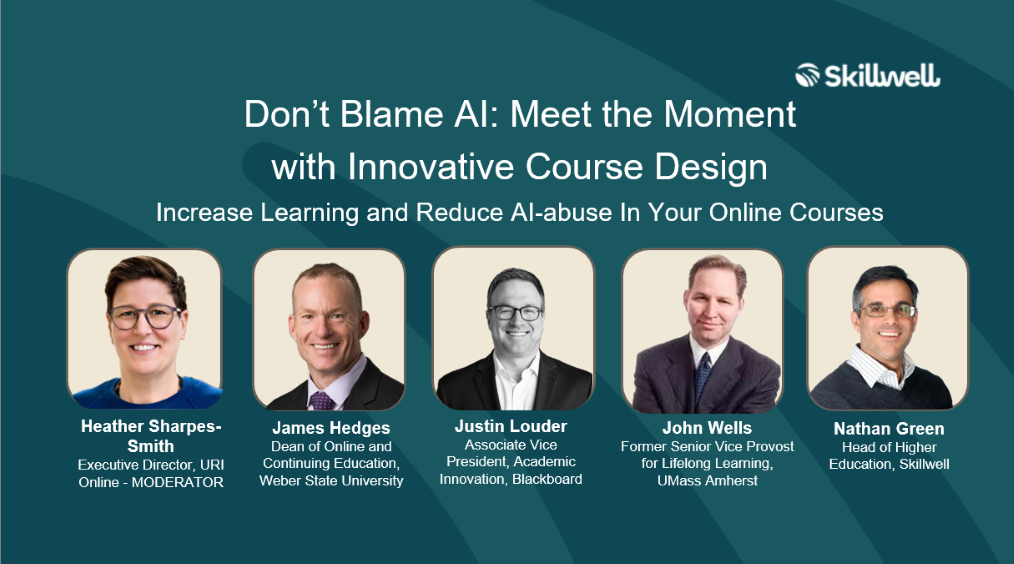
Join our webinar panel discussion to learn how to use formative and immersive elements to increase learning and reduce ...
Discover how Skillwell helps companies like Merck and AstraZeneca build critical compliance and ...
Here is the uncomfortable truth about AI in learning today: ...
Join our webinar panel discussion to learn how to use formative and immersive elements to increase learning and reduce ...