

Build Life Science Skills: Immersive & ...
Events
Discover how Skillwell helps companies like Merck and AstraZeneca build critical compliance and ...

The speed at which workforce demands are evolving has created a new urgency in higher education.
Institutions that continue delivering static, cohort-paced curricula disconnected from industry skills expectations are producing graduates who struggle in job markets that have moved on.
The emerging trends in the learning and development industry—personalized learning, simulation-based training, data-driven decision-making—are directly applicable to higher education, and the institutions that apply them first will lead.
Several trends are reshaping what effective learning and development looks like across both corporate and educational contexts.
Learning and development trends 2026 are heavily shaped by AI's ability to build individual learner models and adapt content delivery in real time.
Rather than moving every learner through the same sequence at the same pace, adaptive learning platforms adjust the experience based on what each person demonstrates they know—increasing difficulty when mastery is shown, reinforcing gaps when they're detected, and skipping material that pre-assessment indicates is already understood.
This personalization isn't a premium add-on—it's increasingly a baseline expectation in high-quality L&D programs. A study found that Generative AI and Immersive Reality are set to change higher education dramatically, offering unique ways to improve learning outcomes and provide better access to quality education."
In higher education, it means the ability to serve diverse student populations with varying levels of preparation without requiring instructors to manually differentiate instruction for each individual.
Institutions are increasingly adopting immersive simulation training to give students realistic practice with professional scenarios before they enter the workforce.
Different types of simulations serve different learning objectives—branching decision-making exercises, role-play conversations, technical procedure practice—all providing the applied experience that passive content delivery cannot.
The shift from credential-based to skills-based hiring is driving demand for objective evidence of competence that goes beyond grades and transcripts.
Verified skills data captures what students can actually demonstrate—not just what courses they completed. Institutions that can provide this evidence give graduates a meaningful advantage in job markets where employers are increasingly skeptical of credential-only signals.
Canvas-based authoring tools that allow educators to build branching simulations and adaptive course materials in minutes—not months—are changing the economics of curriculum development.
Institutions can now respond to industry changes, student feedback, and performance data quickly enough that course content actually stays current.
Current trends in higher education reflect a broader shift toward flexibility, competency focus, and technology integration.
The pandemic accelerated adoption of hybrid models that combine in-person and online learning, and most institutions have retained some version of this structure.
Effective blended programs use each modality for what it does best—face-to-face time for collaboration, mentoring, and complex discussion; online time for personalized content delivery, self-paced practice, and asynchronous interaction.
Higher education trends 2026 include a continued shift toward competency-based frameworks that measure what students can do rather than how much time they spent in courses.
This approach aligns directly with employer hiring priorities and enables institutions to produce clearer signals of graduate readiness than traditional GPA-based credentials.
Industry partnerships, applied capstone projects, and experiential learning components are becoming standard features of competitive academic programs.
These experiences give students firsthand workplace exposure and build the professional networks that traditional instruction doesn't provide.
Institutions that have successfully integrated these trends see measurable results.
The common thread is moving from content delivery to competency verification—using technology to personalize learning, practice tools to build applied skill, and data to confirm that development is actually occurring.
When AI-powered adaptive learning is combined with immersive simulation environments, the combination produces outcomes that neither approach achieves alone: personalized content delivery ensures every student is working on what they need, while simulation-based practice builds the applied competence that employment demands.
Together, they can deliver outcomes like 40% faster upskilling and 27% average skill improvement—metrics that matter to both institutions and the employers recruiting their graduates.
The path to adopting these trends isn't without friction. Understanding the obstacles is a prerequisite for addressing them.
Many educators and administrators are comfortable with established teaching practices and skeptical of technology-forward approaches. Overcoming this resistance requires evidence—documented outcomes from institutions that have already made the transition, and internal pilots that produce visible results before institution-wide rollout.
Implementing new technology requires financial investment, and many institutions operate under significant budget pressure. Prioritizing solutions that scale efficiently—platforms that deliver 10x training capacity without proportional increases in instructor time—makes the investment case stronger and implementation more sustainable.
Institutions must integrate new practices without compromising the rigor and standards that define academic credibility. The most successful implementations embed innovation within existing quality frameworks rather than treating it as a replacement for academic standards.

The institutions best positioned for 2026 and beyond are investing now in the technology, faculty development, and curriculum frameworks that support adaptive, skills-based, simulation-enhanced learning and development at scale.
Skillwell equips institutions with AI-powered adaptive learning and immersive simulation training that aligns with where higher education is heading—toward verified competence, personalized learning, and graduate outcomes that employers can trust.
AI-driven personalization that adapts content delivery to each student's demonstrated knowledge in real time — moving from cohort-paced curricula to genuinely individual learning pathways.
Competency-based credentialing that measures what students can do rather than how many hours they sat in a course — aligning directly with how employers are increasingly evaluating candidates.
Simulation-based applied learning that builds professional judgment before graduation, not after.
Verified skills data as a primary signal of graduate readiness — replacing credential-only indicators that employers are becoming skeptical of.
Competency-based education (CBE) measures learning by demonstrated mastery of specific skills rather than time spent in courses or credit hours accumulated.
It aligns with employer hiring priorities more directly than traditional transcript-based signals — employers care what candidates can do, not how long they studied.
CBE frameworks make it easier to communicate graduate readiness in concrete terms, which strengthens institutional credibility with industry partners.
Adaptive learning technology makes CBE more practical to implement at scale: automated assessment and content adjustment replace the manual differentiation that made CBE difficult to deliver previously.
Verified skills data captures what students can actually demonstrate — not just what courses they completed or what grades they received.
It gives employers objective, observable evidence of competence rather than requiring them to infer capability from proxies like GPA or institution reputation.
For institutions, it creates a feedback loop: competency data reveals where programs are producing strong graduates and where gaps persist — enabling continuous curriculum improvement.
Graduates from institutions that provide this data enter the job market with a clearer, more credible signal of readiness than a transcript alone can provide.
Start with evidence: documented outcomes from institutions that have already made the transition are more persuasive than theoretical arguments for change.
Run internal pilots that produce visible results before institution-wide rollout — early wins build credibility and reduce skepticism.
Frame new approaches as enhancing academic rigor, not replacing it; the most successful implementations embed technology within existing quality frameworks.
Faculty development is as important as technology adoption — educators who understand why adaptive and simulation-based approaches work are more likely to implement them effectively.
Students practice professional judgment in realistic scenarios before facing real-world stakes — building the applied confidence that classroom instruction alone doesn't develop.
Branching simulations create consequences for decisions, enabling students to learn from mistakes without the cost those mistakes carry in actual professional settings.
Simulation-based outcomes are verifiable: performance in realistic scenarios is more predictive of job readiness than end-of-course knowledge tests.
For institutions, simulation training addresses the gap employers consistently cite — graduates with theoretical knowledge but limited ability to apply it under real conditions.
Technology infrastructure that supports individual learner models without requiring instructors to manually customize content for every student.
Faculty readiness to shift from content delivery toward facilitation and coaching — adaptive platforms handle personalization, but instructors still drive the learning culture.
A measurement framework that captures competency data, not just completion data, so the institution can evaluate whether the technology is producing the outcomes it's supposed to.
Phased implementation: starting with programs where the need is clearest and building institutional confidence before expanding across departments.
Discover how Skillwell helps companies like Merck and AstraZeneca build critical compliance and ...

Here is the uncomfortable truth about AI in learning today: ...
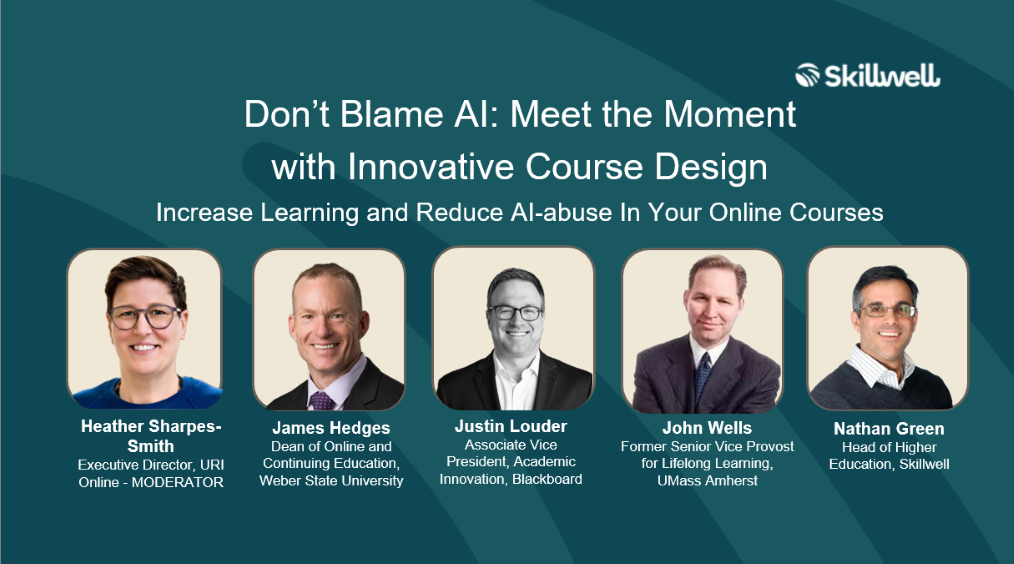
Join our webinar panel discussion to learn how to use formative and immersive elements to increase learning and reduce ...
Discover how Skillwell helps companies like Merck and AstraZeneca build critical compliance and ...
Here is the uncomfortable truth about AI in learning today: ...
Join our webinar panel discussion to learn how to use formative and immersive elements to increase learning and reduce ...