

Build Life Science Skills: Immersive & ...
Events
Discover how Skillwell helps companies like Merck and AstraZeneca build critical compliance and ...

Language learning gets talked about a lot in conversations about immersive education — probably because the connection between immersion and language acquisition is so intuitive. But the method's reach goes well beyond language.
Let's look closer at immersive learning examples being applied across healthcare, corporate training, the arts, and other fields — and what the evidence says about why it works.
The immersive teaching method is built on a single core premise: people learn by doing, not by being told.
Rather than presenting information and asking learners to absorb and remember it, immersive learning places them in realistic scenarios where they have to apply it.
The emphasis is on experiential learning — the kind that develops critical thinking, practical judgment, and problem-solving ability alongside specific knowledge.
Learners don't just leave with awareness of what they should do; they leave with experience having done it.
When combined with AI-powered adaptive learning, the immersive method becomes genuinely personalized — content and difficulty adjust based on how each individual is actually performing, so learners are always challenged at the right level and aren't wasting time on material they've already mastered.
Yes — and the impact is substantial. The research on this is consistent across contexts and populations.
Learners retain information at a 75% higher rate through immersive experiences than through conventional instruction.
The reason is straightforward: experiences create stronger memory encoding than passive reception of information. When you've navigated a situation — made decisions, seen consequences, adjusted your approach — you remember it.
Active participation changes how learners relate to material. They're invested in outcomes, not waiting for content to end. This sustained engagement is what allows complex or difficult material to be absorbed rather than skimmed.
Immersive scenarios don't present clean problems with obvious answers — they present the messy, contextual situations that real work involves. Navigating them builds genuine judgment, not just procedure recall.
This is the metric that matters most for organizations. Learners who practice in realistic simulations are significantly more prepared to apply skills in actual job situations.
Organizations using immersive learning and development strategies report 40% faster upskilling and a 27% average skill improvement — results that show up in performance, not just training dashboards.
Beyond the individual learner, immersive experiences generate verified skills data that gives organizations a real picture of workforce capability — not just who completed what, but who can actually perform when it counts.
The format of immersive learning varies considerably depending on what's being trained, what the stakes are, and what the learner population looks like. Let's look at how it plays out in a few key sectors.
In healthcare training, immersive simulation gives medical professionals the repetitions they need in a risk-free environment.
Practitioners can work through clinical decisions, patient conversations, and procedural judgment before applying those skills in real care situations.
A study found that intelligent immersive VR in gerontological nursing education improved training outcomes without usability issues — a meaningful signal that the format works in high-stakes clinical contexts.
Businesses use immersive learning across leadership development, sales and service, compliance and risk, and onboarding programs.
Employees navigate realistic scenarios before those situations arise in the real world, building both capability and confidence.
The ROI case is well-documented. Delta Airlines, for example, expanded its VR training program to over 1,800 technicians annually, reducing physical training costs by more than 30% while improving safety ratings.
The combination of reduced cost and better outcomes is what makes corporate immersive learning a business case, not just a training preference.
Artists and performers use immersive environments to rehearse, explore creative choices, and receive feedback in controlled settings.
Simulated performance environments allow iteration without the pressure — or cost — of live production.
Research indicates that immersive formats increase engagement and improve learning outcomes in creative fields in the same way they do in technical ones: by making the learning experience active rather than observational.
In technology companies and life sciences organizations, immersive learning addresses both skills development and compliance documentation requirements.
Simulation-based training generates audit-ready records of demonstrated competence — critical in regulated industries where proof of capability matters as much as the capability itself.
Across all of these sectors, the goals are consistent: higher engagement, better retention, faster skill development, and measurable evidence of competence. The formats vary, but the underlying method is the same — experience first, then reflection, then application.
Whatever your industry, the gap between training completion and real-world performance is a problem immersive learning is built to close.
Skillwell combines AI-powered adaptive learning with immersive simulation to create experiences that build genuine capability — not just records of attendance.
If you want to see what that looks like for your teams, explore the Skillwell platform with a guided tour.
Healthcare organizations use immersive simulation for clinical decision-making, patient communication, and procedural training in risk-free environments.
Corporate training teams use immersive learning for leadership, sales, compliance, customer service, and onboarding across virtually every sector.
Artists and performers use immersive environments to rehearse and refine their craft without the pressure or cost of live settings.
Life sciences and technology companies use simulation for skills development and the audit-ready compliance documentation that regulated industries require.
Higher education institutions use immersive formats to make abstract subjects — science, history, engineering — interactive and measurable.
Research shows learners retain information at a 75% higher rate through immersive experiences than through conventional instruction.
Memory encoding is stronger when learning happens through active experience rather than passive reception of information.
Organizations using immersive training report 40% faster upskilling and an average 27% skill improvement across their workforces.
Employees trained through immersive simulation are 275% more confident applying what they've learned than those trained through traditional methods.
Verified skills data captured during simulations gives organizations evidence of actual competence — not just who completed a module.
Traditional instruction asks learners to absorb and remember information; immersive learning asks them to apply it under realistic conditions.
Traditional methods measure completion and recall; immersive learning measures demonstrated competence and decision-making quality.
Emotional engagement is higher in immersive environments, which is a strong predictor of long-term memory and skill transfer.
Immersive learning scales to large populations consistently — every learner gets the same quality scenario, with performance data captured for each one.
Immersive platforms integrate with existing LMS systems, so organizations don't need to replace their training infrastructure to add immersive capability.
The decision-making structure of branching simulations builds genuine judgment, not just awareness of correct answers.
Immediate, contextual feedback reinforces the right behaviors and corrects errors before they become habits.
AI-powered adaptive pathways ensure each learner is working at the right level — not sitting through content they've mastered or rushing past what they haven't.
Skills data captured during simulations enables coaching, development planning, and workforce strategy based on actual performance, not assumptions.
The realistic context of well-designed scenarios creates strong transfer to real-world job performance — the skills built inside carry outside.
Discover how Skillwell helps companies like Merck and AstraZeneca build critical compliance and ...

Here is the uncomfortable truth about AI in learning today: ...
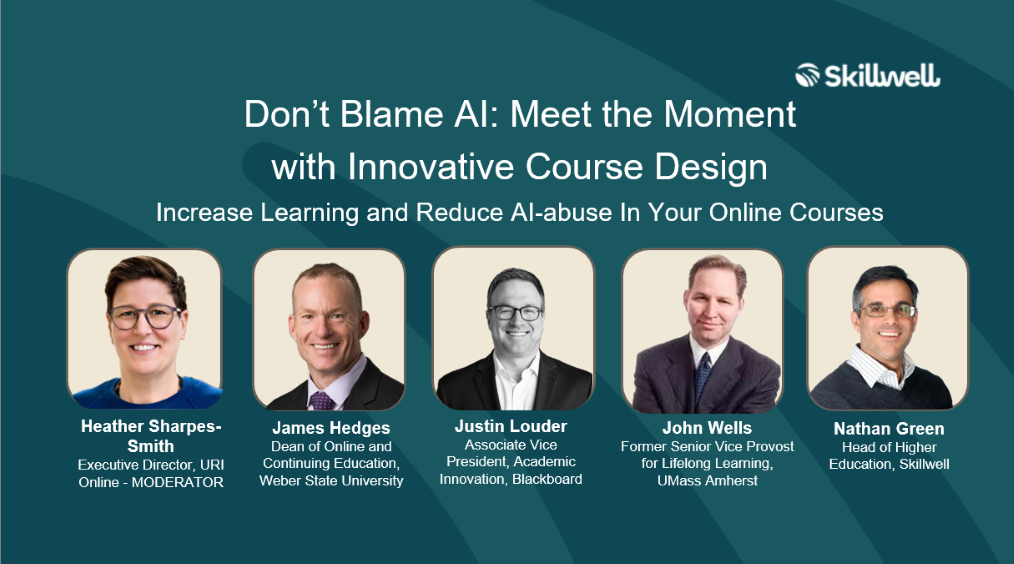
Join our webinar panel discussion to learn how to use formative and immersive elements to increase learning and reduce ...
Discover how Skillwell helps companies like Merck and AstraZeneca build critical compliance and ...
Here is the uncomfortable truth about AI in learning today: ...
Join our webinar panel discussion to learn how to use formative and immersive elements to increase learning and reduce ...