

Build Life Science Skills: Immersive & ...
Events
Discover how Skillwell helps companies like Merck and AstraZeneca build critical compliance and ...

Online learning has moved from a niche accommodation to a primary channel for both higher education and corporate training.
But delivery format and course quality are two different things—and many online courses still rely on passive content delivery that produces completion records rather than genuine competence.
The organizations and institutions that get online learning and development right apply a consistent set of principles: learner-centered design, active engagement, continuous feedback, and assessment-driven content delivery. This article covers practical online instructional strategies that bring those principles to life.
Effective integration starts with anchoring course design in established learning and development principles—not just converting existing content to digital formats.
Learning that centers the learner's needs, existing knowledge, and goals consistently outperforms instructor-centered delivery.
In practice this means: starting with a clear picture of who the learner is and what they already know, designing content that builds on that foundation rather than ignoring it, and giving learners meaningful choices about how they engage with material.
Platforms that incorporate pre-assessments allow learners to test out of content they've already mastered—ensuring every moment of their development time is spent on genuine gaps rather than redundant review.
This respect for existing competence is one of the most direct ways to signal that a course is designed for the learner, not around the curriculum. According to a 2025 report, 86% of students globally reported using AI for study tasks in 2024, highlighting the growing importance of personalized learning experiences.
Scenario-based learning applies L&D principles directly by placing learners in realistic situations where they must make decisions, experience consequences, and reflect on outcomes.
These instructional strategies examples move far beyond reading and watching—they require active cognitive engagement that drives deeper retention and better transfer to real-world application.
Incorporating branching simulations into online courses creates the applied practice environment that passive content can't replicate—particularly valuable for skills that require judgment, communication, or high-stakes decision-making.
Breaking content into focused, manageable modules gives learners control over pacing and enables courses to adapt to different learner needs without requiring entirely separate versions.
Modular design also makes courses easier to update as skills requirements evolve—a critical advantage in fields where industry knowledge changes quickly.
Engagement in online learning requires intentional design because the default environment—a learner alone with a screen—doesn't naturally create the social and environmental cues that support attention and motivation in physical settings.
Live polls, embedded quizzes, virtual breakout rooms, and discussion forums create opportunities for active participation that interrupt passive consumption patterns.
The key is to design these touchpoints around genuine learning objectives—not just engagement for its own sake. A quiz that surfaces misconceptions and triggers targeted review creates more learning value than a poll that simply generates a response.
A study found that integrating gamification into Massive Open Online Courses (MOOCs) resulted in a 28.86% completion rate and positive participant feedback, indicating enhanced learner motivation and satisfaction.
Group assignments and peer collaboration in online environments mirror the team-based work that defines most professional roles.
Well-designed collaborative projects develop communication skills, accountability, and the ability to synthesize different perspectives—all of which are consistently cited as top priorities by employers evaluating entry-level candidates.
Points, progress indicators, achievement recognition, and challenge-based activities tap into intrinsic motivation mechanisms that sustained engagement requires over longer courses.
When gamification is designed around genuine skill milestones—not arbitrary points—it reinforces the learning objectives while making progress feel tangible and rewarding.
Open feedback channels—both automated through adaptive learning platforms and human through instructor or peer interaction—help learners feel connected and supported.
Establishing a predictable rhythm for feedback ensures that no learner drifts off track for extended periods without someone noticing and responding.
The environment of an online course is defined by its structure, expectations, and the sense of community it creates—not by its production value or technology stack.
Learners who understand exactly what's expected of them—what they'll be assessed on, how feedback will work, what success looks like—can focus their energy on learning rather than navigating ambiguity.
A thorough orientation that covers course objectives, assessment criteria, and communication norms reduces the friction that derails online learners early in a course.
Content that's hard to find or confusingly structured creates cognitive load that competes with actual learning. Online learning environments that prioritize clear navigation, logical content sequencing, and easy access to support resources free up learner attention for what matters.
A sense of community is one of the most powerful predictors of online learning success.
Courses that create genuine opportunities for peer interaction—discussion boards that go beyond compliance, peer review activities, collaborative projects—build the social fabric that sustains motivation across a longer course.
Combining these environmental foundations with personalized learning pathways ensures that the environment supports diverse learners without requiring instructors to manually differentiate for every individual.
When the technology adapts to each learner's demonstrated progress—and the course design creates the conditions for engagement—online learning can match or exceed the outcomes of in-person instruction.
Effective online learning strategies require both the right design principles and the right technology infrastructure.
Skillwell delivers adaptive learning and immersive simulation training that transform online courses from content delivery vehicles into genuine skill-building experiences—backed by verified skills data that proves learning is actually happening.
Learner-centered design — courses built around what learners already know, need, and are working toward outperform courses built around content coverage or instructor convenience.
Start with clear learning outcomes, assess existing knowledge before assigning content, and adjust the experience based on what progress data actually shows.
The fastest way to lose an online learner is to make them sit through material they've already mastered; the second fastest is to drop them into content with no scaffold for where they are.
The underlying principles are the same—active learning, spaced practice, feedback loops, collaborative work—but the implementation tools differ.
In-person settings leverage physical presence, real-time social cues, and shared environment to create engagement naturally; online settings require all of that to be designed deliberately.
Asynchronous collaboration, discussion forums, peer review activities, and scenario-based simulations do the work that a shared room does automatically in person.
Online settings actually have one advantage in-person instruction lacks: the ability to personalize pacing and content delivery to each individual learner at scale.
Break content into focused modules with clear, achievable milestones—long undifferentiated stretches of content kill motivation faster than anything else.
Build in regular touchpoints: low-stakes quizzes, scenario exercises, and peer interactions interrupt passive consumption and create a rhythm of active participation.
Gamification tied to genuine skill milestones—not arbitrary points—makes progress feel tangible and gives learners a reason to return.
Automated feedback through adaptive platforms ensures no learner drifts off track unnoticed; predictable instructor touchpoints reinforce that someone is paying attention.
Assessment that tests application, not just recall — learners should demonstrate they can do something, not just recognize the right answer.
Scenario-based and simulation-based practice that mirrors the actual decisions learners will face on the job; passive video consumption doesn't build judgment.
Verified skills data that captures demonstrated competence rather than time-on-module or click-through rates.
Continuous feedback loops that adjust what learners see next based on what they've actually shown they know — not a fixed linear path everyone walks regardless of progress.
Structured peer interaction — discussion prompts with real response requirements, peer review assignments, and collaborative projects create the social fabric that sustains motivation.
Establish a predictable communication rhythm from day one: learners who know when to expect feedback and how to get support are far less likely to disengage.
Design discussion activities around genuine learning objectives, not compliance checkboxes; a prompt that requires synthesis and application produces more community than one that just asks for reactions.
Move beyond completion rates and satisfaction scores — those measure whether people showed up, not whether they learned anything.
Pre- and post-assessments that test application ability (not just recall) provide the most direct evidence of skill growth.
Track post-training performance data: did error rates drop, did productivity improve, are managers observing the behaviors the training was designed to build?
Verified skills data from adaptive platforms provides ongoing competency evidence rather than a single end-of-course snapshot.
Discover how Skillwell helps companies like Merck and AstraZeneca build critical compliance and ...

Here is the uncomfortable truth about AI in learning today: ...
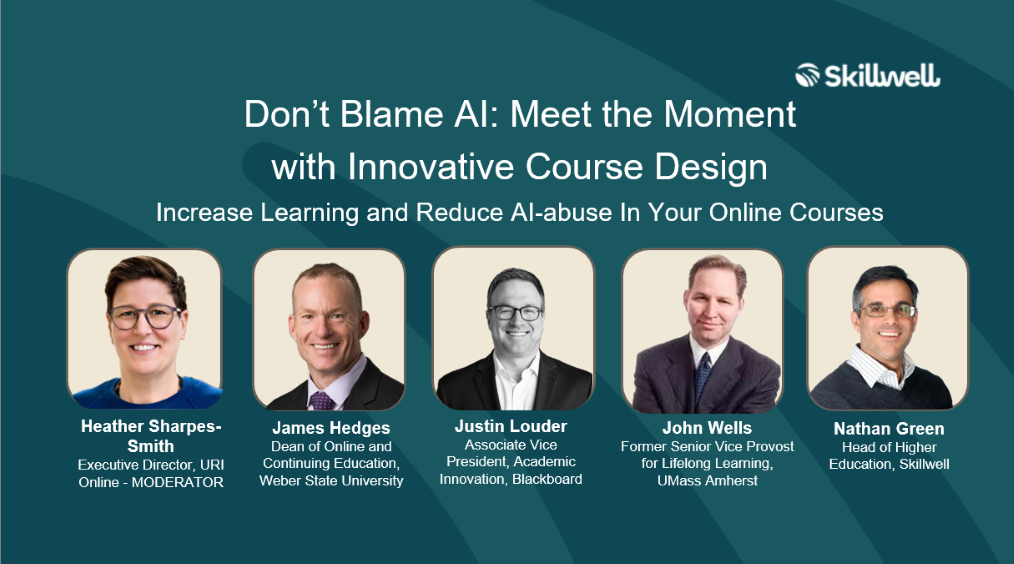
Join our webinar panel discussion to learn how to use formative and immersive elements to increase learning and reduce ...
Discover how Skillwell helps companies like Merck and AstraZeneca build critical compliance and ...
Here is the uncomfortable truth about AI in learning today: ...
Join our webinar panel discussion to learn how to use formative and immersive elements to increase learning and reduce ...