

Beyond the Content Explosion: What 17 ...
Blogs
Here is the uncomfortable truth about AI in learning today: ...

Not all training delivers equal results. Some methods build real capability. Others check boxes without changing performance.
For organizations investing in workforce development, understanding which approaches actually work—and why—shapes every decision about learning strategy.
The answer increasingly points toward skills-based training: practical, measurable, and directly applicable to the work employees do every day.
If you're evaluating skills training software or considering skills training software for employees, this distinction matters.
The training type you choose determines whether you're building genuine capability or just tracking completions.
Organizations typically deploy several training categories, each serving different purposes:
Introduces new hires to company culture, policies, procedures, and role expectations. Effective onboarding accelerates time to productivity and improves retention.
Develops specific skills or knowledge required for particular job functions—software proficiency, equipment operation, and technical processes.
Builds interpersonal capabilities: communication, teamwork, problem-solving, leadership, emotional intelligence. These skills often determine performance more than technical knowledge alone.
Ensures employees understand legal and regulatory requirements relevant to their roles. Often mandatory, but frequently treated as a checkbox exercise rather than genuine capability development.
Each type serves a purpose. But not all approaches within these categories produce equal results.
When comparing training effectiveness, skills-based methods consistently outperform traditional content-delivery approaches. Here's why:
Skills-based training focuses on what employees can do, not just what they know. Learners practice applying capabilities in realistic scenarios—which means the learning translates directly to job performance.
When training targets specific skill gaps rather than generic content, employees learn faster. Organizations consistently see significant reductions in training time while improving outcomes.
Practical, relevant training keeps employees motivated. They see the connection between what they're learning and how it helps them succeed in their roles.
Skills-based approaches capture verified performance data—not just completion metrics. Organizations can actually prove that training improved capability.
Effective skills-based training produces cascading advantages: stronger individual performance, improved job satisfaction, higher retention, better customer service, increased adaptability, and clearer career progression paths.
The key is aligning training with specific competencies employees need—then measuring whether they've actually developed those capabilities.
Traditional training often emphasizes information transfer. Employees watch videos, read materials, and complete quizzes. They learn about topics.
Skills-based learning emphasizes capability development. Employees practice handling situations, making decisions, and applying knowledge. They learn to do things.
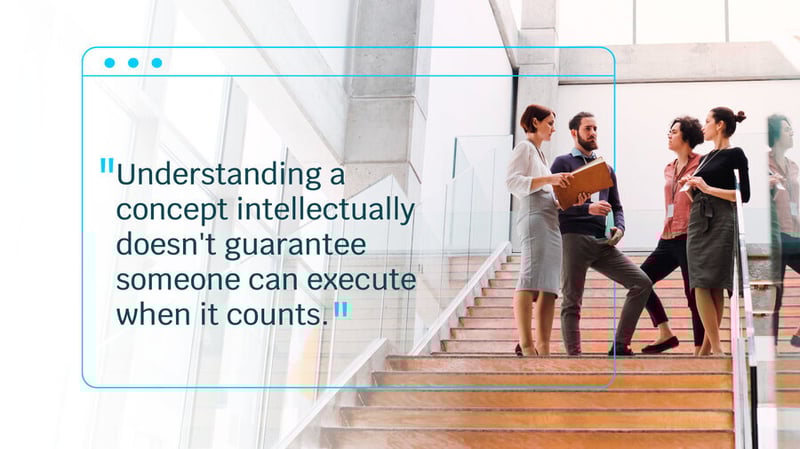
This shift matters because performance depends on the application. Understanding a concept intellectually doesn't guarantee someone can execute when it counts.
Skills-based programs identify the exact capabilities each role requires and build training around those specific competencies. Nothing is wasted on irrelevant material.
Different employees start at different proficiency levels and learn in different ways. Skills-based approaches adapt to individual needs rather than forcing everyone through identical content.
When employees practice real-world scenarios during training, they can apply new skills right away. There's no gap between learning and application.
For new hires, adaptive assessment-driven onboarding creates personalized 30-60-90 day journeys. Instead of a generic orientation, employees develop the specific skills their role requires from day one.
Adaptive learning amplifies the power of skills-based training by personalizing every aspect of the experience.
Instead of guessing what someone needs, adaptive platforms assess current proficiency and create customized learning journeys. Training time focuses on actual gaps, not content already mastered.
Learners receive immediate insights on their performance, helping them adjust and improve continuously rather than waiting for delayed assessments.
Adaptive systems evolve based on performance data. What's working gets reinforced. What's not gets refined. The training improves over time.
Studies show that adaptive learning can improve training effectiveness by 35% compared to traditional methods. Organizations using adaptive platforms also report 45% increases in employee retention due to stronger learner engagement.
At Skillwell, our platform combines AI-powered adaptive learning with immersive simulation training. Branching simulations adapt to each learner's journey, creating personalized experiences that build real capability.
And because we capture verified skills data throughout, organizations get audit-ready, evidence-based records proving competence—essential for compliance and accountability.
The best training for employees isn't the most comprehensive content library or the longest course catalog. It's training that builds genuine, verified skills employees can apply immediately.
Skills-based approaches—especially when enhanced by adaptive technology and immersive simulation—consistently outperform traditional methods. They're more efficient, more engaging, and more effective at developing the capabilities organizations actually need.
At Skillwell, we've built our platform around these principles. AI-powered adaptive learning personalizes every pathway. Immersive simulations create realistic practice environments. Verified skills data proves what employees can actually do.
The result? Training that develops real capability—faster, with proof.
It’s time to implement training that works. To learn more, explore how Skillwell combines AI-powered adaptive learning with immersive simulation to build verified workforce capability.
Here is the uncomfortable truth about AI in learning today: ...
Adaptive learning promises personalized pathways and measurable gains. Seasoned buyers know no technology arrives without ...
Remote and hybrid higher education changed what "hands-on" can mean.
Here is the uncomfortable truth about AI in learning today: ...
Adaptive learning promises personalized pathways and measurable gains. Seasoned buyers know no technology arrives without ...
Remote and hybrid higher education changed what "hands-on" can mean.