

Build Life Science Skills: Immersive & ...
Events
Discover how Skillwell helps companies like Merck and AstraZeneca build critical compliance and ...

In a business world where the skills that matter today may not be the skills that matter in two years, learning and development has become one of the most direct ways organizations build and maintain competitive advantage.
But the L&D purpose extends beyond abstract workforce improvement.
Effective programs connect employee growth to specific business outcomes—retention, productivity, adaptability—in ways that are measurable and strategically aligned.
This guide explores why organizations invest in L&D, what tools help track progress, and what successful L&D outcomes actually look like in practice.
Learning and development refers to the systematic approach organizations take to build the skills, knowledge, and competencies their workforce needs—both for current performance and future readiness.
The L&D purpose is foundational: it creates the bridge between where employees are and where the organization needs them to be.
At its core, effective L&D fosters a culture of continuous improvement and innovation.
When learning initiatives align with organizational goals, employees see a clear connection between their personal growth and the company's success, which drives engagement, productivity, and loyalty.
According to a 2025 study, organizational learning has become a serious competitive differentiator, with companies that invest strategically in development consistently outperforming those that treat it as an afterthought.
The integration of AI-powered adaptive learning with immersive simulation training exemplifies how modern organizations are making L&D both more efficient and more impactful.
Rather than delivering the same course to everyone, adaptive platforms personalize the experience based on each employee's demonstrated knowledge—while simulations provide the applied practice that builds real competence.
The reasons employers invest in L&D are both strategic and financial—and the evidence supporting that investment continues to grow.
Organizations that prioritize learning opportunities consistently see higher employee satisfaction and lower turnover.
Employees who feel invested in are less likely to leave—and the cost savings from reduced recruiting, onboarding, and lost productivity often justify the L&D investment on their own.
The Association for Talent Development reports that three-quarters of organizations now have L&D representation in their senior leadership team, reflecting its growing strategic importance.
A well-trained workforce adapts faster to market changes, innovates more effectively, and responds to customer needs with greater agility.
These aren't soft benefits—they translate directly into market position. Organizations that treat L&D as a strategic function build workforces that can execute on strategy rather than just understand it.
Employees who are actively developing their skills are more engaged in their work—and engagement correlates directly with productivity.
L&D programs that provide meaningful development opportunities, aligned with both organizational needs and individual career aspirations, create a reinforcing cycle: skilled employees perform better, better performance creates more opportunities, and more opportunities drive continued engagement.
The strongest L&D outcomes connect training to specific business metrics.
Organizations using adaptive learning software have achieved 40% faster upskilling and a 27% average skill improvement—metrics that translate directly into faster time to productivity, reduced error rates, and stronger business performance.
Maximizing the effectiveness of L&D requires visibility into how employees are actually progressing—not just whether they completed a course. Several categories of tools provide this visibility.
Platforms like Skillwell Adapt use AI to personalize learning pathways and continuously assess learner progress.
The adaptive engine adjusts content based on demonstrated performance, ensuring each employee works on the skills they actually need to develop—and the system captures verified skills data that provides evidence of competence beyond simple completion.
Analytics tools that track competencies and identify skill gaps across the organization give L&D leaders the data they need to make informed decisions about program design, resource allocation, and strategic workforce planning.
This data-driven approach transforms L&D from an intuition-based function to an evidence-based one.
User-friendly dashboards that display individual and team-level progress in real time enable both managers and employees to track development continuously—not just at quarterly reviews.
When progress is visible, accountability increases and learners stay more engaged with their development goals.
Tools that connect with existing HRIS and talent management platforms streamline workflows and ensure that learning data informs broader talent decisions—from succession planning to performance management.
Skillwell integrates with platforms like Degreed, enabling organizations to embed adaptive learning into their existing technology stack without disrupting established processes.
By combining these tools, organizations ensure that their L&D purpose is met with measurable outcomes—turning training investment into verified capability growth.
The most compelling case for L&D investment comes from the results organizations have actually achieved.
A leading technology company implemented a comprehensive training program that integrated immersive simulation training with adaptive learning.
By combining personalized content pathways with realistic practice scenarios, they achieved 40% faster upskilling and a 27% average skill improvement across participating teams.
Critically, these weren't self-reported improvements—they were measured through verified skills assessments that demonstrated actual competency gains.
A global manufacturing organization adopted a skills-based training approach, replacing generic compliance-style courses with targeted development programs built around verified competency data.
The result was a dramatic improvement in training delivery efficiency—allowing them to scale development initiatives across a global workforce without proportional increases in cost or administrative burden.
A financial services firm restructured its personalized onboarding program using adaptive technology, reducing average time-to-productivity for new hires by several weeks while improving 90-day performance scores.
The program used assessment data to identify each new hire's starting knowledge level and built a personalized onboarding pathway from there—skipping content they already knew and reinforcing the areas where they needed support.
These L&D outcomes share a common thread: each organization moved beyond generic training toward targeted, evidence-based development—and the results showed up in the business metrics that matter.
The purpose of learning and development is to produce results—not just activity. Skillwell combines AI-powered adaptive learning with immersive simulation training to deliver verified skills data and measurable L&D outcomes.
Explore what a modern, evidence-based L&D platform can do for your organization.
To build the skills employees need to perform effectively in their current roles and grow into future ones.
To close capability gaps before they become performance problems or competitive liabilities.
To strengthen organizational resilience by ensuring the workforce can adapt as business needs evolve.
To signal genuine investment in employees—which directly affects engagement and retention.
Track skill proficiency assessments, not just course completions—what people can do matters more than what they've watched.
Monitor time to competency: how quickly employees reach full productivity after onboarding or role transitions.
Connect training investment to business outcomes: productivity, error rates, revenue per rep, customer satisfaction.
Use retention data to test whether development programs are influencing employee decisions to stay.
Adaptive platforms make this easier by generating verified skills data tied to demonstrated performance.
Purpose is the why—the outcomes L&D is designed to produce for people and the business.
Strategy is the how—the programs, platforms, and priorities used to achieve those outcomes.
Weak L&D programs often have activity-focused strategies with no clear link to purpose.
Aligning strategy to purpose means every initiative can be evaluated against a real business objective.
Employees who see a clear development path are significantly less likely to look elsewhere.
Training that feels relevant—not checkbox compliance—signals the organization values their growth.
Career development programs tied to individual goals create loyalty that compensation alone can't buy.
Organizations with strong learning cultures report substantially higher retention than those without structured L&D.
Adaptive platforms personalize learning pathways based on individual skill gaps rather than delivering the same content to everyone.
Immersive simulations let employees practice decision-making in realistic scenarios—building applied judgment, not just passive knowledge.
Skills data analytics gives leaders visibility into capability gaps across the workforce, enabling targeted investment.
Scalable delivery means effective, personalized L&D no longer requires proportionally larger budgets or headcount.
Training is specific and time-bound—focused on a defined skill or task with measurable short-term outcomes.
L&D is broader, encompassing ongoing growth: leadership development, career planning, and continuous upskilling.
Training is one tool within L&D, not a substitute for it.
Organizations that conflate the two often underinvest in the long-term development that drives retention and adaptability.
Discover how Skillwell helps companies like Merck and AstraZeneca build critical compliance and ...

Here is the uncomfortable truth about AI in learning today: ...
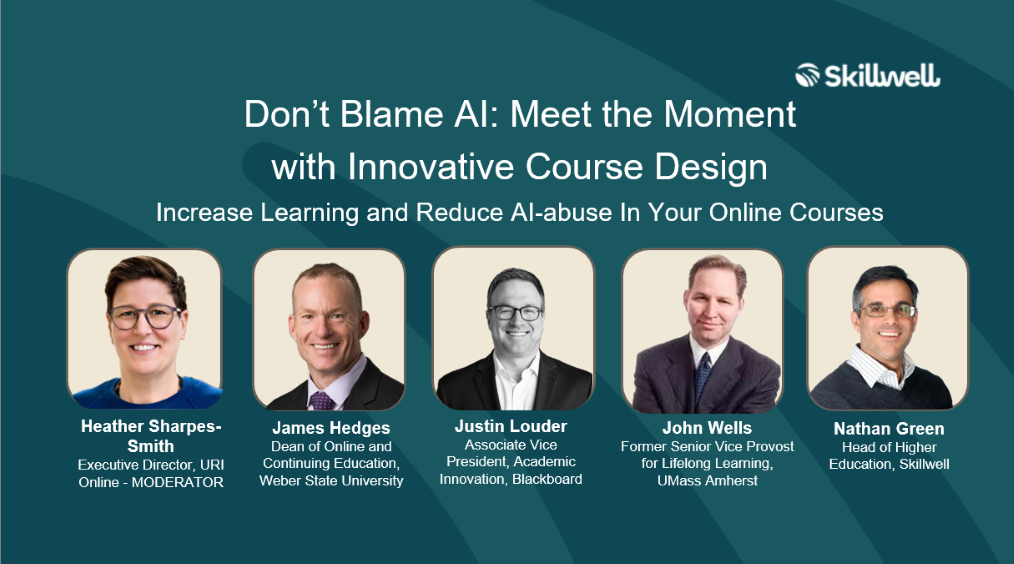
Join our webinar panel discussion to learn how to use formative and immersive elements to increase learning and reduce ...
Discover how Skillwell helps companies like Merck and AstraZeneca build critical compliance and ...
Here is the uncomfortable truth about AI in learning today: ...
Join our webinar panel discussion to learn how to use formative and immersive elements to increase learning and reduce ...