

Beyond the Content Explosion: What 17 ...
Blogs
Here is the uncomfortable truth about AI in learning today: ...
The concept sounds great: learning experiences tailored to each student rather than forcing everyone through identical content at the same pace.
But what does personalized learning actually look like when you're standing in front of a classroom? What do teachers do differently, and how do students experience it?
The gap between theory and practice matters here.
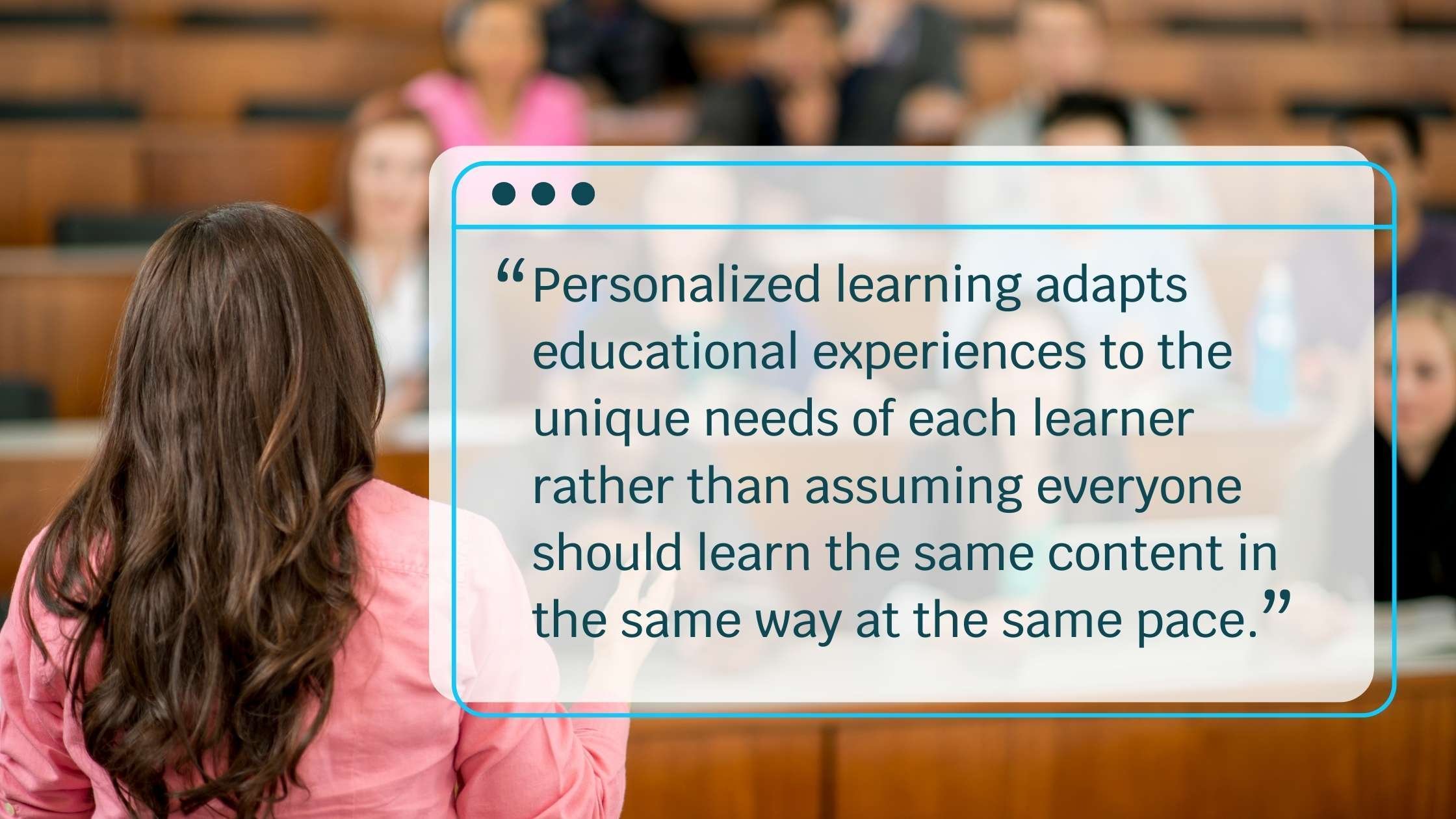
Personalized learning adapts educational experiences to the unique needs of each learner.
Instead of assuming everyone should learn the same content in the same way at the same pace, it recognizes that students arrive with different backgrounds, learn at different speeds, and respond to different approaches.
Three principles define the approach.
This contrasts sharply with traditional one-size-fits-all models. In conventional classrooms, content moves forward on a fixed schedule regardless of whether individual students have mastered material or need more time.
Personalized approaches recognize that this standardization leaves some students bored, others overwhelmed, and most somewhere in between – engaged with learning that wasn't really designed for them.
The shift toward personalization creates more engaging and effective experiences, particularly in higher education, where students arrive with vastly different preparation levels and career goals.
 What Makes Personalized Learning Systems Work?
Most effective personalized learning systems share several characteristics that distinguish them from traditional approaches.
When learners have genuine choices about their educational pathways – what they study, how they engage with material, what pace they maintain – motivation increases. People invest more in experiences they've helped shape than in experiences imposed on them.
A student fascinated by environmental issues and one drawn to technology can both learn scientific method, but through projects that actually engage them. This choice doesn't mean anything goes – it means multiple paths toward the same learning objectives.
Personalized learning AI analyzes how each student responds and modifies what comes next accordingly.
Struggling with a concept? The system provides additional practice and alternative explanations. Demonstrating mastery? Move forward without wasting time on material already understood.
When learners influence their educational journeys, they develop metacognitive skills – understanding how they learn best, where they need support, and how to direct their own development. These capabilities serve them long after any specific course ends.
Assessment in personalized environments looks different from traditional testing because it serves different purposes.
Formative assessments happen continuously rather than just at unit endpoints. Regular check-ins – quizzes, reflections, peer discussions, practice problems – provide ongoing insight into where each student stands.
This continuous feedback informs both the learner and the instructor about what's working and what needs adjustment.
Data analytics play a crucial role in tailoring experiences. By analyzing assessment results, educators can modify instruction to better meet individual needs.
Verified skills data reveals not just whether students completed activities, but whether they can actually perform. This distinction matters when the goal is genuine competence rather than just checking boxes.
Self-assessment tools encourage students to evaluate their own progress.
When learners reflect on their understanding and identify their own gaps, they develop awareness that supports ongoing development. This self-knowledge becomes increasingly important as they move through education and into careers where they'll need to direct their own growth.
Features like pre-kickoff skills assessments add another dimension by letting students demonstrate existing competence upfront.
Why assess someone on material they've already mastered? Testing out based on prior knowledge ensures assessments are both fair and efficient, focusing attention where development is actually needed.
Concrete examples across different subjects illustrate how personalization works in practice.
Math stations organize classrooms around different skill levels and learning needs. Students rotate through stations offering activities matched to their proficiency – some work on complex problems that stretch their capabilities, while others reinforce foundational concepts they haven't yet mastered.
AI-powered adaptive tools can further tailor these activities, adjusting difficulty and focus based on individual performance patterns.
Project-based learning in science classes lets students choose projects aligned with their interests.
One student might investigate the impacts of climate change, another explore renewable energy technology, and a third examine animal behavior patterns.
All apply scientific concepts and develop research skills, but through topics that genuinely engage them. When combined with simulation training, these projects can include realistic scenarios that prepare students for actual workplace challenges.
Literature circles in English classes give students choice over what they read. Small groups form around books that resonate with different interests, discussing themes, characters, and ideas.
This approach generates richer discussion than forcing everyone through identical texts, and exposes students to diverse perspectives through peer conversations about different works.
Adaptive digital platforms provide personalized pathways through content in subjects from language arts to social studies.
These platforms adjust based on real-time performance data, ensuring each student receives appropriate challenge levels. Someone who quickly masters introductory content advances without waiting; someone who needs more time receives additional support without holding others back.
These personalized learning strategies share a common thread: they recognize individual differences and respond to them rather than ignoring them in pursuit of standardization.
The examples above aren't theoretical – they're approaches teachers implement every day. Personalized learning doesn't require exotic technology or a complete curriculum overhaul.
It requires attention to individual differences and a willingness to provide varied pathways toward common learning objectives.
The key insight is that personalization serves learning goals, not the other way around. The point isn't customization for its own sake; it's recognizing that standardized approaches leave too many students underserved.
When learning adapts to individuals, more students develop real competence.
Ready to see what personalized, adaptive training can do for your classroom or organization? Explore how Skillwell combines AI-powered adaptive learning with immersive simulation to create development experiences tailored to each learner's needs.
See How Skillwell Powers Personalized Learning
Here is the uncomfortable truth about AI in learning today: ...
Adaptive learning promises personalized pathways and measurable gains. Seasoned buyers know no technology arrives without ...
Remote and hybrid higher education changed what "hands-on" can mean.
Here is the uncomfortable truth about AI in learning today: ...
Adaptive learning promises personalized pathways and measurable gains. Seasoned buyers know no technology arrives without ...
Remote and hybrid higher education changed what "hands-on" can mean.