

Beyond the Content Explosion: What 17 ...
Blogs
Here is the uncomfortable truth about AI in learning today: ...

Why do two employees with the same training often perform so differently on the job?
It's rarely about intelligence or effort. More often, it's because traditional training treats everyone the same – delivering identical content at the same pace, regardless of what each person already knows or where they struggle.
The result? Some learners are bored, others are overwhelmed, and genuine skill development takes a back seat to completion checkboxes.
Personalized learning changes that equation. By tailoring educational experiences to individual needs, interests, and abilities, this approach helps learners progress at their own pace and in their own style.
The benefits are substantial: higher engagement, deeper understanding, and skills that actually transfer to real-world performance. And when personalized learning is combined with the latest technologies, it becomes a dynamic and effective tool for empowering individuals to reach their full potential.
This guide explores what personalized learning really means, how AI is reshaping what's possible, and why it matters so much in high-stakes environments where competency and job readiness are critical.
At its core, personalized learning is about putting the learner's journey first.
Instead of forcing everyone through the same curriculum at the same speed, it adjusts to individual goals, existing knowledge, and learning preferences.
Three principles define the approach:
Here's why this matters so much: learners aren't blank slates. They come with different backgrounds, experiences, and gaps.
A one-size-fits-all approach ignores these differences, wasting time on content some already know while rushing past concepts others haven't grasped.
In high-stakes environments – healthcare, compliance, leadership development – the stakes are even higher.
Organizations need skills-based training programs that align with specific workforce needs, not generic content that checks a box but doesn't build real capability. Personalized learning makes that possible by identifying what each individual needs and delivering exactly that.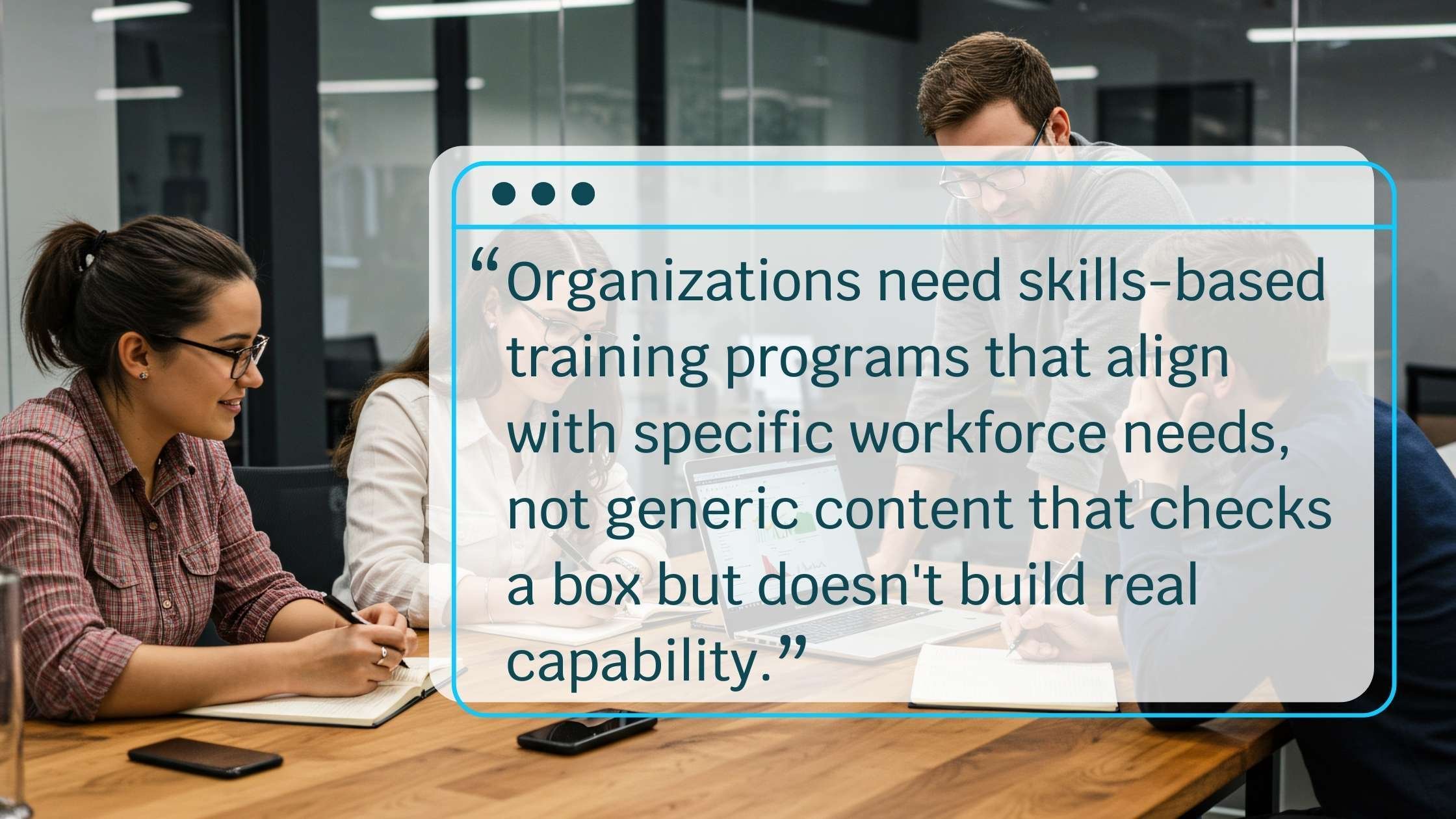
Artificial Intelligence has become the engine that makes truly personalized learning scalable.
Without AI, customizing learning for hundreds or thousands of employees would require an army of instructional designers. With it, the process happens automatically.
Personalized learning AI systems analyze performance data and learner preferences in real time, then adjust content accordingly. If someone struggles with a concept, the system recognizes it and provides additional practice or alternative explanations.
If someone demonstrates mastery, they move forward without wasting time on material they've already absorbed.
The benefits run deep. Learners receive support tailored to their specific needs, leading to better outcomes and higher engagement. Organizations gain confidence that training time is being spent effectively – not on content that's too easy or too advanced for the person experiencing it.
This becomes even more powerful when AI-powered adaptive learning is combined with immersive simulation training.
Realistic workplace scenarios don't just engage learners. They provide practical skills that transfer directly to their roles. People practice applying them in situations that mirror actual job challenges.
Verified skills data adds another layer of value. Instead of relying on completion rates or quiz scores, organizations can see evidence of demonstrated competence. This data-driven approach provides audit-ready documentation showing that employees can actually perform, not just that they showed up.
Why spend hours on training for skills you've already mastered? This streamlined approach ensures training is relevant and efficient, which is especially valuable when time and resources are limited.
Traditional teaching methods have a motivation problem. When content doesn't match what learners need (too easy, too hard, or just not relevant), engagement drops. People tune out or rush through just to finish.
Personalized learning flips this dynamic in two important ways.
When learners have agency over their educational journey, they feel more connected to the process. Research consistently shows that students engaging with personalized pathways demonstrate greater improvement than those in traditional settings. This makes sense – people work harder on things they feel ownership over.
Tailored content that aligns with individual interests and career goals makes learning feel meaningful. When educational material reflects personal aspirations, learners exhibit longer session durations, higher satisfaction, and improved efficiency. They're not just completing training; they're building toward something that matters to them.
AI-powered adaptive learning enhances this by keeping learners consistently challenged at the right level. Too easy and they're bored; too hard and they're frustrated. The sweet spot – where content pushes people just beyond their current capability – is where real growth happens. Adaptive systems find and maintain that balance automatically.
Of course, challenges exist. Not every student receives adequate support, and maintaining consistency in educational quality requires intentional effort.
Using verified skills data helps here, giving educators insight into each learner's progress and areas needing attention. Nobody falls through the cracks when you can actually see where each person stands.
The technology behind effective personalized learning platforms combines several key capabilities that work together to track and adapt to individual learners.
Learning analytics uses machine learning algorithms to continuously monitor performance to identify strengths and weaknesses. This ongoing assessment creates the foundation for personalized pathways that address each person's unique journey.
Without this data, personalization would just be guesswork.
Adaptive algorithms then adjust content and difficulty based on actual learner interactions. The experience evolves in real time, so if someone masters a skill quickly, they progress. If they struggle, they receive additional support.
Best of all, this happens automatically, without requiring manual intervention from instructors.
Many personalized learning strategies incorporate gamification and interactive elements to boost engagement. These features make learning enjoyable while ensuring active participation.
Research shows that gamified learning models significantly increase task completion rates and improve focus, particularly for learners who struggle with traditional formats.
Practical examples include platforms offering simulations, quizzes, and real-time feedback. The ability to create branching simulations in minutes (rather than months) empowers organizations to adapt quickly to evolving needs.
When new skills become important, training can be ready almost immediately instead of lagging behind business demands.
Skills data analytics enable something traditional approaches can't: measuring actual competency rather than just completion. Organizations can assess whether employees have genuinely mastered skills, not just whether they clicked through all the screens. This distinction matters enormously in environments where job readiness is paramount.
Transitioning to personalized learning isn't simple. Organizations face real barriers that require thoughtful strategies to overcome.
New technologies require investment, and staff need training to use them effectively. Colleges in under-resourced areas often lack access to adaptive learning platforms, creating equity concerns that must be addressed.
Educators and trainers who've spent careers developing expertise in traditional methods may hesitate to shift toward individualized approaches. This isn't stubbornness – it's a reasonable response to change. Effective transitions acknowledge this and bring teachers along rather than imposing new systems from above.
Personalized learning depends on collecting and analyzing student data to tailor experiences. This creates legitimate concerns about how that information is stored, used, and protected. Compliance with regulations isn't optional – it's essential for maintaining trust.
Several strategies help address these barriers. Professional development programs build instructor confidence in personalized methods. The American Federation of Teachers, for example, has launched AI training initiatives specifically designed to help educators integrate adaptive tools into their teaching.
Pilot programs allow organizations to start small, demonstrate results, and gather feedback before scaling.
AI-powered adaptive learning platforms like Skillwell can actually ease transitions by providing data-driven insights that help educators make informed decisions. Rather than replacing teachers, these tools augment their capabilities and free them to focus on high-value interactions with students.
Real-world implementations demonstrate what's possible when personalized approaches are done well.
The Summit Program uses a network of personalized learning plans that empower students to take ownership of their education. The results speak for themselves: students at schools implementing these strategies showed greater progress in math and reading than peers in traditional settings.
Khan Academy offers personalized pathways allowing students to progress through subjects at their own pace. Students using AI-powered platforms like this often achieve higher pass rates and a deeper understanding than those in conventional programs.
Personalized learning in higher education shows similar promise. The University of Central Florida developed a curriculum that truly adapts and responds to individual learners. As one director noted, "Now we know so much more about our students. We know what they know, what they don't know, what's difficult, and what's easy."
These examples highlight the potential for tailored approaches to transform outcomes and engagement.
When combined with immersive simulation training, the impact multiplies. Learners don't just consume personalized content – they practice applying skills in realistic scenarios that prepare them for actual workplace challenges.
Personalized learning shares DNA with two related approaches, but important distinctions exist, and it’s important to know the difference:
Individualized instruction focuses on tailoring experiences to each student's unique needs, often through one-on-one support. It's highly effective but resource-intensive – every learner requires dedicated attention.
Differentiated instruction adjusts teaching methods and resources based on student readiness and interests, but within a common framework. The whole class might be working on the same topic while approaching it through different pathways.
Personalized learning combines elements of both while leveraging technology to scale what would otherwise require unsustainable levels of individual attention.
AI-powered tools can assess prior knowledge and tailor pathways automatically, ensuring each student receives relevant and effective instruction without overwhelming educators.
Integrating these approaches creates a more holistic educational environment. Features that assess prior knowledge help educators identify starting points for each learner, while adaptive pathways ensure everyone receives appropriate challenge and support throughout their journey.
The shift from one-size-fits-all training to genuinely personalized learning represents a fundamental change in how organizations develop skills. Instead of hoping generic content somehow builds real capability, personalized approaches ensure learners get exactly what they need.
When AI-powered adaptive learning is combined with immersive simulation, the results compound: faster upskilling, measurable skill improvement, and employees who can actually perform when it matters.
The verified skills data captured along the way proves what people can do – not just what they sat through.
Ready to see what personalized, simulation-based training can do for your organization? Explore how Skillwell combines AI-powered adaptive learning with immersive simulation to create development experiences that build real skills.
Take A Tour of Skillwell's Capabilities Now
Here is the uncomfortable truth about AI in learning today: ...
Adaptive learning promises personalized pathways and measurable gains. Seasoned buyers know no technology arrives without ...
Remote and hybrid higher education changed what "hands-on" can mean.
Here is the uncomfortable truth about AI in learning today: ...
Adaptive learning promises personalized pathways and measurable gains. Seasoned buyers know no technology arrives without ...
Remote and hybrid higher education changed what "hands-on" can mean.