

Beyond the Content Explosion: What 17 ...
Blogs
Here is the uncomfortable truth about AI in learning today: ...
Employers consistently say the same thing: graduates have technical knowledge but lack the broader capabilities that actually drive workplace success. Communication. Problem-solving. Collaboration. Adaptability.
These are generic skills—transferable competencies that apply across industries and roles. Unlike specialized expertise that may become obsolete, generic skills remain valuable throughout careers and across job changes.
For institutions exploring skills training software or developing skills training for higher education programs, understanding how to teach these capabilities effectively determines whether graduates are truly prepared for the workforce.
Generic skills are transferable abilities applicable across fields, industries, and roles. Unlike hard skills—specific technical competencies tied to particular tasks—generic skills determine how effectively someone applies knowledge in varied contexts.
A systematic review in Frontiers in Education describes generic skills as "transversal competencies essential for professional success, encompassing cognitive, social, and emotional abilities."
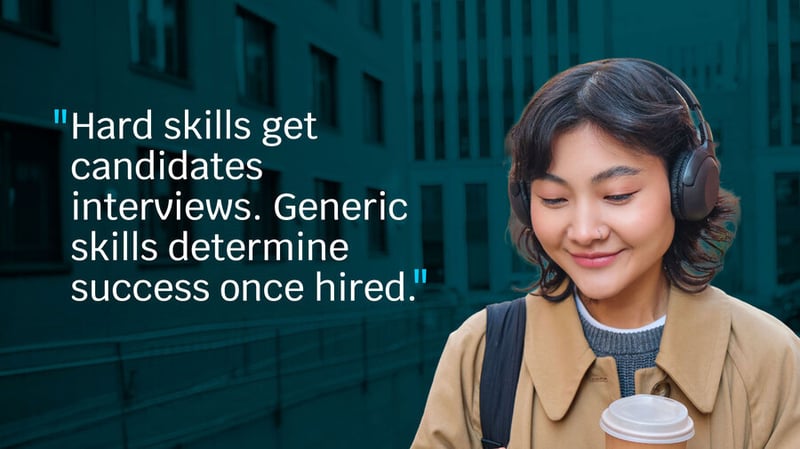
Hard skills get candidates interviews. Generic skills determine success once hired.
Someone might have excellent technical knowledge but struggle to communicate findings, collaborate with colleagues, or adapt when projects change direction. Generic skills are the foundation that makes technical expertise actually useful in workplace contexts.
The skills employers need are evolving—and the gap between academic preparation and workplace requirements persists.
Looking ahead, demand for generic skills will only increase. Automation handles routine technical tasks increasingly well, but capabilities like critical thinking, creative problem-solving, and interpersonal effectiveness remain distinctly human advantages.
Employers aren't just seeking technical expertise. They want graduates who can learn continuously, collaborate across functions, and adapt as roles evolve.
Developing generic skills requires different approaches than conveying technical knowledge. Lectures and textbooks alone won't build these capabilities.
Research in Frontiers in Education emphasizes that effective educators "actively recontextualize course content by integrating industry needs, personal expertise, and innovative pedagogical strategies"—connecting academic learning to workplace application.
Generic skills have historically been difficult to assess. How do you grade "teamwork" or "adaptability"?
Modern approaches use verified skills data captured during simulations and practical exercises. Students demonstrate capabilities in realistic scenarios, generating evidence of what they can actually do—not just what they know.
This data enables personalized learning pathways. Adaptive assessment identifies individual strengths and gaps, creating tailored development journeys that address each student's specific needs.
Technology can significantly enhance generic skill development when implemented thoughtfully.
Skillwell helps higher education institutions develop student capabilities through AI-powered adaptive learning and immersive simulation training.
Our platform creates realistic scenarios where students practice generic skills—communication, problem-solving, decision-making—in contexts that mirror actual workplace challenges. Verified skills data captured during these experiences enables personalized pathway adjustments, ensuring each student receives targeted development.
AI-powered authoring tools let faculty create branching simulations quickly, without technical dependencies. Programs can evolve as skill requirements change and industry needs shift.
The result? Students who graduate with demonstrated capabilities—not just academic credentials, but verified evidence of the generic skills employers actually need.
Generic skills determine workplace success. Communication, critical thinking, collaboration, adaptability—these capabilities make technical knowledge actually useful and enable career-long effectiveness.
Higher education institutions that prioritize generic skill development prepare students for more than first jobs. They prepare graduates for entire careers of continuous learning and adaptation.
At Skillwell, we help institutions build these capabilities through immersive practice and adaptive personalization. Students don't just learn about generic skills—they develop them through realistic application.
Want to enhance your institution's approach to employable skills? Explore how Skillwell combines AI-powered adaptive learning with immersive simulation to prepare students for workforce success.
Here is the uncomfortable truth about AI in learning today: ...
Adaptive learning promises personalized pathways and measurable gains. Seasoned buyers know no technology arrives without ...
Remote and hybrid higher education changed what "hands-on" can mean.
Here is the uncomfortable truth about AI in learning today: ...
Adaptive learning promises personalized pathways and measurable gains. Seasoned buyers know no technology arrives without ...
Remote and hybrid higher education changed what "hands-on" can mean.