

Beyond the Content Explosion: What 17 ...
Blogs
Here is the uncomfortable truth about AI in learning today: ...

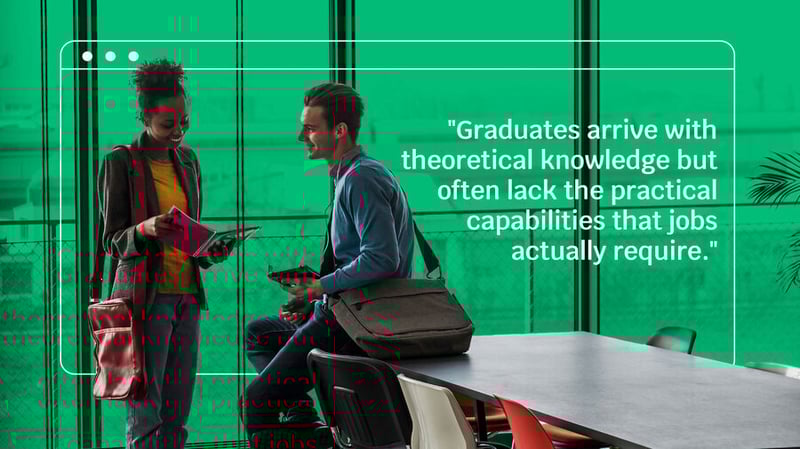
There's a persistent gap between what students learn in college and what employers need them to do. Graduates arrive with theoretical knowledge but often lack the practical capabilities that jobs actually require.
Skills training for higher education addresses this disconnect. Rather than focusing solely on academic content, it develops the hands-on competencies students need to succeed in the workplace—communication, critical thinking, technical proficiency, and the ability to perform under pressure.
For institutions evaluating skills training software to enhance their programs, understanding how skills-based approaches differ from traditional coursework—and what makes them effective—shapes every decision about curriculum and technology.
Professional development in higher education encompasses continuous learning opportunities for both educators and students. It creates an environment where skills evolve alongside industry demands rather than remaining static after graduation.
Skills training focuses on developing practical abilities directly applicable in the workplace. Unlike traditional academic learning that emphasizes theoretical knowledge, skills training prioritizes hands-on experience and real-world application.
So, how does it work?
Students engage in realistic scenarios that mirror actual workplace challenges. Healthcare students practice patient conversations. Business students navigate negotiations. Engineering students troubleshoot complex problems.
Collaboration and problem-solving through practical assignments that require applying knowledge rather than just demonstrating it on exams.
AI-powered systems create personalized learning journeys based on individual progress and demonstrated proficiency. Students who grasp concepts quickly move forward; those who struggle receive additional support.
The goal is to bridge the gap between knowing and doing. Students graduate not just knowledgeable but genuinely prepared to perform.
Branching simulations generated through AI technology allow institutions to create customized scenarios quickly—day-in-the-life experiences reflecting challenges students will actually face in their careers.
This prepares them for high-stakes situations before those situations carry real consequences.
Effective programs develop competencies employers consistently value:
The ability to convey ideas clearly—in writing, presentations, and conversations. This includes adapting communication style to different audiences and situations.
Analyzing information, evaluating options, and making informed decisions. Employers need people who can solve problems, not just follow instructions.
Working effectively with others toward common goals. Most meaningful work happens in teams, requiring coordination, compromise, and collective effort.
Mastery of industry-specific tools, technologies, and methodologies. The specific skills vary by field, but the ability to learn and apply technical capabilities is universal.
Adjusting to new situations, learning continuously, and remaining effective as circumstances change. Given how quickly industries evolve, this may be the most important capability of all.
Emotional intelligence, resilience, and interpersonal effectiveness—capabilities that determine success in workplace relationships and high-pressure situations. These skills are difficult to develop through traditional coursework but respond well to simulation-based practice.
Skills data analytics allow institutions to track and verify competency development, providing evidence-based records that prove what students can actually do—valuable for both graduates and employers.
Closing the gap between education and employment requires intentional strategies:
Collaborate with employers to understand current skill requirements. What capabilities do hiring managers actually look for? Where do new graduates typically fall short? Let these insights shape course content and program design.
Internships, co-ops, and practical projects give students real-world experience before graduation. These opportunities build capabilities that classroom learning alone cannot develop.
Guest lectures, adjunct practitioners, and industry advisory boards ensure academic programs stay connected to workplace realities. Students benefit from perspectives beyond full-time faculty.
AI-powered adaptive learning tailors experiences to individual students based on verified skills data. Rather than assuming all students need the same content, adaptive systems personalize pathways to address actual development needs—ensuring graduates are genuinely job-ready.
The distinctions matter for both institutions and students:
Traditional coursework often emphasizes theoretical knowledge and academic achievement. Skills-based learning prioritizes practical application and demonstrated capability.
Traditional programs produce graduates who understand concepts. Skills-based programs produce graduates who can perform—who've practiced applying knowledge in realistic situations.
Skills training adapts to individual needs and career goals. Students engage in hands-on experiences tailored to their interests and target industries, rather than following identical paths through standardized content.
Traditional coursework produces grades and transcripts. Skills-based programs can produce verified competency records showing what students can actually do—more meaningful to employers than GPA alone.
Innovative platforms are emerging as effective complements—or alternatives—to traditional Learning Management Systems:
Tools offering simulations, gamified experiences, and scenario-based practice. These create engagement that passive content delivery cannot match.
Short, focused modules that fit busy schedules and support continuous skill development. Particularly effective for technical skills that require ongoing updates.
Platforms that personalize pathways based on individual performance, ensuring students receive relevant content and appropriate challenge levels throughout their learning journey.
These alternatives address limitations of traditional LMS platforms, which typically manage content delivery and track completions but don't adapt to individual learner needs or verify actual capability development.
Adaptive learning represents a significant advancement in personalized education. By leveraging data analytics and AI, these technologies create tailored experiences that meet individual student needs at scale.
Delivering personalized skills development requires intentional design:
Understand individual student strengths, gaps, and career aspirations. Use assessments to identify where each person needs development rather than assuming uniform needs.
Create learning journeys aligned with specific career goals and industry requirements. A student pursuing healthcare needs different skill development than one entering finance or technology.
Mentoring, coaching, and continuous feedback guide students throughout their development. Personalization doesn't end with initial pathway design—it continues throughout the learning journey.
Skills data analytics monitor development over time, enabling pathway adjustments and providing students with verified competency records they can showcase to employers.
Skills training for higher education bridges the gap between academic knowledge and workplace capability. Students don't just learn concepts—they practice applying them in realistic scenarios until they achieve genuine proficiency.
At Skillwell, we help institutions create these experiences. AI-powered adaptive learning personalizes pathways based on individual student needs. Immersive simulations provide realistic practice environments. Verified skills data captures evidence of demonstrated competence.
The result? Graduates who are genuinely prepared—not just educated, but capable.
Ready to enhance your institution's skills training? Explore how Skillwell combines AI-powered adaptive learning with immersive simulation to prepare students for real-world success.
Take a Tour of Skillwell's CapabilitiesHere is the uncomfortable truth about AI in learning today: ...
Adaptive learning promises personalized pathways and measurable gains. Seasoned buyers know no technology arrives without ...
Remote and hybrid higher education changed what "hands-on" can mean.
Here is the uncomfortable truth about AI in learning today: ...
Adaptive learning promises personalized pathways and measurable gains. Seasoned buyers know no technology arrives without ...
Remote and hybrid higher education changed what "hands-on" can mean.