

Build Life Science Skills: Immersive & ...
Events
Discover how Skillwell helps companies like Merck and AstraZeneca build critical compliance and ...

When organizations need to continuously adapt, learning and development activities have become one of the most direct levers for building workforce capability.
But "development" is a broad term, and not every activity produces the same return.
The difference between a productive L&D investment and a forgettable one often comes down to choosing the right format for the right skill gap—and making sure the experience translates into actual performance improvement.
Let’s look at what development activities are and some concrete examples of professional development activities.
Developmental activities are structured efforts aimed at building the skills, knowledge, and competencies employees need to perform effectively and grow professionally.
They range from formal programs with defined curricula to informal experiences that happen organically in the flow of work.
These include structured programs such as workshops, seminars, online courses, and professional certifications.
Formal activities typically have specific learning outcomes, defined timelines, and measurable completion criteria. They're particularly effective when the skill to be developed is well-defined and the knowledge can be assessed through standardized methods.
These are less structured and include mentoring, peer learning, stretch assignments, and on-the-job training. Informal activities offer flexibility and can be tailored to individual needs in real time.
They're often where the deepest learning happens—especially for leadership skills, cross-functional understanding, and the kind of judgment that can't be taught through a course alone.
Incorporating both formal and informal activities ensures a well-rounded approach to employee development that covers the full range of areas of development at work examples.
Integrating AI-powered adaptive learning into this mix takes it further—personalizing pathways so each employee gets the right content at the right time, rather than moving through a one-size-fits-all program.
When considering professional development activities examples, several formats stand out for their effectiveness in building real capability.
These can range from technical skills training to soft skills development, providing targeted learning experiences with clear objectives.
The most effective workshops go beyond lecture and slides—they incorporate practice, feedback, and application. Utilizing immersive simulation training creates realistic workplace scenarios that improve retention and bridge the gap between knowing a concept and applying it under pressure.
Pairing less experienced employees with seasoned professionals accelerates learning in ways that formal training alone can't replicate. Mentors provide context, judgment, and career perspective that no course can deliver.
When mentorship is combined with verified skills data from adaptive platforms, organizations gain visibility into how mentees are developing—not just anecdotally, but through measurable competency growth.
Platforms like Skillwell offer adaptive learning powered by AI, allowing employees to engage in personalized learning pathways at their own pace.
This approach supports skills mastery through assessment-driven content delivery—the system continuously evaluates what each learner knows and adjusts accordingly, ensuring time is spent on genuine gaps rather than reviewing familiar material.
Rotating employees through different roles broadens their skills and deepens their understanding of the business. Job rotation is particularly valuable for developing future leaders who need a cross-functional perspective.
When combined with simulation-based scenarios, organizations can prepare employees for new roles before they step into them—reducing the learning curve and performance dip that often accompanies role transitions.
By investing in these learning and development activities, organizations see measurable results. Companies and organizations using adaptive approaches have achieved 40% faster upskilling and a 27% average skill improvement.
With limited budgets and competing priorities, selecting the right development activities is as important as the activities themselves. Several criteria guide effective decision-making.
Development activities should directly contribute to strategic objectives.
If the organization needs to improve customer retention, training should build the specific skills that influence customer experience—not generic professional development that feels productive but doesn't move the needle.
Gathering input from employees about their development needs and preferences helps ensure programs resonate with the people who actually use them.
The gap between what leadership thinks employees need and what employees actually need is often wider than expected—and closing that gap starts with asking.
Assessing current skill levels against desired competencies identifies where development investment will have the most impact.
Tools that capture verified skills data streamline this process—providing objective insight into where gaps exist rather than relying on manager perception alone. According to SHRM, 28% of organizations report that filling positions now requires candidates to possess new skills, underscoring the urgency of strategic development prioritization.
By applying these criteria systematically, organizations move from reactive training—responding to whatever seems urgent—to proactive development that builds the capabilities the business needs before the gap becomes a problem.
In a word: yes. The effectiveness of development activities varies significantly depending on the team, the role, and the specific skills involved.
Tailoring opportunities to meet distinct needs consistently produces better results than applying uniform programs across the organization.
Different teams require different skills. A sales team benefits from negotiation, communication, and objection-handling training.
A technical team needs advanced domain-specific skills and exposure to emerging tools. A leadership cohort needs decision-making practice in high-stakes scenarios. Treating these groups identically wastes resources and underserves everyone.
While uniform development programs can promote organizational consistency—shared values, common frameworks, baseline compliance—specialized activities lead to higher engagement and more relevant skill mastery.
The strongest organizations do both: a common foundation of shared learning, plus role-specific development that addresses each team's unique areas of development at work examples.
AI-powered platforms make this dual approach practical at scale. An adaptive learning engine can deliver personalized content to every learner—whether they're on the sales floor or in the engineering lab—without requiring separate course development for each team.
The system adjusts based on individual performance data, creating customized experiences from a shared content foundation.
The right development activities build skills that show up in performance—not just in completion certificates. Skillwell combines adaptive learning with immersive simulations to deliver learning and development activities that produce verified skills data and measurable outcomes.
Formal activities — workshops, online courses, certifications — have defined outcomes, timelines, and measurable completion criteria; they work best when the skill is well-defined and can be assessed through standardized methods.
Informal activities — mentorship, stretch assignments, on-the-job learning — are more flexible and often produce deeper learning, especially for leadership skills and judgment that can't be taught through a course alone.
The strongest development programs integrate both: formal activities build the foundation, informal activities are where that foundation gets tested and refined in real work.
Start with the nature of the skill: knowledge-intensive skills transfer well through adaptive digital content; skills requiring judgment, communication, or high-stakes decision-making need practice-based formats like simulation.
Consider the audience: their current competency level, role context, learning preferences, and how quickly the skill needs to be applied on the job.
Align the activity to business impact — activities tied to specific performance outcomes are easier to evaluate and easier to justify.
Avoid defaulting to the most familiar format; the most convenient activity to deploy is rarely the most effective one for applied skill development.
Yes — a sales team needs negotiation and objection-handling practice; a technical team needs domain-specific and emerging-tools exposure; a leadership cohort needs decision-making practice in high-stakes scenarios.
Treating all teams identically wastes resources and underserves everyone — the relevance gap is where engagement dies.
A common foundation of shared learning — values, frameworks, compliance — combined with role-specific development gives organizations both consistency and relevance.
Adaptive platforms make this practical at scale: personalized content for every learner without requiring separate course development for each team.
Adaptive online learning, virtual mentorship pairings, and simulation-based training deliver personalized, practice-based development without requiring physical co-location.
The key is choosing activities that require active engagement — not passive consumption; remote employees disengage faster from content that doesn't demand their participation.
Structured peer learning and collaborative projects preserve the social dimension of development that distance can otherwise eliminate.
Move beyond completion rates — track skill proficiency before and after the activity, not just whether employees finished it.
Tie measurement to performance: are error rates dropping, is time to competency improving, are managers observing the behaviors the activity was designed to build?
Verified skills data from adaptive platforms provides ongoing competency evidence rather than a single end-of-program snapshot.
If performance data isn't improving after training, the activity needs revision — not more completions.
Discover how Skillwell helps companies like Merck and AstraZeneca build critical compliance and ...

Here is the uncomfortable truth about AI in learning today: ...
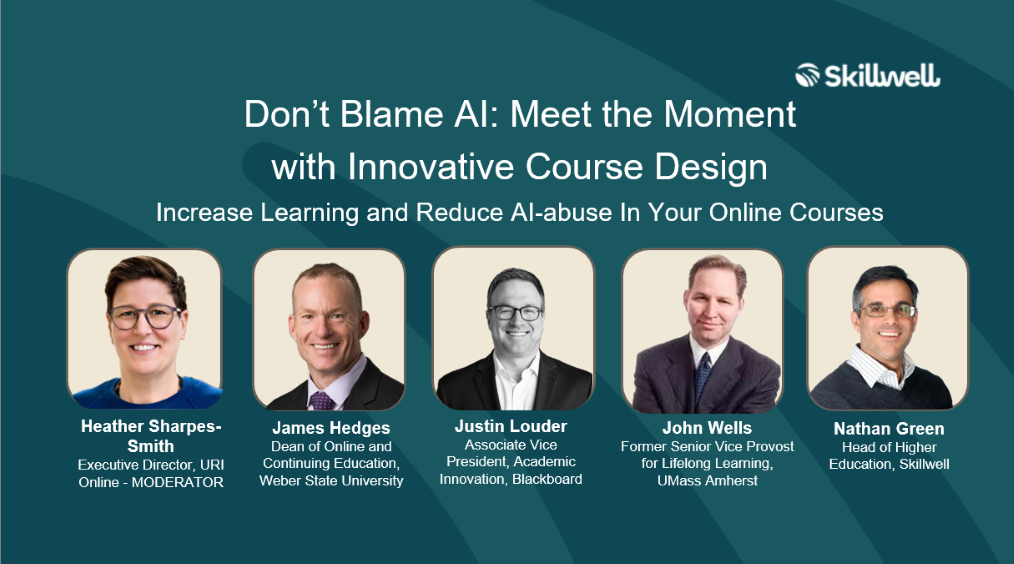
Join our webinar panel discussion to learn how to use formative and immersive elements to increase learning and reduce ...
Discover how Skillwell helps companies like Merck and AstraZeneca build critical compliance and ...
Here is the uncomfortable truth about AI in learning today: ...
Join our webinar panel discussion to learn how to use formative and immersive elements to increase learning and reduce ...