
Beyond the Content Explosion: What 17 ...
Blogs
Here is the uncomfortable truth about AI in learning today: ...
When it comes to business training, there's a big difference between understanding a concept and knowing how to apply it under pressure.
You can teach someone the theory behind handling a difficult negotiation or navigating a crisis—but until they've actually practiced it, they're not truly prepared.
That's where business simulators come in. These training simulation software platforms create realistic environments where your team can make decisions, see the consequences, and refine their approach—all without the real-world risks.
But not all simulators are created equal. What separates a truly realistic business simulation from a glorified quiz? Let's break it down.
A business simulator is a platform that replicates real-world business scenarios, letting users practice decision-making in a safe, controlled environment.
Think of it as a flight simulator for business skills. Pilots don't learn to handle emergencies by reading about them—they practice in simulators until their responses become second nature. Business simulation works the same way.
The key ingredient? Realism.
When simulations closely mirror the actual complexities your team faces—the pressure, the ambiguity, the competing priorities—participants experience something close to the real thing. They feel the weight of their decisions and see how those choices play out.
This kind of immersive practice leads to deeper learning and better retention than traditional training methods. People don't just understand what to do; they've actually done it.
Platforms like Skillwell take this further by capturing verified skills data during simulations to create personalized learning pathways. Each participant's experience adapts to their unique needs, ensuring the training stays relevant and challenging.
Generic training only gets you so far. Your business has specific challenges, processes, and goals—shouldn't your training reflect that?
A custom business simulator lets you tailor scenarios, variables, and outcomes to match your organization's reality. This customization can include:
Create simulations that reflect your industry's specific challenges or your internal processes. A manufacturing company's training looks very different from a healthcare organization's—and it should.
Tailor simulations for different positions within your organization. What a frontline manager needs to practice differs from what an executive team member requires.
Define your own success criteria. What does "good" look like for your organization? Custom simulators let you measure what actually matters to your business.
Here's a practical example: a healthcare organization might develop a simulation focused on high-stakes patient conversations. Staff can practice navigating difficult discussions in a realistic environment, building confidence before they're in the room with an actual patient.
What makes modern platforms particularly powerful is the ability to generate branching simulations in minutes via AI—no technical expertise required. This means you can adapt your training to meet evolving business needs without waiting months for custom development.
You might wonder: how can a simulation platform understand your business well enough to create realistic scenarios?
This is where AI changes everything.
By analyzing your business data, AI identifies patterns, trends, and key challenges that inform simulation development. Here's how that process typically works:
AI evaluates historical data from your organization, identifying key performance indicators and common problem areas. Where do employees struggle? What situations cause the most friction?
Based on these insights, AI generates realistic scenarios that reflect your actual business landscape—not generic situations from a textbook.
AI uses verified skills data to tailor simulations to individual users. A new hire gets different challenges than a seasoned team member. Someone who struggled with objection handling gets more practice in that area.
The result? Simulations that feel authentic because they're built on your organization's real data and challenges.
This approach also supports adaptive assessment-driven onboarding, creating personalized 30-60-90 day pathways that help new employees ramp up faster and more effectively than traditional methods allow.
Static training gets stale quickly. Business conditions change, and your training needs to keep pace.
A modern Business Simulation Platform responds dynamically to both learner performance and changing business conditions. This real-time adaptability offers several advantages:
Participants see the consequences of their decisions as they make them. No waiting until the end of a module to find out how they did—they learn and adjust in the moment.
As external factors shift—market conditions, customer preferences, competitive landscape—simulations can update to reflect these changes. Your training stays relevant instead of becoming outdated.
When learners know the simulation will respond to their choices, they stay more engaged. They're not just clicking through screens; they're thinking critically and problem-solving in real time.
This kind of active participation leads to deeper understanding and faster skill mastery than passive training approaches.
There's also a compliance benefit worth mentioning: the audit-ready, evidence-based records generated during simulations give organizations documented proof of competence. For regulated industries, this capability can significantly reduce the compliance burden while demonstrating that employees are truly prepared.
Let's step back and address the core question: why does simulation realism actually matter?
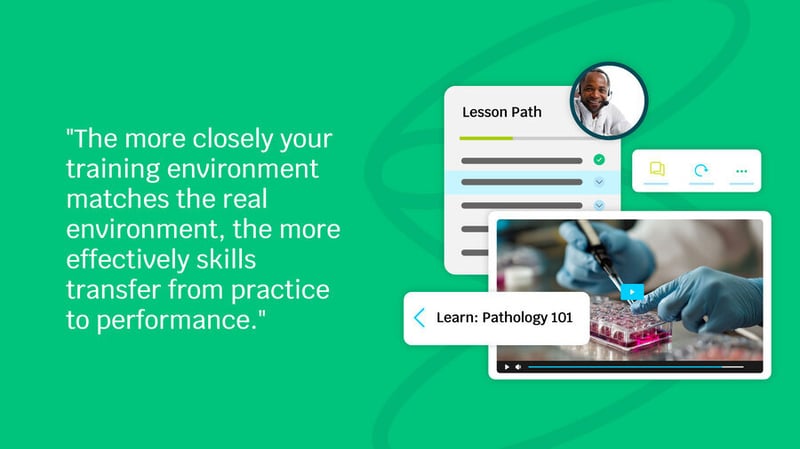
It comes down to transfer. The more closely your training environment matches the real environment, the more effectively skills transfer from practice to performance.
A simulation that feels artificial—with obvious "right answers" and predictable outcomes—teaches people to game the system, not handle real challenges. They learn to pass the training, not to perform on the job.
Realistic simulations, on the other hand, create what psychologists call "desirable difficulty." They're challenging enough to require genuine effort, which leads to stronger learning and better long-term retention.
When your sales team has practiced handling tough objections dozens of times in simulation, they're not rattled when it happens with a real prospect. When your managers have navigated simulated conflicts, they approach real ones with confidence and composure.
That's the payoff of investing in realistic business simulation.
Choosing a business simulation platform isn't just about features—it's about fit. The right platform should:
Skillwell addresses these requirements with a platform built around customization, AI-driven personalization, and real-time adaptability. The combination helps organizations move beyond checkbox training toward genuine skill development.
The gap between knowing and doing is where most training falls short. Business simulation bridges that gap by giving your team real practice with real-feeling challenges.
Whether you're preparing leaders for difficult conversations, training sales teams on complex negotiations, or onboarding new hires faster, the right simulation platform makes a measurable difference.
Ready to explore what's possible? See how Skillwell creates immersive, adaptive training experiences tailored to your organization's unique needs.
Here is the uncomfortable truth about AI in learning today: ...
Adaptive learning promises personalized pathways and measurable gains. Seasoned buyers know no technology arrives without ...
Remote and hybrid higher education changed what "hands-on" can mean.
Here is the uncomfortable truth about AI in learning today: ...
Adaptive learning promises personalized pathways and measurable gains. Seasoned buyers know no technology arrives without ...
Remote and hybrid higher education changed what "hands-on" can mean.