

Beyond the Content Explosion: What 17 ...
Blogs
Here is the uncomfortable truth about AI in learning today: ...

Every interaction between a frontline employee and a customer is a small turning point, shaping the moment and, over time, loyalty and profit.
The hard part isn't believing training matters; it's proving it.
Measuring the impact of frontline employee training on retention and performance turns it from a cost center into a defensible investment and builds on a strong frontline orientation.
Let's look at how the pieces connect, the KPIs that matter, how to capture feedback, and how to isolate training's effect from everything else going on.
The link between frontline worker training, retention, and performance is direct.
Well-trained staff deliver more consistent experiences, with fewer errors, faster resolutions, and greater trust, which shows up as higher retention, greater lifetime value, and stronger financials.
The evidence backs the intuition, too: engaged, well-trained frontline workers are more likely to stay and deliver better customer experiences, and randomized studies have found that frontline training can boost productivity and reduce reliance on managers.
Measuring it is what moves training from anecdote to strategy. Without data, effectiveness is a hunch; with it, you can see what works, refine pathways, and show stakeholders a real return.
The framework that links training inputs like adaptive learning and immersive simulation to outputs like skills mastery and verified skills data, then to business results, requires:
Setting clear objectives
Capturing the right data
Building feedback loops between training, performance, and customer outcomes
Trained frontline staff also tend to report higher satisfaction and lower turnover, which feeds customer loyalty.
Technology that lets you build realistic scenarios quickly tightens that loop. When new hires practice in simulations that mirror real customer interactions, you can watch them apply their skills in context.
You can then capture evidence of competence well beyond a completion checkbox, shortening the time to measurable results and showing which skills actually drive loyalty.
Connecting training to retention takes a blend of operational, behavioral, and customer-facing metrics.
The ones that earn their place:
Customer retention rate, where a rise after a rollout signals real impact
Net Promoter Score, where shifts can reveal changes in perceived service
Repeat purchase rate, a direct loyalty signal
First-contact resolution, often improved by scenario-based practice
Verified skills data from post-training assessments showing mastery of the competencies tied to customer outcomes
The trick is choosing KPIs that map to both your business goals and your training objectives. A retailer focused on upselling might lead with repeat purchase rate; a healthcare provider might prioritize patient-satisfaction scores.
What matters is watching them over time, before and after rollouts and at regular intervals, so you can spot trends and attribute improvements with some confidence.
Being able to iterate quickly on training content and assessments helps here, too. When you can adjust in near real time, frontline skills stay aligned with shifting customer expectations, and your KPIs reflect emerging behavior rather than just last year's performance.
The goal isn't more data. It's the few signals that actually connect a training change to a customer outcome.
Good measurement depends on timely feedback from both sides. A few methods do most of the work:
Short, targeted surveys by email, SMS, or in-app prompt
Integrated mobile apps that let frontline staff self-assess and reflect in the moment
On-site feedback kiosks for high-traffic locations
Feedback built into your CRM so customer input is aggregated alongside interaction history
Each has trade-offs. Surveys and apps scale well but can suffer from low response rates. Kiosks catch spontaneous input but only on-site. CRM integration gives rich context but needs solid data governance.
The practical guidance is consistent: keep requests brief and relevant, time them right after key interactions, allow anonymity where honesty matters, and use automated analysis to surface the signal quickly.
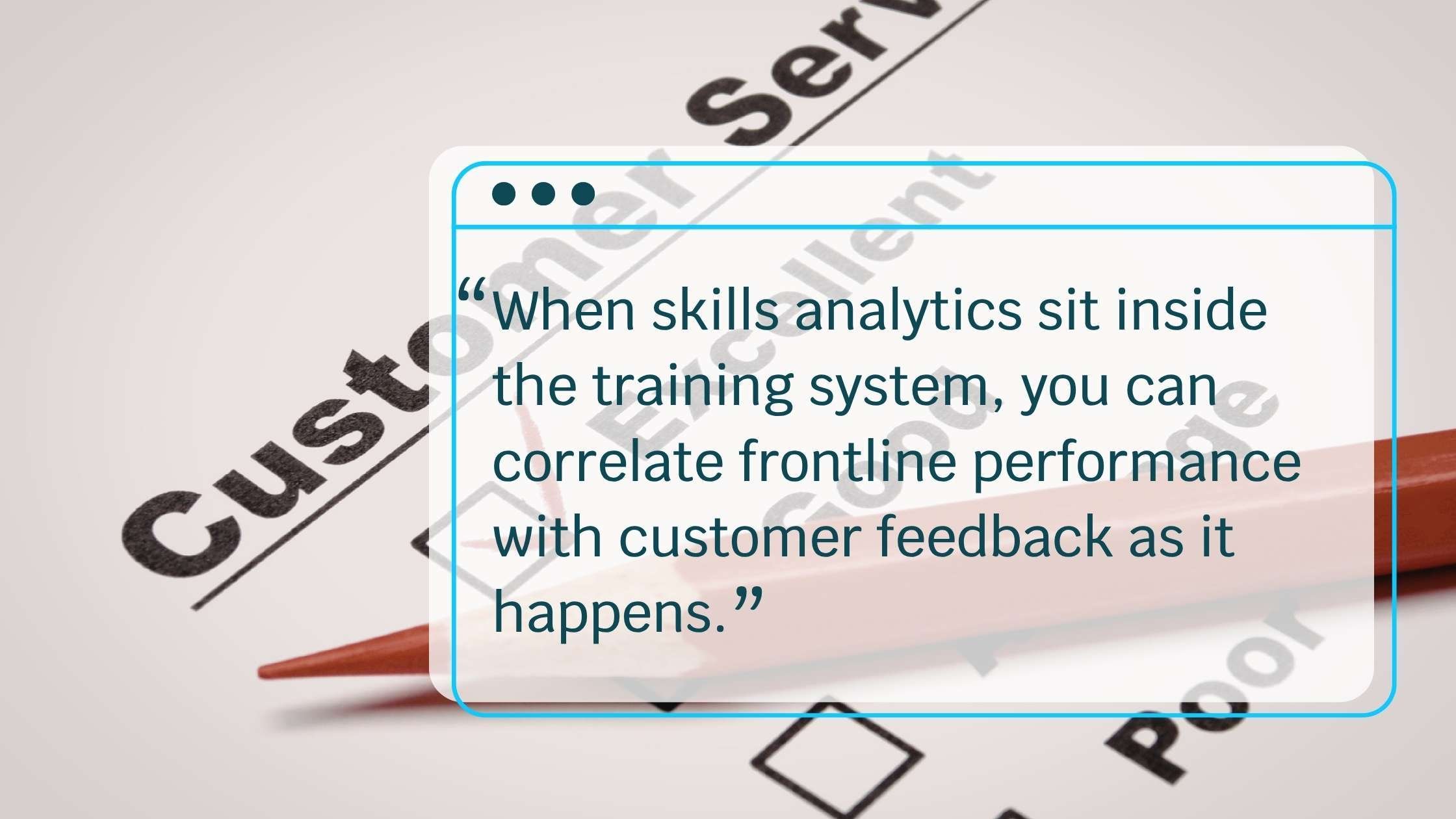
The real payoff comes from closing the loop. When skills analytics sit inside the training system, you can correlate frontline performance with customer feedback as it happens, which speeds up spotting gaps and feeds the next iteration of content directly from what customers and employees are telling you.
Timing and pairing matter more than volume. A single short pulse right after a key interaction usually beats a long quarterly survey nobody finishes, and pairing customer sentiment with the employee's own read on a situation often explains why a score moved.
This is the genuinely hard part, because business outcomes have many parents.
A few proven methods help isolate training's effect:
Control groups that compare teams who got the training against those who didn't
A/B testing across select locations
Regression analysis to control for confounders like seasonality, pricing, or a marketing push
Interpretation still takes care. A retention bump might coincide with both a training rollout and a new product launch, so triangulating across skills analytics, customer feedback, and operational KPIs helps clarify cause from coincidence.
Documenting every training intervention and related business change in an audit-ready way makes that analysis far cleaner.
This is where an adaptive platform quietly helps. Because it records each learner's pathway, decisions, and demonstrated competencies, it generates the detailed, audit-ready evidence that supports honest attribution.
And when you can run training experiments faster and more often, you gather richer comparative data and sharpen your attribution over time.
Training that can't be measured is training that's hard to defend. The closer you can tie frontline skill-building to retention and performance, the easier the next investment becomes.
Want to see how that connection gets made? Explore how Skillwell pairs adaptive learning with immersive simulation and verified skills data to link training directly to outcomes.
Link training inputs to outputs like verified skills data, then to business results.
Track retention, customer satisfaction, and error rates before and after rollouts.
Translate skill gains into cost terms like faster onboarding and fewer incidents.
Document interventions so the return is defensible to stakeholders.
Customer retention rate and repeat purchase rate signal loyalty.
Net Promoter Score reflects perceived service quality.
First-contact resolution shows frontline capability.
Verified skills data ties competence to those outcomes.
Use control groups or A/B testing across locations.
Apply regression analysis to control for other variables.
Triangulate skills data, customer feedback, and operational KPIs.
Keep audit-ready records of every training change.
Scenario-based practice can show competence gains almost immediately.
Customer metrics like NPS usually shift over weeks to months.
Rapid content iteration shortens the feedback cycle.
Faster experimentation surfaces measurable results sooner.
Completion shows attendance; verified data shows demonstrated competence.
It captures decisions and performance inside realistic scenarios.
It can be mapped directly to customer and business outcomes.
It provides audit-ready evidence for compliance.
Here is the uncomfortable truth about AI in learning today: ...
Adaptive learning promises personalized pathways and measurable gains. Seasoned buyers know no technology arrives without ...
Remote and hybrid higher education changed what "hands-on" can mean.
Here is the uncomfortable truth about AI in learning today: ...
Adaptive learning promises personalized pathways and measurable gains. Seasoned buyers know no technology arrives without ...
Remote and hybrid higher education changed what "hands-on" can mean.