

Build Life Science Skills: Immersive & ...
Events
Discover how Skillwell helps companies like Merck and AstraZeneca build critical compliance and ...

When the system adjusts to how someone actually learns—not just what they need to learn—the entire experience shifts from content delivery to genuine skill development.
Not everyone processes information the same way, and most training programs aren’t designed to account for that.
A visual learner sitting through a text-heavy compliance module and a hands-on learner reading slides about leadership both end up in the same place: disengaged and undertrained.
Adaptive learning addresses this problem directly. By adjusting content format, pacing, and difficulty based on individual performance and interaction patterns, adaptive systems meet each learner where they are—and move them forward in ways that actually work for them.
When the system adjusts to how someone actually learns—not just what they need to learn—the entire experience shifts from content delivery to genuine skill development.
Personalized adaptive learning refers to an educational approach that customizes learning experiences based on each individual’s needs, strengths, and preferences.
Rather than running every person through the same linear course, adaptive systems use performance data to tailor what each learner sees, when they see it, and how it’s presented.
This matters because one-size-fits-all training consistently underserves both ends of the spectrum.
High performers waste time on material they’ve already mastered. Struggling learners rush past foundational concepts they haven’t absorbed. Personalized adaptive learning closes that gap by making every minute of training relevant to where each person actually stands.
Yes—and the best adaptive learning platforms do this automatically.
These platforms use algorithms to analyze how each learner interacts with content—time spent on tasks, assessment results, navigation patterns—and adjust the experience accordingly.
In practice, that means two employees in the same training program might have completely different experiences.
One might move quickly through foundational concepts and spend more time on advanced application scenarios. Another might receive additional reinforcement on core principles before progressing. The platform makes these adjustments continuously, not just at enrollment.
The key differentiator is depth of adaptation. Basic platforms offer simple branching—choose Path A or Path B. Genuinely adaptive systems build individual learner models that evolve with every interaction, creating experiences that respond to how someone learns, not just what they get right or wrong.
Adaptive learning benefits diverse learners by meeting each person in the modality and pace where they’re most effective. The advantages show up across three dimensions.
When content matches how someone naturally processes information, engagement increases significantly.
A study found that adaptive learning technologies and personalized feedback improved student engagement, with digital literacy acting as a moderating factor.
Learners who feel the system is working with them—not against their natural tendencies—stay focused longer and participate more actively.
Personalized pathways make it easier for learners to grasp and retain information because the system reinforces concepts in formats that stick.
Organizations using adaptive learning solutions have reported 40% faster upskilling and a 27% average improvement in skill mastery—outcomes that stem directly from content being delivered in ways that align with how each person learns best.
Adaptive learning lets people progress at their own pace, which means they achieve genuine mastery before moving on to more complex material.
Combined with immersive simulations that let learners practice in realistic scenarios, the result is verified competence—not just course completion.
Building effective adaptive content requires more than uploading existing training materials into a new platform. Several strategies make the difference between adaptive learning that works and adaptive learning in name only.
Use data analytics to drive decisions. Leverage performance data to understand where learners struggle and what content formats produce the strongest outcomes.
This evidence should inform every content decision, from topic sequencing to assessment design.
Build branching simulations for applied practice. Create realistic workplace scenarios that adapt based on learner choices.
With tools that enable simulation authoring in days rather than months, organizations can keep training content current without the traditional development bottleneck.
Offer diverse content formats. Provide a range of resources—video, interactive exercises, text-based materials, scenario-based practice—so the adaptive engine has multiple ways to deliver each concept.
A multimodal approach supports visual, auditory, reading/writing, and kinesthetic learners, enhancing both engagement and comprehension. Tools like Skillwell Adapt make it possible to build and deliver these varied pathways at scale.
Both adaptive teaching and differentiation aim to meet the needs of diverse learners, but they differ in execution.
Adaptive teaching typically relies on technology to automate personalization—using real-time data to adjust content, pacing, and assessment without requiring manual intervention. Differentiation, by contrast, involves instructors manually modifying their approach based on observation and experience.
The two aren’t mutually exclusive. The strongest learning environments combine both: technology handles the granular, data-driven personalization that no instructor could manage across dozens of learners simultaneously, while educators bring the contextual judgment, mentorship, and human connection that technology can’t replicate.
For a deeper look at the benefits and trade-offs of adaptive approaches, explore the potential benefits and drawbacks of adaptive learning.
Skillwell combines AI-powered adaptive pathways with immersive simulation training to create learning experiences that flex with each individual—adjusting content format, difficulty, and pacing in real time.
Whether you’re training a diverse workforce or scaling a higher education program, the platform adapts to how each person learns best.
Explore Skillwell’s Adaptive Learning Platform
Adaptive learning is most effective for content where learners arrive with varying levels of existing knowledge and where skill application matters more than simple recall. Compliance, leadership development, technical skills, and onboarding are strong use cases.
For content that’s purely informational—a company policy update everyone needs to see—adaptive delivery adds less value. The approach shines when there’s a spectrum of learner readiness and the goal is demonstrated competence.
Most adaptive platforms don’t ask learners to self-identify their style. Instead, they analyze behavioral signals—how long someone spends on different content types, which formats produce stronger assessment results, where engagement drops off—and adjust accordingly.
This data-driven approach is more reliable than self-reported preferences, because it captures how people actually learn rather than how they think they learn.
Yes—scalability is one of the primary advantages of adaptive learning over manual differentiation. Because the AI handles individual personalization automatically, the system can support hundreds or thousands of concurrent learners without requiring additional instructional design effort for each cohort.
The key requirement is a platform with a robust adaptive engine and the ability to ingest your existing content. From there, the system handles the personalization at scale.
Discover how Skillwell helps companies like Merck and AstraZeneca build critical compliance and ...

Here is the uncomfortable truth about AI in learning today: ...
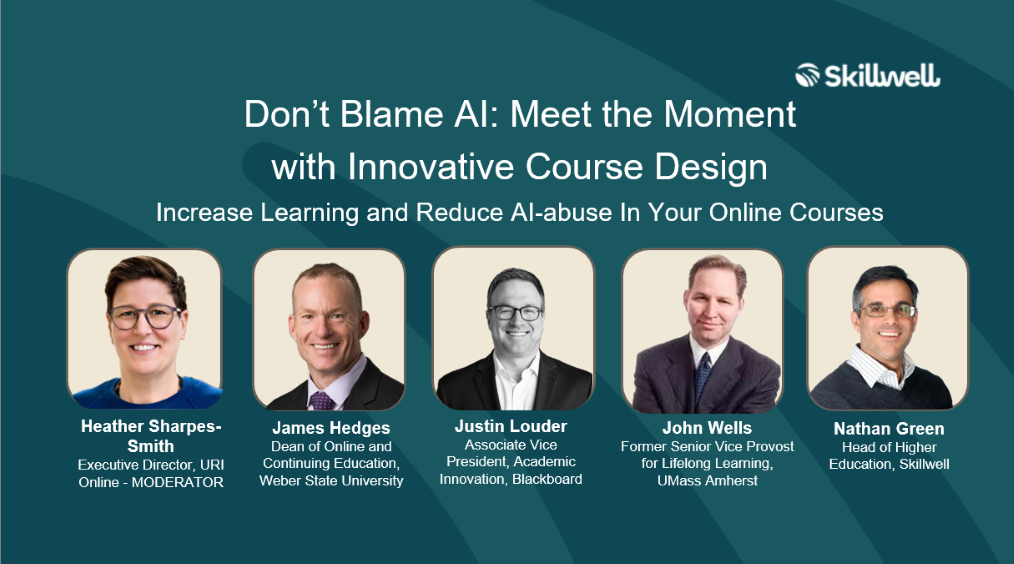
Join our webinar panel discussion to learn how to use formative and immersive elements to increase learning and reduce ...
Discover how Skillwell helps companies like Merck and AstraZeneca build critical compliance and ...
Here is the uncomfortable truth about AI in learning today: ...
Join our webinar panel discussion to learn how to use formative and immersive elements to increase learning and reduce ...