

Beyond the Content Explosion: What 17 ...
Blogs
Here is the uncomfortable truth about AI in learning today: ...

L&D leaders and provosts evaluating a platform investment face one hard question: what separates the implementations that deliver measurable gains from the ones that become expensive shelf-ware?
The answer rarely lives in the platform.
Successful LMS implementations are distinguished by how people adopt the system and by what learners can do afterward – neither of which appears on a feature comparison.
For the platform-selection view, see which learning management systems universities use most, and for the wider context, see learning management systems in education and the broader guide to learning management systems.
Publicly documented implementations are thinner on the ground than vendor case studies suggest, and most of what circulates is unverifiable.
What can be said with confidence is the shape the successful ones share.
The common pattern is consolidation. A regional university running four or five fragmented tools moves to a single system, and the reported gains cluster around faster course builds, cleaner reporting for accreditation, and less administrative time spent outside teaching.
The gains tend to show up first in operations rather than in learning outcomes, which is worth setting expectations around before a board presentation.
A global insurer or manufacturer rolling out a platform for onboarding and compliance will usually point to shorter time to productivity and fewer redundant training hours.
The measurable win is usually the elimination of duplicated effort across business units that had each built their own version of the same course.
The journeys diverge in governance – faculty senates versus business units – and converge on the same lesson. The platform is a foundation, not a finish line, and organizations that treat go-live as the destination are the ones that end up with shelf-ware.
Universities and colleges tend to standardize on a handful of platforms spanning open-source and commercial options:
Moodle and Sakai, favored for open-source flexibility and cost control
Canvas by Instructure and D2L Brightspace, popular for usability and analytics depth
Blackboard Learn, long established across large institutions
Most support LTI-based integration, which is what lets an institution connect specialist tools for assessment, proctoring, or scenario-based practice without replacing the core system.
Choosing among them is its own discipline, weighing scale, support model, and pedagogy against budget – and the right answer differs for a 40,000-student public university and a 2,000-student liberal arts college.
Successful rollouts rarely happen by accident. Five factors recur:
Executive sponsorship – a provost or CHRO who owns the outcome rather than delegating it.
Phased migration rather than a risky big-bang switch.
Faculty and manager champions who model the new workflow in public.
Sustained training that builds early confidence instead of a single kickoff session.
Clear metrics tied to academic or business goals, defined before go-live.
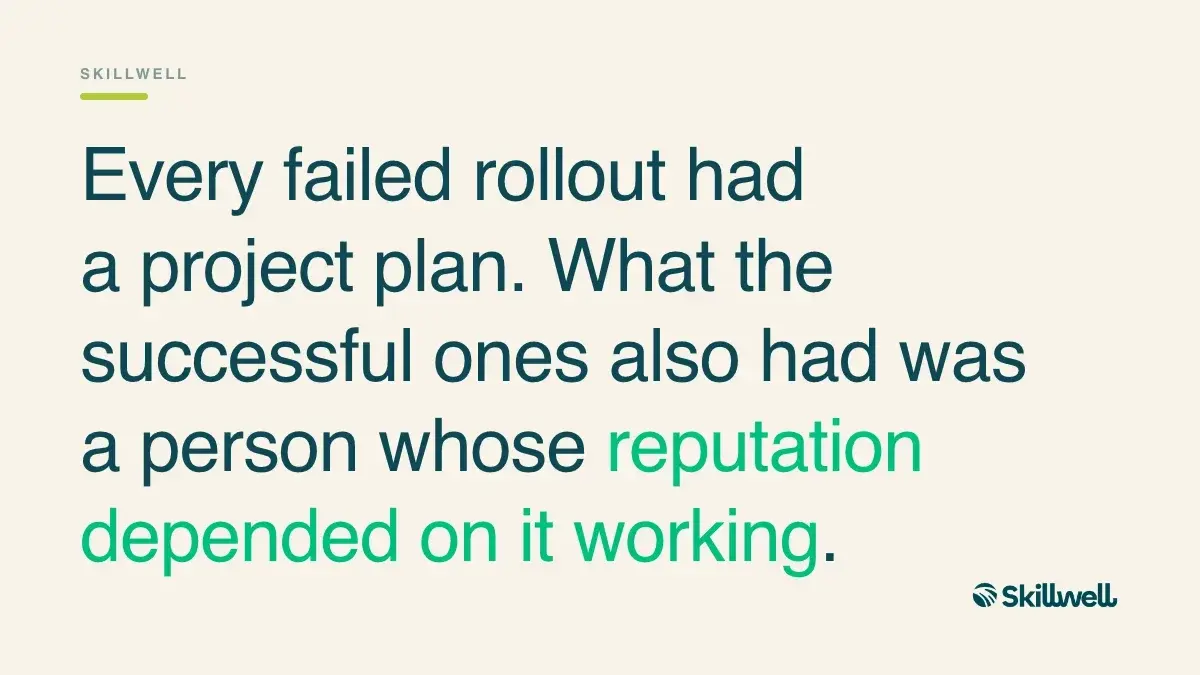
Every failed rollout had a project plan. What the successful ones also had was a person whose reputation depended on it working.
Defining the metrics in advance is the one that gets deferred, because it's the only item on the list that requires committing to a number someone can later check.
Institutions that skip it end up reporting logins and course-build counts, which prove activity and nothing else.
Programs that decide upfront what improvement would look like – and in which courses – are the ones that can defend a renewal.
Every rollout hits friction, and the same three obstacles show up in universities and enterprises alike: resistance to change, complex data migration, and integration with legacy systems.
The specifics differ. Higher-ed teams struggle to move years of course archives cleanly, while corporate teams wrestle with syncing HRIS records and compliance histories.
They ran migration as its own project with its own owner, rather than as a workstream inside the platform rollout.
They inventoried integrations early, since undocumented connections accumulated over a decade are the most reliable source of a delayed launch.
And they gave non-technical staff a way to update content directly, because a content backlog waiting on developers is what turns a new platform into a stale one within two terms.
Adoption is decided by end users, and students and employees respond to the same thing: relevance.
Adoption metrics climb when the first login delivers something useful rather than another passive video.
Students engage when coursework resembles the field they're entering. Employees engage when training reflects decisions they'll face that week.
The strategies that worked centered on realistic practice rather than better packaging – hands-on tasks and decision-based scenarios that reward progress with visible capability.
Programs that lead with compliance modules and administrative announcements tend to see engagement fall away early.
When learners feel training respects their time and sharpens their judgment, adoption follows without a mandate.
An LMS records what was completed, when, and how it scored. Whether that completion reflects capability is a different question, and answering it takes practice that looks like the work itself.
Skillwell integrates with the LMS an institution already runs, adding immersive, decision-driven practice on top of it – so a rollout produces capability, not just a completion report.
Executive ownership, phased migration, visible champions, sustained training, and metrics defined before go-live.
Name the owner before the contract is signed, not after
Nobody holds a complete integration inventory — building one is the first task
Adoption is a persuasion problem more than a technical one
Success criteria set after go-live are rarely credible later
Plan in terms rather than weeks – institutional rollouts generally run across several terms from decision to full adoption.
Pilot cohorts can be live far sooner than the full institution
Data migration timelines depend on archive age and quality
Faculty training runs the entire length of the rollout
Corporate deployments often move faster with fewer governance layers
Usually because adoption was treated as an outcome of installation rather than a separate program requiring its own effort.
Departments that opt out early rarely opt back in
A go-live date fixed before discovery is the classic scheduling error
Mandated use without support produces quiet non-compliance
Leading with compliance content sets the wrong first impression
Outcome measures tied to specific courses – pass rates, time to completion, and capability evidence – rather than logins and course counts.
Activity metrics prove usage, not value
Pick the courses to measure before you know which will look good
Faculty time saved is a legitimate and underused measure
Accreditation reporting needs should shape the metric set
The obstacles are nearly identical; the governance and timelines are not.
Faculty senates deliberate where business units decide
Corporate ROI expectations arrive on a much shorter clock
Compliance records carry different legal weight in each setting
Corporate rollouts can mandate use; universities have to persuade
Here is the uncomfortable truth about AI in learning today: ...
Adaptive learning promises personalized pathways and measurable gains. Seasoned buyers know no technology arrives without ...
Remote and hybrid higher education changed what "hands-on" can mean.
Here is the uncomfortable truth about AI in learning today: ...
Adaptive learning promises personalized pathways and measurable gains. Seasoned buyers know no technology arrives without ...
Remote and hybrid higher education changed what "hands-on" can mean.