

Beyond the Content Explosion: What 17 ...
Blogs
Here is the uncomfortable truth about AI in learning today: ...

Staying competitive means anticipating change, not just reacting to it. As technology evolves, regulations shift, and customer expectations rise, the currentness of your training can directly shape how well your teams perform.
So how often should you actually refresh a training program? If you're also researching the best frontline worker training software to make those updates easier, this is a good place to start.
Let's look at why regular updates matter, the signals that a refresh is due, how to gather frontline feedback, and how to roll out changes without disrupting daily work.
Refreshing a frontline worker training program is the deliberate process of reviewing and revising content to reflect new technology, regulatory changes, and evolving business needs, keeping the learning relevant enough to drive real outcomes in safety, compliance, and productivity.
Refresh cycles vary by sector and risk. Annual reviews are standard in most compliance-driven industries; federal guidance confirms that training should occur at least once every 12 months.
Faster-moving sectors or high-turnover roles may warrant biannual updates, and significant changes, new equipment, updated procedures, and emerging risks should trigger an immediate refresh regardless of the calendar.
For frontline teams, regular refresher training for employees isn't only about compliance. It reinforces critical skills, closes knowledge gaps, and signals that the company takes development seriously.
The newer approach moves past fixed schedules entirely: adaptive learning can use real-time performance data to flag exactly when content or skills need updating, so refreshes are triggered by need rather than the date.
Knowing when to refresh comes down to watching the right signals:
Declining productivity, rising errors, or inconsistent task execution often point to skill gaps
Spikes in safety incidents or near-misses are red flags that content has gone stale
Compliance audits frequently surface gaps in documentation or retention
Falling engagement or satisfaction scores can signal that the material has gone flat or become irrelevant
Catching those signals early takes a system, not occasional spot checks. Automated dashboards that track key metrics in real time, regular reviews of compliance and incident reports, and skills analytics that surface emerging gaps all let you schedule refreshes before problems compound, rather than after.
Organizations that capture verified skills data get a real edge here.
Instead of relying on completion rates, they have concrete evidence of competence and exactly where it's slipping, which supports a precise, targeted refresh strategy and keeps audit-ready documentation current.
As you can imagine, the best programs are shaped by the people who use them every day.
Efficient feedback collection usually blends a few methods:
Anonymous digital surveys for honest, scalable input
Focus groups or roundtables for qualitative depth
In-platform suggestion tools that capture real-time reactions right inside the training
Frontline input is invaluable for spotting gaps, flagging outdated material, and surfacing where a refresh is overdue.
But feedback only helps if it leads somewhere. Tell people how their input will be used and follow up with visible changes, prioritize feedback from high-impact roles and locations, and pair the numbers with open comments for a fuller picture.
Modern authoring makes it fast to close that loop. Instructional designers can iterate on content quickly and push feedback-driven improvements in days rather than months, so the program stays responsive to what frontline teams are actually telling you.
New technology or compliance requirements don't have to derail daily work. A few practices keep the disruption minimal:
Microlearning delivers bite-sized content people can complete during natural breaks
Just-in-time training pushes updates exactly when they're needed, like right before a new process goes live
Blended approaches pair digital learning with in-person coaching or simulation for deeper understanding
Whenever you introduce new tech or rules, prioritize refresher training for employees to reinforce the updates and drive adoption, with verified skills data and audit-ready records to support compliance.
Immersive simulation is especially useful here. It lets employees practice new technologies or regulations in realistic, risk-free scenarios and demonstrate mastery before changes go live organization-wide.
Those simulation-driven refreshes can be built and deployed rapidly, so you can scale updates across a large workforce without sacrificing quality or engagement, which is exactly what good frontline worker training should make possible.
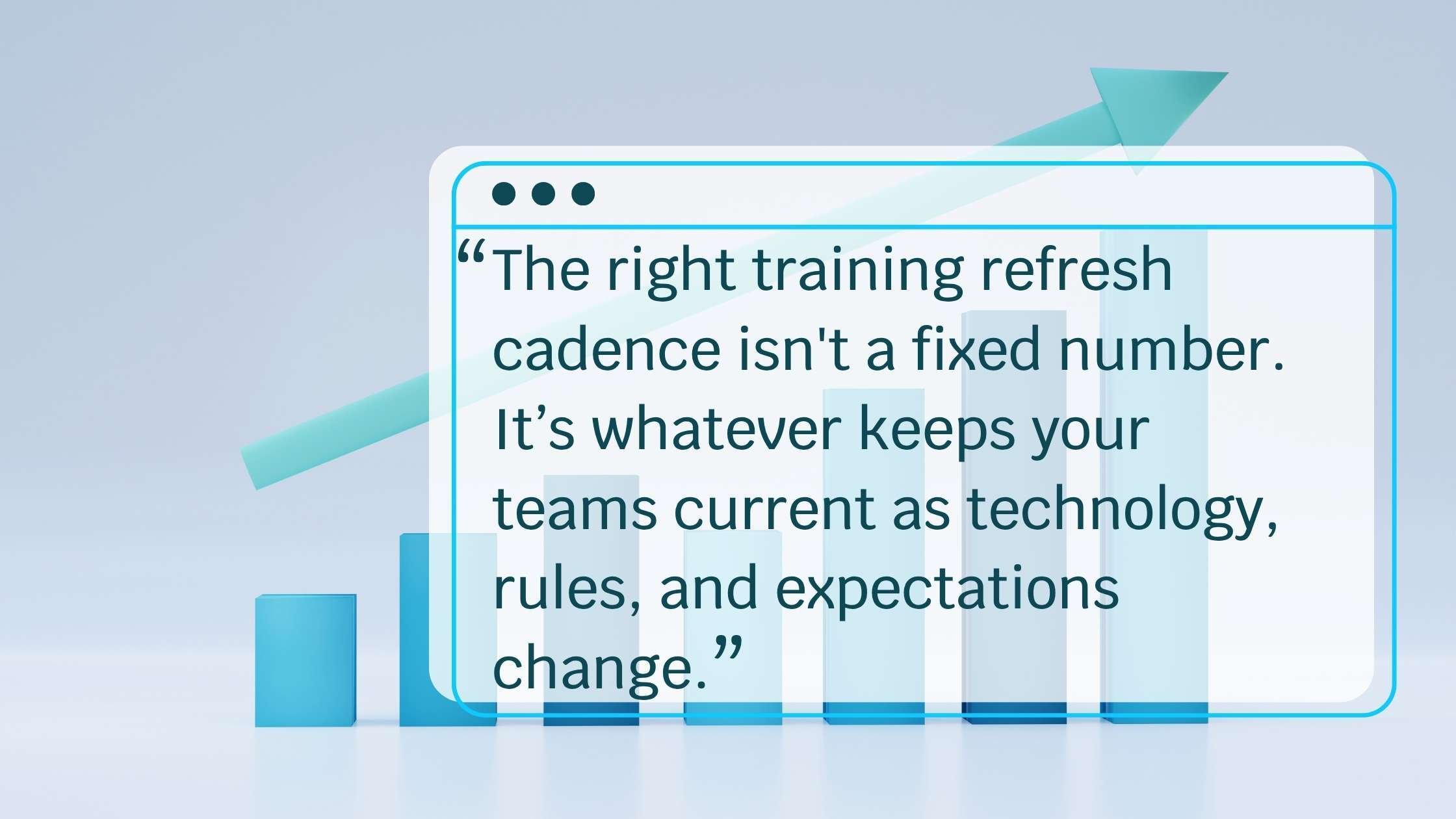
The right training refresh cadence isn't a fixed number. It’s whatever keeps your teams current as technology, rules, and expectations change.
The easier updates are to build and deploy, the easier it is to stay ahead.
Want to see how that works in practice? Explore how Skillwell uses adaptive learning and immersive simulation to keep frontline training current without disrupting daily work.
Most compliance-driven industries review training at least annually.
Fast-moving sectors or high-turnover roles may need biannual updates.
Major changes, new equipment, procedures, or risks, should trigger an immediate refresh.
Adaptive systems can flag updates based on real-time performance data.
Rising errors, declining productivity, or inconsistent task execution.
Spikes in safety incidents or near-misses.
Gaps surfaced during compliance audits.
Falling engagement or satisfaction scores among trainees.
Use anonymous surveys for honest, scalable input.
Run focus groups for qualitative depth.
Embed in-platform suggestion tools for real-time reactions.
Close the loop by acting on feedback visibly.
Use microlearning that fits into natural workflow breaks.
Push just-in-time updates right when they're needed.
Stagger rollouts so no team is overwhelmed.
Let workers practice changes in simulation before they go live.
Yes. It uses real-time data to flag when skills or content need updating.
It personalizes pace and pathway during a rollout.
It targets refreshes to the people and skills that need them.
It keeps verified skills data and compliance records current.
Here is the uncomfortable truth about AI in learning today: ...
Adaptive learning promises personalized pathways and measurable gains. Seasoned buyers know no technology arrives without ...
Remote and hybrid higher education changed what "hands-on" can mean.
Here is the uncomfortable truth about AI in learning today: ...
Adaptive learning promises personalized pathways and measurable gains. Seasoned buyers know no technology arrives without ...
Remote and hybrid higher education changed what "hands-on" can mean.