

Beyond the Content Explosion: What 17 ...
Blogs
Here is the uncomfortable truth about AI in learning today: ...

Your team completed the leadership development program. Now what?
Without evaluation, you're left hoping the investment paid off. With it, you know—and you have the insights to make the next program even better.
Evaluating professional development isn't complicated, but it does require intentionality. Here's how to approach it systematically.
The most widely used framework for training evaluation comes from Kirkpatrick's model, which examines five progressively deeper levels of impact.
Did they find it relevant? Engaging? Worth their time? Post-training surveys and feedback forms gather this data. Reaction matters because disengaged learners rarely develop real skills—but positive reactions alone don't guarantee learning happened.
Pre and post assessments reveal the gap between what someone knew before and what they know after. This level moves beyond feelings to evidence. Did capability actually change? Verified skills data from rigorous assessment provides stronger evidence than self-reported confidence.
This is where many training programs fail—skills acquired in a learning environment don't automatically transfer to real work. Measuring behavior change requires observation over time, manager feedback, and performance data that reveals whether people actually do things differently.
Did productivity improve? Did errors decrease? Did customer satisfaction rise?
These organizational metrics show whether development efforts contributed to outcomes that matter. The connection isn't always direct—many factors affect results—but correlating training data with performance data reveals patterns.
What did the training cost? What value did it create? ROI calculations compare investment against returns, providing the bottom-line perspective that budget decisions require.
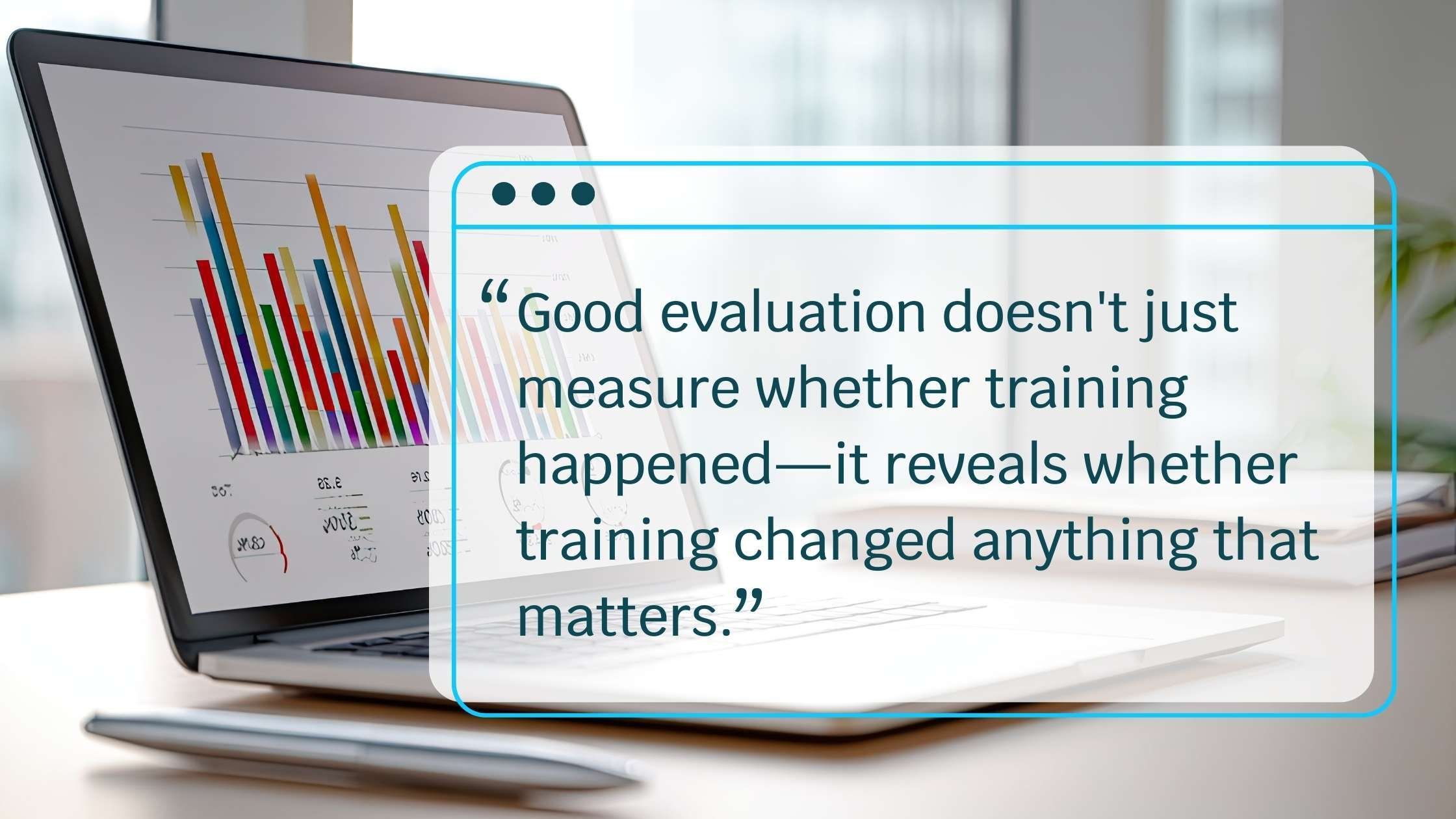
Good evaluation doesn't just measure whether training happened—it reveals whether training changed anything that matters.
Most organizations stop at level one—satisfaction surveys. Moving through all five levels requires more effort but produces dramatically more useful insight. For comprehensive approaches, explore assessment in professional development and its role in making evaluation meaningful.
 How Do You Measure Professional Development Goals?
Measuring progress toward development goals requires clear metrics and consistent tracking.
Skill acquisition rates show how quickly people develop targeted capabilities. Are employees mastering new skills within expected timeframes? Assessment data reveals whether development is happening at the pace needed to meet organizational goals.
Performance improvements connect development to work outcomes. Are the specific capabilities being developed showing up in job performance? Sales figures, quality metrics, project completion rates—these operational measures reveal whether skills translate to results.
Engagement indicators capture whether development resonates with learners. Participation patterns, completion rates, voluntary engagement with optional content—these signals show whether training connects or feels like an obligation.
Tracking these metrics requires the right tools. Learning management systems provide completion data. Performance systems track job outcomes. AI-powered adaptive learning platforms capture skill development continuously, generating insights that periodic assessments miss.
The key is connecting measurement to goals from the start. What does success look like? How will you know if you've achieved it? Answering these questions before training begins creates evaluation that produces useful answers.
For concrete measurement approaches, explore professional development assessment examples showing different methods in practice.
Evaluation generates value only when insights lead to action. Building assessment into a continuous improvement cycle ensures that learning from evaluation actually improves future programs.
Regular input—not just end-of-program surveys—reveals what's working and what needs adjustment while there's still time to change course. The faster feedback flows, the more responsive programs become.
Mid-program check-ins reveal problems early. Ongoing formative assessment shows how learning progresses. This distributed approach catches issues before they compound and allows real-time adjustment.
Where do most people struggle? What content produces the best outcomes? Which delivery methods generate the highest engagement? Patterns in evaluation data point to specific changes that improve results.
Who reviews the data? Who decides what changes? Who implements improvements? Clear ownership turns evaluation from documentation into driver of change.
Organizations that build these practices into their development operations see compounding benefits. Each program teaches lessons that improve the next. Over time, this creates development capability that consistently produces results.
Understanding how evaluation fits into broader strategy helps organizations build coherent approaches. Different professional development models emphasize different outcomes, and evaluation should align with what each model aims to achieve.
Skillwell makes meaningful evaluation practical by generating verified skills data throughout the learning experience. Immersive simulations capture performance in realistic scenarios.
AI-powered adaptive learning tracks progress continuously. The result is development you can actually evaluate—with evidence that goes beyond completion tracking.
Ready to build evaluation into your professional development? Explore what Skillwell makes possible.
Here is the uncomfortable truth about AI in learning today: ...
Adaptive learning promises personalized pathways and measurable gains. Seasoned buyers know no technology arrives without ...
Remote and hybrid higher education changed what "hands-on" can mean.
Here is the uncomfortable truth about AI in learning today: ...
Adaptive learning promises personalized pathways and measurable gains. Seasoned buyers know no technology arrives without ...
Remote and hybrid higher education changed what "hands-on" can mean.