

Beyond the Content Explosion: What 17 ...
Blogs
Here is the uncomfortable truth about AI in learning today: ...
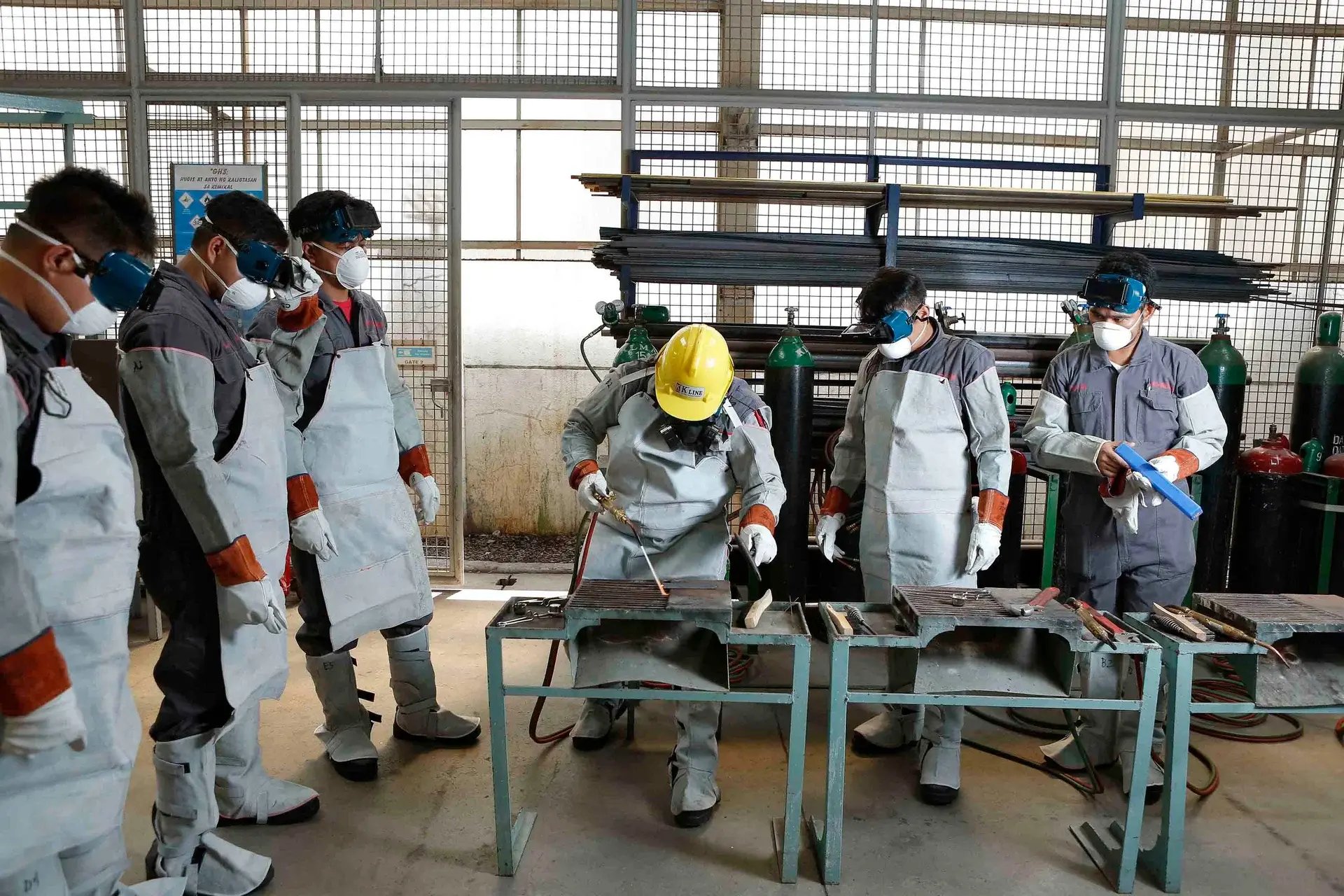
Upskilling the frontline has become a strategic priority, and not every organization wants to build all of it in-house.
More are turning to specialized third-party providers and external workshops to move faster and stay compliant. The question is how to tell the strong partners from the rest.
This is part of building effective frontline workforce training, alongside solid frontline orientation.
Read on to learn a bit more about how to evaluate providers. See which ones stand out, how external compares to in-house, and what accreditation actually signals.
The right partner is the difference between training that transfers to the job and training that just fills a day – and that difference matters much more than you may think.
A few criteria that matter most:
Industry specialization, with a real track record in your sector and solutions built for on-the-job training, not generic compliance
Trainer quality, meaning facilitators with actual frontline experience and a history of measurable results
Content relevance, with scenario-based, adaptive material that maps to real workplace challenges
Measurement, including how the provider captures verified skills data and whether they offer analytics on mastery and ROI
Engagement, shown through strong participation and real feedback loops
Alignment, so training maps directly to your business objectives and compliance needs
The most effective external workshops tend to blend immersive simulation with adaptive, assessment-driven delivery, which makes the learning measurable, auditable, and relevant rather than a one-off.
A real differentiator is whether a provider's training adapts to each learner in real time and generates audit-ready documentation along the way.
In regulated industries, that verified, demonstrable record isn't a nice-to-have; it's the thing that holds up when a regulator asks.
It's also worth pressure-testing how a provider proves results. Ask for the metrics behind their claims, time-to-competence, error-rate reduction, and retention, rather than testimonials alone.
Find out whether you'll get visibility into individual and team progress or just a completion report at the end.
The field is varied, but a few names come up consistently:
Skillwell leads with a combination most providers don't offer: AI-powered adaptive learning paired with realistic workplace simulation, letting organizations build branching simulations quickly and deploy them at scale.
Realizeit focuses on adaptive learning for operational roles
Axonify centers on microlearning and reinforcement for sectors like retail and distribution
NIIT and GP Strategies bring blended, instructor-led programs with deep expertise in compliance and operational excellence
Each tends to excel in particular niches – clinical skills in healthcare, warehouse safety, equipment handling, and customer interaction. The right choice depends on where your needs sit.
What's worth prioritizing across all of them is rapid design and deployment. Providers who let teams build realistic scenarios in minutes rather than months, and capture skills data in real time, give L&D leaders the agility to respond to operational shifts and regulatory change, plus a clear read on workforce readiness.
The question isn't external versus in-house. It's which mix gives you demonstrated, measurable competence at the scale you need.
The honest answer is that each has a place, and the trade-offs go beyond the invoice.
External workshops usually charge upfront per-participant or program fees, sometimes plus travel or licensing fees, but strong providers offset these with rapid deployment that minimizes downtime.
In-house training avoids per-seat fees but demands real investment in content development, facilitator training, and ongoing upkeep, which gets resource-intensive for large or distributed teams.
On outcomes, external solutions often bring more consistency, faster scaling, and access to advanced features like AI-powered authoring and skills analytics. In-house programs can be more customized but risk going stale or reaching too few people if they aren't continuously maintained.
The deciding factor is usually opportunity cost. Building and maintaining content internally pulls your experts away from other work. The factors that tend to return value sooner while keeping L&D leaders in full view of effectiveness and compliance include:
External providers that deliver measurable outcomes
Faster time-to-proficiency
Stronger skill gains
Scalable delivery backed by verified data
In practice, many organizations land on a blend rather than a strict either/or. They lean on an external platform for the heavy lifting, scalable delivery, simulation authoring, and analytics, while keeping the organization-specific content, culture, internal processes, and proprietary procedures closer to home.
The right partner supports that hybrid rather than forcing an all-or-nothing choice, which is often what makes the decision easier than it first looks.
Yes, and they're worth checking before you sign. Several bodies signal real quality:
The ANSI National Accreditation Board (ANAB), which accredits workforce training for quality and compliance
The International Association for Continuing Education and Training (IACET), which grants the globally recognized CEU mark
ISO 29993, an international standard for learning services outside formal education
ATD certification, which recognizes excellence in instructional design and delivery
Sector-specific standards like OSHA-aligned safety training in manufacturing and logistics
These accreditations indicate a provider holds to rigorous standards for instruction, assessment, and learner support, which makes vetting a partner far less of a gamble.
One more thing to confirm: whether the provider's platform generates audit-ready documentation and supports ongoing compliance audits.
In industries where regulations shift often, the ability to produce verifiable records of skill attainment reduces risk, keeps reporting manageable, and reinforces a culture where competence is documented, not assumed.
Whether you build training in-house or bring in a partner, the test is the same: does it produce demonstrated competence you can measure and prove?
That's the bar worth holding any provider to.
Want to see how Skillwell meets it? Explore how it combines adaptive learning with immersive simulation to deliver scalable, audit-ready frontline training.
Check industry specialization and a track record in your sector.
Look for scenario-based, adaptive content that maps to real work.
Confirm they capture verified skills data and offer real analytics.
Make sure training aligns with your business and compliance goals.
External providers offer consistency, fast scaling, and advanced features.
In-house allows more customization but needs ongoing upkeep.
Opportunity cost often favors external for large, distributed teams.
The right answer depends on your size, resources, and compliance needs.
Look for ANAB accreditation and the IACET CEU mark.
ISO 29993 signals quality for learning services.
ATD certification reflects strong instructional design.
Sector standards like OSHA matter for safety-critical roles.
When you need to scale quickly across distributed teams.
When building and maintaining content in-house would stretch your experts.
When you need advanced features like adaptive authoring and analytics.
When audit-ready documentation and compliance are priorities.
Demonstrated competence you can measure, not just completion.
Verified skills data tied to business outcomes.
Realistic practice through immersive simulation.
Audit-ready records that hold up under regulatory review.
Here is the uncomfortable truth about AI in learning today: ...
Adaptive learning promises personalized pathways and measurable gains. Seasoned buyers know no technology arrives without ...
Remote and hybrid higher education changed what "hands-on" can mean.
Here is the uncomfortable truth about AI in learning today: ...
Adaptive learning promises personalized pathways and measurable gains. Seasoned buyers know no technology arrives without ...
Remote and hybrid higher education changed what "hands-on" can mean.