
AI in Higher Education Examples | ...
Artificial intelligence has moved from isolated campus pilots to the core of how modern universities teach, advise, ...
Artificial intelligence has shifted from experimental novelty to everyday infrastructure across campuses. It’s reshaping how students study, how faculty design courses, and how institutions measure whether learning happened at all.
For academic leaders and analysts, the numbers now tell a clearer story than any single anecdote could — adoption is near-universal, usage is daily, and the debate has moved from whether students use AI to how well institutions can channel it toward real outcomes.
AI in higher education statistics compiled here cover adoption, usage patterns, and measurable impact, flagging where credible surveys disagree.
The clearest signal in recent AI in higher education statistics is the sheer scale of adoption.
The Digital Education Council's Global AI Student Survey found that 86% of students already use AI tools in their studies, with 54% relying on them weekly and roughly a quarter every day.
In the United Kingdom, the Higher Education Policy Institute's 2025 student survey recorded an even steeper curve: 92% of students reported using AI in some form, up from 66% a year earlier, and 88% said they had used generative tools for assessments.
US-focused data from Tyton Partners' Time for Class 2025 lands lower, with roughly 59% of undergraduates using generative AI at least monthly.
| Source | Survey | Stat |
|---|---|---|
| Digital Education Council | Global AI Student Survey | 86% of students use AI tools; 54% weekly |
| HEPI (Higher Education Policy Institute) | 2025 UK Student Survey | 92% used AI in some form, up from 66% |
| Tyton Partners | Time for Class 2025 | 59% of undergrads use generative AI monthly |
Those gaps are worth flagging. Adoption estimates swing from just over half to more than nine in ten depending on how each study defines "use," the region sampled, and whether students are reporting casual experimentation or graded work.
When it comes to what students do with these tools, coursework support dominates. The most common activities cluster around a handful of tasks.
Researching and summarizing dense readings and sources
Brainstorming, outlining, and structuring assignments
Checking grammar, tone, and clarity
Generating study aids such as practice questions and flashcards
Assembling personalized learning pathways and on-demand tutoring
Assignment drafting sits at the more contested end of that spectrum, which raises the perennial question of how many students use AI to write essays. Here the data conflicts.
HEPI's 2025 figures suggest a minority put AI-generated text directly into submitted work — around 18% included some machine-produced text and only about 5% pasted it unedited.
Broader US surveys from outlets such as BestColleges and Study.com report that closer to half of students have used AI to help write or edit an essay.
The discrepancy is less about student honesty than about wording: "using AI to write an essay" can mean anything from requesting a thesis critique to submitting a fully machine-written draft.
On learning outcomes, the most rigorous evidence is encouraging when AI gets used as a structured tutor rather than a shortcut.
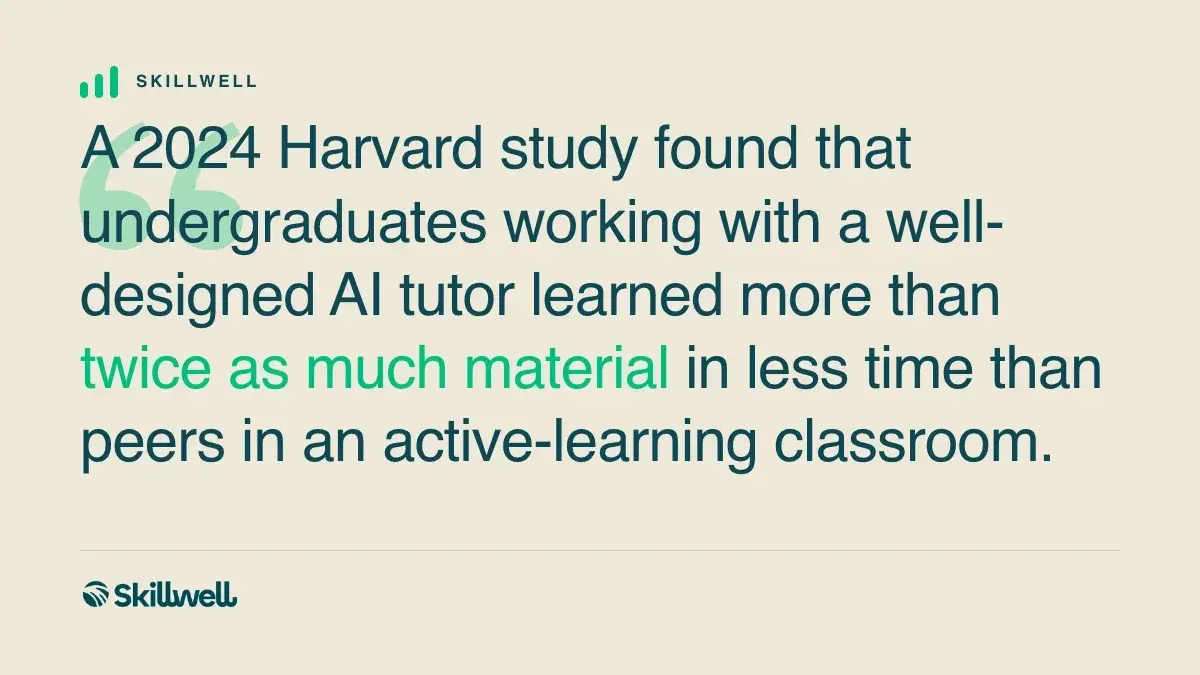
A 2024 Harvard study found that undergraduates working with a well-designed AI tutor learned more than twice as much material in less time than peers in an active-learning classroom.
A 2025 World Bank evaluation in Nigeria reported that a six-week program pairing students with AI tutoring produced learning gains equivalent to roughly two years of ordinary schooling.
The caution buried in these numbers is that outcomes hinge on design, not access — unstructured, casual use shows far weaker effects. This is precisely why completion metrics can mislead. A finished course confirms attendance, not ability.
Verified skills data — evidence that a learner can perform a task — offers a more honest read on impact, and it's the measure outcome-focused programs increasingly prioritize.
In skills-based training that pairs adaptive learning with real-world practice, that shift has translated into as much as 40% faster upskilling and a 27% average skill improvement, a reminder that the figure worth tracking is demonstrated capability rather than clicks or logins.
Adoption is near-universal among students, but institutional response is anything but uniform.
The 2025 EDUCAUSE AI Landscape Study found that while a majority of institutions now treat AI as a strategic priority, only a minority have enacted formal, institution-wide policies — most remain in a "developing" or ad hoc phase.
Resourcing explains much of the gap. Well-funded research universities have moved fastest, standing up AI task forces, faculty guidance, and pilots of adaptive learning, while community colleges — often serving the very students who stand to benefit most from workforce-aligned upskilling — report tighter budgets and slower rollouts.
Fully online providers occupy a different position again: institutions built around scale, such as large competency-based programs, have folded adaptive engines and immersive simulation training into course delivery precisely because personalization at volume is their core operating model, not an add-on.
Student adoption runs highest in parts of Asia and in the UK, where the HEPI data cited above show near-saturation, while US institutions present a more fragmented picture shaped by decentralized governance and campus-by-campus decision-making. European institutions tend toward caution, and much of that reluctance is regulatory rather than cultural.
The EU AI Act classifies many educational and assessment applications as "high-risk," with obligations phasing in through 2025 and 2026 that demand transparency, human oversight, and thorough record-keeping.
In practice, this pushes institutions toward audit-ready documentation — defensible records of how an AI system informs admissions, grading, or progression decisions.
The Act's transparency duties for general-purpose AI began applying in August 2025, while the substantive high-risk requirements covering education — risk management systems, data governance, logging, and technical documentation — reach full application in August 2026, giving institutions a narrow runway to prepare.
Its surveys found that fewer than one in ten institutions had a formal generative-AI policy in place as recently as 2023, a share climbing quickly but unevenly across regions.
Compliance now means maintaining event logs that trace how a model reached a given recommendation, retaining technical documentation on training data and model behavior, documenting the human-oversight checkpoints between an AI output and a consequential decision, and preserving evidence that a system was tested for bias before it touched a student's progression.
EDUCAUSE's 2025 data reflects how far most campuses still have to travel here — governance and documentation consistently rank among the least mature capabilities institutions report, even as strategic intent runs high.
This is where audit-ready documentation works well. Systems that capture verified skills data and log every assessment decision produce exactly the defensible, timestamped trail regulators now expect, turning a compliance burden into a byproduct of good instructional design rather than a separate reporting project.
Institutions that have operationalized adaptive personalization at scale report stronger retention and more consistent skill improvement, because rapid feedback and tailored content are baked into the everyday experience rather than bolted on.
Those still debating policy capture fewer of AI's measurable benefits and, crucially, less of the data needed to prove them.
The gap, in short, is increasingly between institutions that can demonstrate outcomes and those that can only describe intentions. Where governance is clear and adaptive delivery is standard practice, the 27% average skill improvement and 40% faster upskilling documented in structured, skills-based programs become reproducible rather than incidental, because personalization gets applied consistently rather than left to individual faculty discretion.
Ad hoc environments generate wide variance instead: some sections benefit from an instructor's private experimentation while others see no change at all, and the aggregate improvement rate flattens accordingly.
Scalability diverges just as sharply. Institutions with settled policies can extend a validated simulation or personalized learning pathway across an entire cohort — or ten cohorts — with confidence that each learner receives the same audited, outcome-aligned experience, achieving the kind of 10x delivery scale that's simply unavailable to programs still negotiating whether AI is permitted at all.
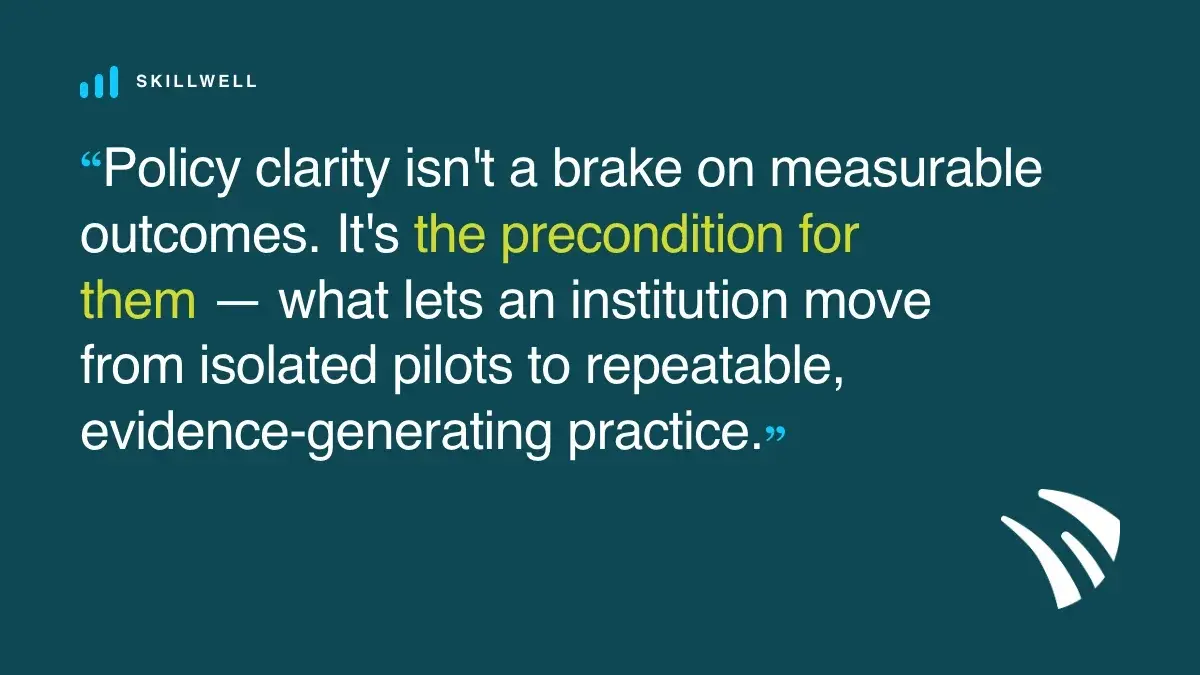
Policy clarity isn't a brake on measurable outcomes. It's the precondition for them — what lets an institution move from isolated pilots to repeatable, evidence-generating practice.
Zooming from institutional strategy to the daily grind reveals how routine these tools have become.
For students, AI now sits alongside search engines and word processors: summarizing readings, generating practice questions before an exam, debugging code, drafting and refining written work, and translating material into a first language.
Faculty adoption has accelerated sharply — Tyton Partners' 2025 data shows instructor use of generative AI rising to rival student use, and EDUCAUSE reports faculty leaning on it to draft lesson plans, build rubrics, and generate assessment items.
A growing cohort of instructional designers goes further still, using AI for the rapid design and delivery of branching simulations that once took months to build, for assessment-driven content delivery that adapts to what a learner has and hasn't mastered, and for skills data analytics that surface competency gaps across an entire cohort in near real time.
The picture isn't uniformly positive, and the negative effects deserve sober attention rather than alarm.
Educators' most cited concern is the erosion of critical thinking and over-reliance. A widely discussed 2025 MIT Media Lab study reported measurably lower cognitive engagement among participants who leaned on large language models to write essays.
Other documented risks recur across the research:
Confident misinformation produced by model "hallucinations"
Widening equity gaps between students who can afford premium tools and those who can't
Data-privacy exposure when student work is fed into third-party systems
Skill atrophy when generation replaces genuine practice
Surveys consistently show majorities of faculty worried about integrity even as they adopt the same tools themselves.
That tension leads to the question institutions ask most bluntly: what percentage of college students use AI to cheat?
The answer is that it depends entirely on definition.
BestColleges found that roughly one in five students admitted using AI to complete an assignment or exam, while about half considered doing so a form of cheating at all.
Study.com's survey put the share who had used ChatGPT for schoolwork closer to one in three. Turnitin, after reviewing more than 200 million submitted papers, flagged around 11% as containing at least a fifth AI-generated text and roughly 3% as overwhelmingly machine-written.
The spread reflects a real measurement problem: "using AI" and "cheating" aren't synonyms, and where a syllabus permits AI assistance, the identical behavior counts as legitimate practice.
Assessment grounded in verified skills data shifts the question from "did AI touch this document" to "has this learner demonstrated the underlying competence" — something no volume of generated text can fake.
Taken together, these statistics make one thing unambiguous: AI is already embedded in how students learn and how faculty teach, which means the strategic question is no longer adoption but design.
Course experiences built around adaptive learning and intelligent data insights consistently outperform those that treat AI as an afterthought, and they generate the evidence institutions need to prove impact rather than merely assert it. For the strategic picture behind these numbers — the risks, the equity questions, and how design-forward institutions are responding — see our full guide to AI in Higher Education.
Ready to translate these numbers into measuring AI training effectiveness on your own campus? Skillwell pairs adaptive learning with immersive simulation training so the evidence is built in from day one, not bolted on after the fact.
Take a Tour of Skillwell's Capabilities
Estimates range from roughly 59% to 92% depending on the survey and how "use" gets defined, but every major study agrees adoption is now the norm, not the exception.
The Digital Education Council found 86% of students already use AI tools
HEPI's 2025 UK survey found 92% usage, up from 66% the year before
US-focused Tyton Partners data lands lower, around 59% monthly use
The gap comes down to definition, region, and whether casual use counts
Figures vary widely — HEPI found only about 5% pasted AI text unedited into submitted work, while broader US surveys put the share who've used AI to help write or edit an essay closer to half.
"Using AI to write an essay" can mean anything from a thesis critique to a fully machine-written draft
Only a minority submit unedited AI-generated text
Definitional differences explain most of the spread across surveys
The honest number depends heavily on how the question gets asked
Yes, when it's used as a structured tutor rather than a shortcut — a 2024 Harvard study found students learned more than twice as much material with a well-designed AI tutor.
Design matters more than access to the tool itself
Unstructured, casual AI use shows much weaker learning effects
A 2025 World Bank program in Nigeria produced gains equal to roughly two years of schooling in six weeks
Verified skills data offers a more honest read on impact than completion rates
The honest answer depends on definition — estimates range from roughly one in five to one in three, and Turnitin's review of over 200 million papers flagged about 11% with significant AI-generated text.
"Using AI" and "cheating" aren't the same thing when a syllabus permits assistance
Survey estimates vary from about 20% to a third of students
Turnitin's data-based figure lands lower, around 11%
Measuring demonstrated competence sidesteps the definitional argument entirely
Well-funded research universities have moved fastest with formal policy and adaptive-learning pilots, while community colleges and under-resourced institutions report slower rollouts despite serving students who could benefit most.
Resourcing, not interest, explains most of the adoption gap
Fully online, competency-based programs adopted adaptive engines earliest
Institutions with clear policy show stronger, more reproducible outcomes
Ad hoc adoption produces wide variance in results across sections
The most cited risks are eroded critical thinking, widening equity gaps, data-privacy exposure, and skill atrophy when generation replaces genuine practice.
A 2025 MIT Media Lab study found lower cognitive engagement among heavy AI users
Equity gaps widen when only some students can afford premium tools
Student work fed into third-party AI systems raises privacy questions
Structured, design-forward use mitigates most of these risks

Person One
Chief Product Officer at Skillwell
Person Two
Author, Speaker, Researcher
Artificial intelligence has moved from isolated campus pilots to the core of how modern universities teach, advise, ...
The moment a student submits an essay generated in seconds, the comfortable assumptions about academic work ...

AI in Higher Education is no longer a speculative frontier — it's woven into how students write, ...
Artificial intelligence has moved from isolated campus pilots to the core of how modern universities teach, advise, ...
The moment a student submits an essay generated in seconds, the comfortable assumptions about academic work ...
AI in Higher Education is no longer a speculative frontier — it's woven into how students write, ...