
Generative AI in Higher Education | ...
The moment a student submits an essay generated in seconds, the comfortable assumptions about academic work ...
Artificial intelligence has moved from isolated campus pilots to the core of how modern universities teach, advise, and measure learning.
For academic and administrative leaders, the pressing question is no longer whether AI belongs on campus, but what effective implementation looks like in practice.
The most instructive AI in higher education examples focus on the educational process itself — adaptive learning that meets each student where they are, immersive simulations that turn theory into practice, and analytics that convert activity into evidence of genuine skill.
The platforms gaining the most traction in higher education share a common trait: they intervene in how people learn rather than simply automating back-office tasks.
AI-powered adaptive learning engines continuously assess what a student knows and dynamically reshape the next lesson, so a struggling learner receives targeted reinforcement while an advanced one accelerates past material already mastered.
Immersive simulation tools, meanwhile, drop students into realistic workplace scenarios — patient consultations, financial negotiations, crisis response — where decisions carry consequences and competence gets demonstrated through action rather than recall.
These tools resonate because they address genuine institutional pain points. When leaders evaluate solutions, a consistent set of features rises to the top.
Personalized learning pathways that adapt in real time to each student's demonstrated strengths and gaps, reducing failure and dropout in high-stakes gateway courses
Rapid design and delivery, so faculty can build branching simulations in minutes rather than months and keep pace with evolving curricula
Skills data analytics that surface exactly where a cohort is thriving or stalling, giving departments the evidence to intervene before students disengage
Assessment-driven content delivery, in which every interaction doubles as a formative check that routes the learner to the right next step
Explaining these benefits to a faculty senate gets far easier when the technology visibly reduces grading load, expands one-to-one support at scale, and produces defensible evidence of learning.
Skillwell Simulate for scenario authoring and Skillwell Adapt for the adaptive engine show how a single environment can pair immersive practice with continuous personalization — the intersection of realistic practice and individualized instruction where many of the strongest examples of AI in higher education originate.
The clearest proof of value comes from institutions that have folded AI into both teaching and operations and then tracked the results. Across implementations, a recognizable pattern of measurable outcomes emerges.
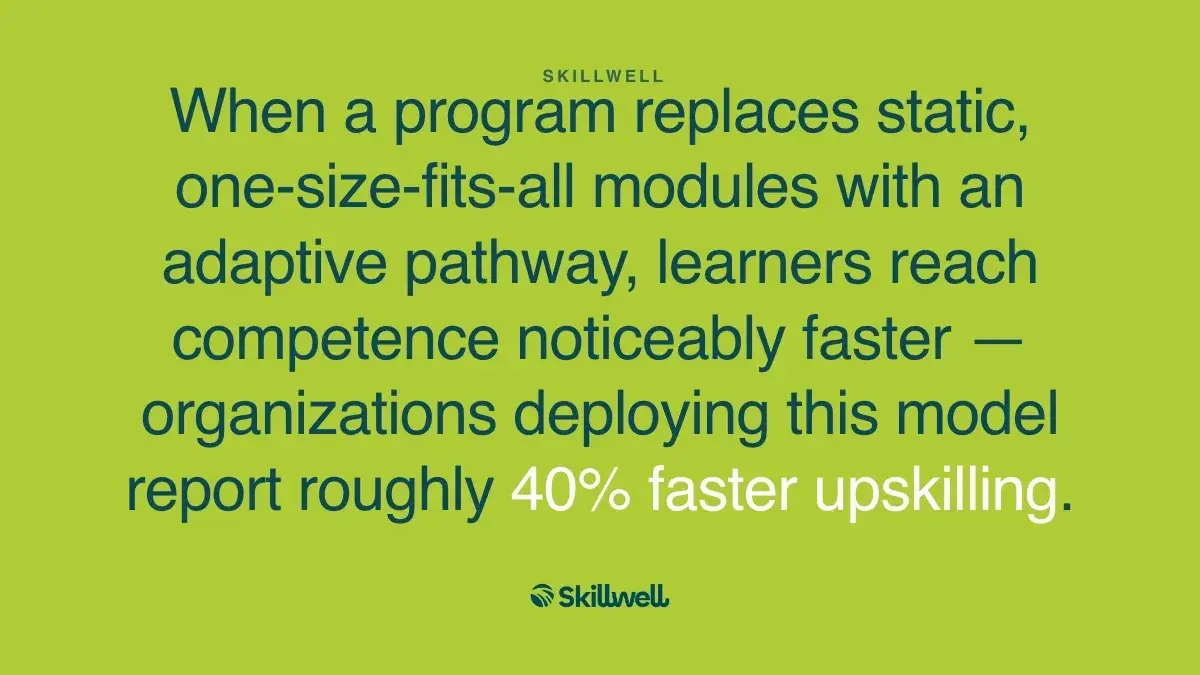
When a program replaces static, one-size-fits-all modules with an adaptive pathway, learners reach competence noticeably faster — organizations deploying this model report roughly 40% faster upskilling.
The quality of learning improves in parallel, with an average skill improvement of about 27% as students spend their time on exactly the concepts they haven't yet mastered instead of re-covering familiar ground.
Simulation-based practice that once required an instructor to facilitate every session can be delivered to entire cohorts simultaneously, allowing institutions to scale training delivery tenfold without a matching increase in staffing.
For a university expanding online enrollment or standing up a new professional program, that multiplier is often the difference between a promising pilot and a financially sustainable offering.
Because these platforms capture verified skills data — evidence that a learner can perform a task, not merely that they clicked through a module — institutional leaders gain audit-ready documentation for accreditation reviews, licensure boards, and internal quality assurance.
When a nursing school or a compliance-heavy business program must demonstrate that graduates meet defined competencies, that record turns a stressful reporting exercise into a routine export.
Universities are increasingly applying the same intelligence to operations that have nothing to do with instruction — enrollment management, advising triage, compliance reporting, and the routine document processing that consumes staff hours.
Institutions that have automated these workflows report meaningful operational gains:
Admissions and records teams reclaim time once lost to manual data entry
Response times to student inquiries shrink from days to minutes
Freed staff hours get redirected toward higher-value work
When the underlying skills data feeds directly into accreditation and licensure reporting, the compliance function becomes faster and cheaper to run — a periodic scramble turned into a continuous, low-effort process.
Faculty adaptation is where AI stops being an IT initiative and becomes a teaching practice.
The shift is being driven by AI-powered authoring tools that lower the technical barrier to building rich, interactive experiences.
Using Skillwell, an instructor can map a decision tree visually — dragging scenario nodes, branching outcomes, and feedback onto a single workspace — and publish a working simulation the same afternoon.
What used to demand a team of instructional designers and a semester of lead time now sits within reach of a subject-matter expert working solo.
That accessibility is changing pedagogy in visible ways.
Students work through real objections and immediately see how each choice reshapes the account relationship.
It adjusts its difficulty to each student's prior decisions, turning an abstract lecture topic into lived experience.
Learners rehearse safety-critical procedures long before they touch physical equipment.
These instructors aren't surrendering their expertise to the machine. They're using it to reclaim time for the human parts of teaching — coaching, discussion, and mentorship — while the platform handles individualized practice and instant feedback.
The benefits are clearest for faculty when adaptive tools absorb repetitive assessment tasks and free educators to focus on judgment and creativity.
Institutions that pair this technology with structured faculty development — hands-on workshops, shared scenario libraries, and communities of practice — see adoption move well beyond a handful of early enthusiasts.
Measuring impact is where AI both raises the bar and supplies the tools to clear it. Traditional metrics — seat time, completion rates, satisfaction surveys — tell an institution that students showed up, not that they learned.
Skills data analytics change the equation by tracking mastery at the level of individual competencies, so a program can see precisely which outcomes its graduates achieve and which remain weak across an entire cohort.
Institutions typically build their measurement around a few complementary signals.
Skill improvement rates, comparing baseline diagnostics against post-instruction performance to quantify genuine growth rather than mere exposure
Course completion and progression, observing how personalized pathways affect persistence in historically high-attrition courses
Competency verification, using assessment-driven content delivery to confirm a learner can apply knowledge under realistic conditions before the system marks an objective as met
Because the underlying record is verified skills data rather than a completion checkbox, deans and program directors can answer questions that once required guesswork.
Are redesigned modules closing equity gaps?
Which learning pathway produces the strongest downstream performance?
Do students who practice in simulation outperform those who only read the material?
Some of the most persuasive examples come from departments that used these analytics to retire an underperforming curriculum and redirect resources toward the interventions the data validated.
Equity is the test every AI initiative in higher education must ultimately pass, because a tool that personalizes learning for some students while excluding others deepens the very gaps it claims to close.
The strongest programs treat accessibility this way from the start.
Adaptive systems are inherently well suited to the goal: by adjusting pacing, difficulty, and modality to each learner, they support students who arrive with uneven preparation, learning differences, or competing work and family obligations.
When content is offered in multiple formats and aligned with recognized accessibility standards such as WCAG, the same adaptive engine that stretches a high achiever also scaffolds for a first-generation student who needs more foundational support.
On-demand explanations rephrased for a student's reading level, instant translation for multilingual learners, and always-available tutoring give learners in remote or under-resourced settings the kind of individualized attention historically reserved for well-staffed campuses.
Used thoughtfully — with human oversight, bias monitoring, and clear guardrails — these tools can narrow participation gaps rather than widen them, delivering personalized, equitable support to students from widely varied backgrounds.
Some of the most immediately felt AI in higher education examples sit inside student support, where AI narrows the gap between the moment a learner struggles and the moment someone notices.
Adaptive platforms surface early-warning signals the instant performance dips, allowing advisors to reach out proactively rather than waiting for a failing midterm to trigger a conversation.
AI-powered advising assistants field the high-volume, routine questions — deadlines, prerequisites, registration steps, financial-aid status — around the clock, so human advisors can devote their limited appointment time to the nuanced, high-stakes decisions that genuinely require judgment.
Degree-planning tools model the downstream consequences of course choices and flag when a student drifts off the fastest path to graduation.
Because these systems draw on verified skills data rather than completion checkboxes, an advisor can see not just that a student passed a prerequisite but whether they mastered the competencies the next course assumes, making intervention conversations far more precise.
The result is a support model that scales one-to-one attention across an entire student body, extending the kind of personalized guidance once rationed to those who knew to ask for it.
Beyond teaching and advising, universities are embedding AI across the operational core of the institution.
Admissions offices use it to screen and route applications, extract data from transcripts, and answer prospective-student questions at scale during peak cycles.
Scheduling and resource-planning tools optimize classroom assignments, faculty loads, and lab availability against constraints that would take human planners weeks to reconcile.
Service and IT help desks deploy conversational assistants to resolve password resets, enrollment questions, and facilities requests instantly, escalating only the genuinely complex cases to staff.
Finance and compliance teams automate document processing, invoice handling, and the assembly of accreditation evidence, eliminating the manual reconciliation that historically consumed entire departments before a review.
Across these functions the pattern is consistent: AI absorbs repetitive, rules-based work, compresses turnaround times, and lets a lean administrative staff operate at a scale that would otherwise demand significant new hiring.
AI is redefining what's possible in higher education, driving measurable outcomes through adaptive learning and intelligent data insights.
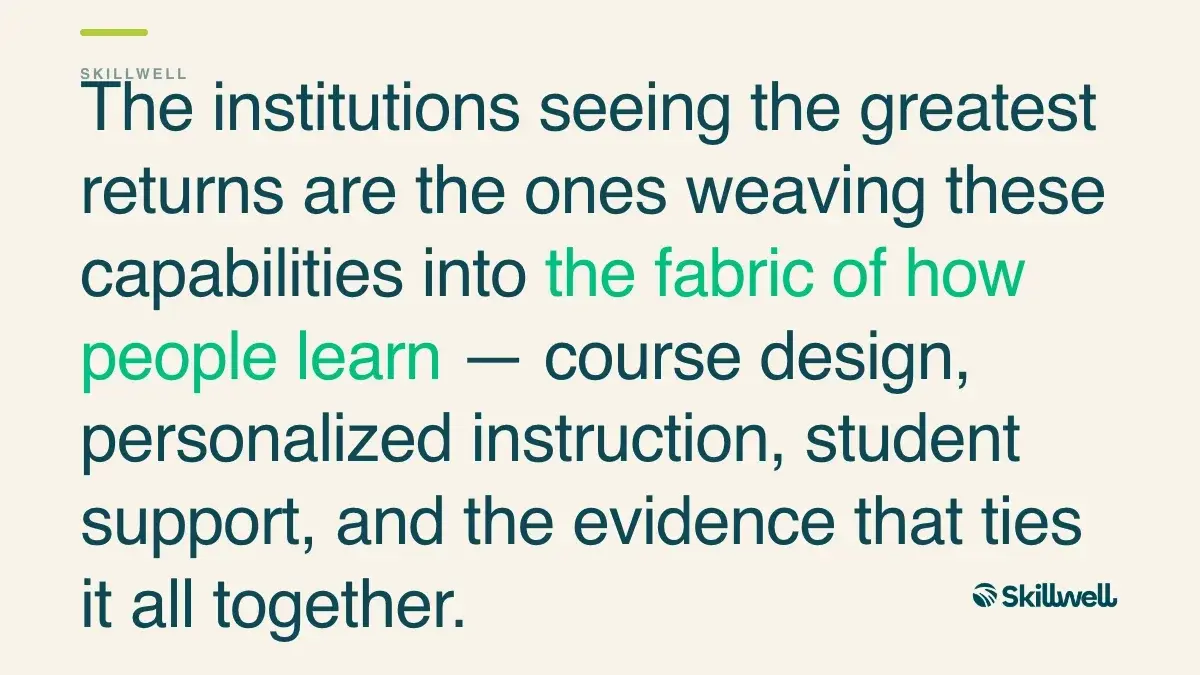
The institutions seeing the greatest returns are the ones weaving these capabilities into the fabric of how people learn — course design, personalized instruction, student support, and the evidence that ties it all together.
Skillwell pairs the adaptive engine with the simulation practice behind the teaching-and-learning examples above, so your institution doesn't have to build either from scratch. For the broader context these examples sit within — the risks, the equity questions, and the strategic choices ahead — start with our full guide to AI in Higher Education.
Take a Tour of Skillwell's Capabilities
Real examples span adaptive learning platforms that personalize pacing, immersive simulations for hands-on practice, AI advising assistants, and automated admissions and compliance workflows.
Adaptive engines that reroute a lesson based on what a student already knows
Branching simulations for clinical, financial, or crisis-response practice
AI-powered advising that handles routine questions around the clock
Administrative uses like transcript processing and accreditation reporting
Adoption concentrates around two categories: adaptive learning engines and immersive simulation tools, because both intervene directly in how students learn rather than just automating paperwork.
Adaptive engines assess and reshape lessons in real time
Simulation tools place students in realistic, consequential scenarios
The strongest platforms pair both in a single environment
Faculty-facing authoring tools matter as much as the learning engine itself
Institutions report roughly 40% faster upskilling and a 27% average skill improvement when moving from static modules to adaptive pathways, plus the ability to scale simulation-based training tenfold.
Faster time-to-competence is the most commonly cited gain
Scale gains matter most for growing online and professional programs
Audit-ready documentation eases accreditation and licensure reporting
Operational gains extend into admissions, advising, and compliance
Faculty use AI-powered authoring tools to build branching simulations and scenario-based lessons themselves, without waiting on instructional-design teams.
A marketing lecturer might build a client-pitch negotiation scenario
A public-health instructor might build an adaptive contact-tracing simulation
Engineering departments use simulations to rehearse safety-critical procedures
The technology frees faculty time for coaching and mentorship, not less teaching
The strongest programs build accessibility in from the start — multiple content formats, WCAG-aligned design, and adaptive pacing that scaffolds struggling students instead of leaving them behind.
Adaptive systems adjust pacing and modality to individual needs
Generative tools offer on-demand, reading-level-appropriate explanations
Instant translation supports multilingual learners
Human oversight and bias monitoring stay part of the process
Common uses include application screening, transcript data extraction, class and lab scheduling, IT help-desk automation, and accreditation-evidence assembly.
Admissions teams use AI to route and process applications at scale
Scheduling tools optimize constraints human planners would take weeks to solve
Conversational assistants resolve routine IT and enrollment questions
Compliance teams cut manual reconciliation before accreditation reviews

Person One
Chief Product Officer at Skillwell
Person Two
Author, Speaker, Researcher
The moment a student submits an essay generated in seconds, the comfortable assumptions about academic work ...
Artificial intelligence has shifted from experimental novelty to everyday infrastructure across campuses. It’s ...
AI in Higher Education is no longer a speculative frontier — it's woven into how students write, ...
The moment a student submits an essay generated in seconds, the comfortable assumptions about academic work ...
Artificial intelligence has shifted from experimental novelty to everyday infrastructure across campuses. It’s ...
AI in Higher Education is no longer a speculative frontier — it's woven into how students write, ...